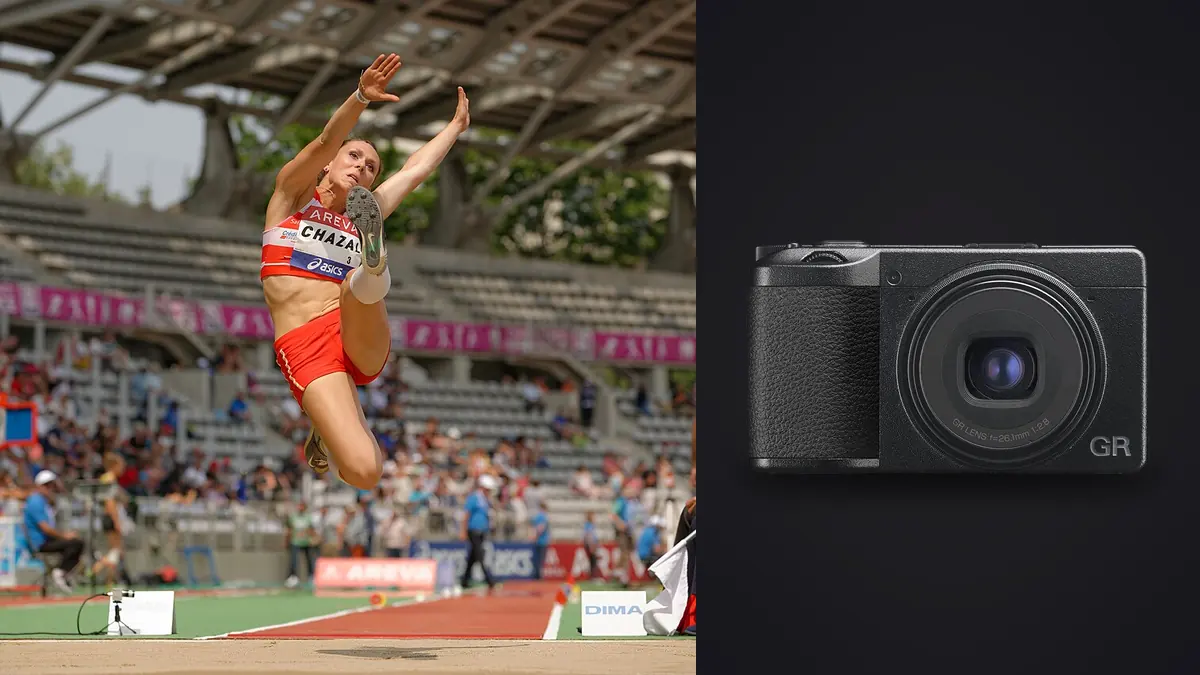
I want to get the obvious objection out of the way first, because every comment section on a post like this leads with it: the Ricoh GR IIIx is not a sports camera. It has a fixed 40mm-equivalent lens, contrast-detect autofocus with no phase-detect pixels to fall back on, a continuous shooting mode that tops out well below what a dedicated action body offers, and no viewfinder unless you bolt on the optional accessory finder. On paper, none of that says "track meet."
And yet I've shot four track meets with one in the last two seasons, alongside a Nikon Z9 that did the actual sprint-and-jump coverage, and the GR IIIx earned its spot in my bag every time. Not for the 100m final. For everything around it. This is a piece about knowing exactly what a tool is bad at so you can stop asking it to do that thing, and use it for what's left.
What the GR IIIx actually struggles with here
Let's be specific instead of vague, because "it's not built for action" isn't useful advice on its own.
The autofocus is contrast-detect only. On a still subject in good light it's fast and accurate, honestly faster than people expect from a compact. On a subject moving toward or across the frame at sprinting speed, contrast-detect AF has to rack focus back and forth to find the peak, and by the time it settles the runner has moved. I tried continuous AF tracking on a 200m backstretch pass at maybe 25 meters and got a genuinely low keeper rate, closer to what I'd call unusable for anything you need in focus rather than merely interesting.
The focal length is the second wall. 40mm equivalent is a normal, slightly-tight-of-standard field of view. It's a fantastic length for a runner's face if you're standing three meters away at the finish line with credentials, and a completely useless length if you're in the stands 30 meters back watching the 800m pack round the bend. There's no reaching for this camera. You either are close enough or you aren't, and at most public-access vantage points at a track meet, you aren't.
Buffer and burst rate round out the list. Continuous shooting sits in the low single digits of frames per second in practical use, and the buffer fills fast enough that spraying frames through a hurdles sequence the way you would with a mirrorless sports body just isn't an option. You get a handful of frames, then a pause while it writes.
Put those three together and mid-race, mid-distance track action is off the table. I don't fight that anymore. I bring a longer lens on another body for the race itself.
Where it stops being a liability
The turn is Snap Focus. If you haven't used it, it's a manual-focus-distance override that skips the AF hunt entirely: you set a fixed distance (Ricoh gives you steps like 1m, 1.5m, 2m, 2.5m, 3.5m, 5m, and infinity, plus a manual dial-in), and the camera fires at that exact distance the instant you press the shutter. Pair it with Full Press Snap in the menu and a hard, full shutter press bypasses autofocus altogether and just shoots at the preset distance. No hunting, no lag, no missed moment while the lens searches. That only works if you can predict where the subject will be. A sprinter mid-race, you can't. A long jumper's landing in the sand pit, a shot putter's release point at the front of the circle, a specific hurdle on the far side of lane four, you absolutely can. Those are fixed points in space. The athlete comes to the point, not the other way around, and Snap Focus turns the GR IIIx's biggest weakness into a non-issue because the camera never has to guess.
How I actually set it up on the field-event side
For long jump and triple jump, I stand at the pit, pace off roughly 4 to 5 meters back from the landing area, and set Snap Focus to match. I shoot in shutter priority around 1/1600s to freeze the sand kicking up on landing, ISO on auto with a ceiling around 3200 for daytime meets (higher if it's an evening session under stadium lights, which get dim faster than they look). I take the shot the half-second before the athlete's heels hit, based on the arc of the jump, not by chasing focus. For shot put and discus, similar idea but from behind the cage or net, distance set to whatever the circle-to-camera gap actually measures, not a guess. The wind-up is slow enough that timing the release is the hard part, not focus. Hurdles are the trickiest of the bunch because the subject is moving through the focal plane rather than landing in it. I pick one hurdle, set the distance to that hurdle exactly, and accept that I'm getting one usable frame per athlete per pass, not a sequence. That's a real limitation. A longer, faster-focusing camera would give you the whole approach-clear-land sequence. The GR IIIx gives you the clear, and only if your distance is right to within maybe half a meter.
Event-by-event, honestly
Here's the breakdown I actually use when deciding whether the GR IIIx comes out of the bag for a given event, based on what's worked and what hasn't across the meets I've shot with it.
| Track & field situation | Subject speed | Typical working distance | GR IIIx verdict |
|---|---|---|---|
| 100m / 200m, mid-race | Very high (10+ m/s) | 15-40m across the track | Skip it. Too far for 40mm, too fast for contrast-detect AF. |
| 100m finish line, straight-on | Very high | 3-8m if credentialed at the line | Viable. Snap Focus at 5m, Full Press Snap, no AF to fight. |
| Long jump / triple jump landing | Momentary peak, then still | 4-6m from the pit edge | Best use case. Pre-focus the sand, wait for the landing. |
| Shot put / discus circle | Slow wind-up, fast release | 6-10m, behind the cage | Good. Set distance to the circle's edge and hold. |
| Hurdles, one specific barrier | High, repeating rhythm | 2-4m, low angle track-side | Workable for a single frame per pass, not a sequence. |
| 4x100/4x400 exchange zone | High, converging paths | 3-6m | Doable if you commit to one exchange box and don't chase. |
| Distance races (1500m+), backstretch | Moderate | 20m+ | Skip for action; fine as an environmental wide shot. |
| Warm-up area, blocks, coaching moments | Low to none | 2-6m | Excellent. This is where the camera actually lives all day. |
Look at that last row. That's the honest answer to "why bring it at all." A track meet is four or five hours of mostly standing around punctuated by 10-second bursts of the thing everyone came to see. The stretching, the coach pulling someone aside, the moment before the gun, the exhausted collapse after a personal best, none of that requires fast AF or a long lens. It requires a camera small enough that nobody notices you're pointed at them, and the GR IIIx disappears in a way a body with a 300mm hanging off it never will.
The digital crop modes are worth using here
The GR IIIx offers in-camera crop simulations to roughly 50mm and 71mm equivalent fields of view, cropping into the 24-megapixel APS-C sensor rather than moving glass. I use the 50mm crop more than I expected to at meets, mostly for head-and-shoulders reaction shots from the infield rail where 40mm was leaving too much track and sky in frame. You're trading resolution for reach (you end up somewhere in the 12-14 megapixel range at the tightest crop, from memory of the files I've pulled), which is a fine trade for web and social use and a rougher one if a coach wants a large print afterward. I wouldn't rely on the crop modes for anything I plan to print above roughly 8x10.
What happens after the meet
Here's the part nobody warns you about going in: even with a slow burst rate, a full day at a track meet with a camera set to Snap Focus and Full Press Snap produces a genuinely large number of frames, because the whole point of that setup is firing fast and often on anticipated action, and a chunk of them are duplicates or near-duplicates of the same jump, the same release, the same finish. Add a second body doing the actual race coverage at 15-20fps and you're looking at a folder that takes real time to get through by eye. This is the part of the workflow where I stopped doing manual triage entirely. I run the day's card through imagic's scoring and ranking workflow before I open anything in an editor. The local sharpness and focus scoring catches the Snap Focus misses immediately, the frames where I guessed the landing distance wrong by half a meter and the sand is soft instead of the athlete, and those get flagged out before I waste time looking at them twice. The burst and duplicate clustering is the bigger time-saver on a day like this specifically, because it groups the six or eight near-identical frames from a single jump sequence together instead of making me scroll past all of them individually, so I'm picking one best frame per cluster instead of judging every frame cold. The other thing that matters for meet work specifically is that imagic runs entirely on the machine, no upload step. I've shot meets at facilities with no usable wifi and a laptop battery that needed to last through the culling pass in the car afterward, and not depending on a connection to get through a card is not a small convenience in that situation.
Color consistency across two cameras
Shooting the GR IIIx alongside a second, larger-sensor body means two different color signatures landing in the same folder, and a set of race photos where the sprint shots and the sideline shots look like they came from different photographers is a bad look for a delivery. I built an apply_my_style preset in imagic off my usual track-meet edit (the punch I like in stadium-light shadows, a specific warmth I pull back on skin tones under sodium lighting), and running both cameras' files through the same trained preset gets them close enough that nobody downstream notices the gear switch mid-gallery. It's not going to fix a genuinely bad exposure, but it closes the gap on color that would otherwise be an obvious tell.
What I'd tell someone thinking about doing this
If you already own a GR IIIx and you're wondering whether it has any business at a track meet, my answer is yes, but only if you go in accepting the trade you're making. It will not replace a long lens and a fast-focusing body for the race itself. What it does well is the fixed-distance, anticipated-action shots (landings, releases, one specific hurdle) and the entirely-unplanned human moments around the edges of the competition, where its size and silence are the actual selling point rather than a compromise you're tolerating. If you don't own one and you're asking whether to buy one specifically for sports work, don't. Buy it for the reasons people usually buy a GR: a pocketable, fast-handling camera for everyday and travel shooting where a 40mm view and instant response matter more than reach or tracking AF. The track meet use case is something you discover it's decent at after the fact, not a reason to acquire it in the first place.
Frequently Asked Questions
Can the Ricoh GR IIIx track a runner well enough for a sharp mid-race photo?
Not reliably. Continuous autofocus on the GR IIIx is contrast-detect only, and at typical track meet distances (15 meters or more across a track) it struggles to lock onto a subject moving at sprint speed. Save it for moments where the subject arrives at a spot you've already focused on, rather than trying to follow motion across the frame.
Is Snap Focus actually usable for real sports moments, or is it a gimmick?
It's genuinely useful, but only for predictable subject positions. Landing pits, throwing circles, a single hurdle, a finish line you're standing close to; anywhere you can measure or pace off the distance in advance and know the subject will pass through it. It does nothing for you if you can't predict where the action will happen.
Does the fixed 40mm lens rule out most of a track meet?
For anything happening more than about 10 meters away without press-level access, yes, effectively. 40mm is a portrait-and-environment length, not a reach length. The digital crop modes stretch that a bit (roughly to 50mm and 71mm equivalent) at a resolution cost, but they don't turn this into a telephoto tool.
What's the actual best use for a GR IIIx at a track meet, if not the races?
Warm-ups, coaching interactions, the tension before the gun, and reactions after the finish. Anywhere the value is discretion and speed of response rather than reach or continuous tracking. That's also usually the material that ends up telling the more interesting story once you're editing the day.