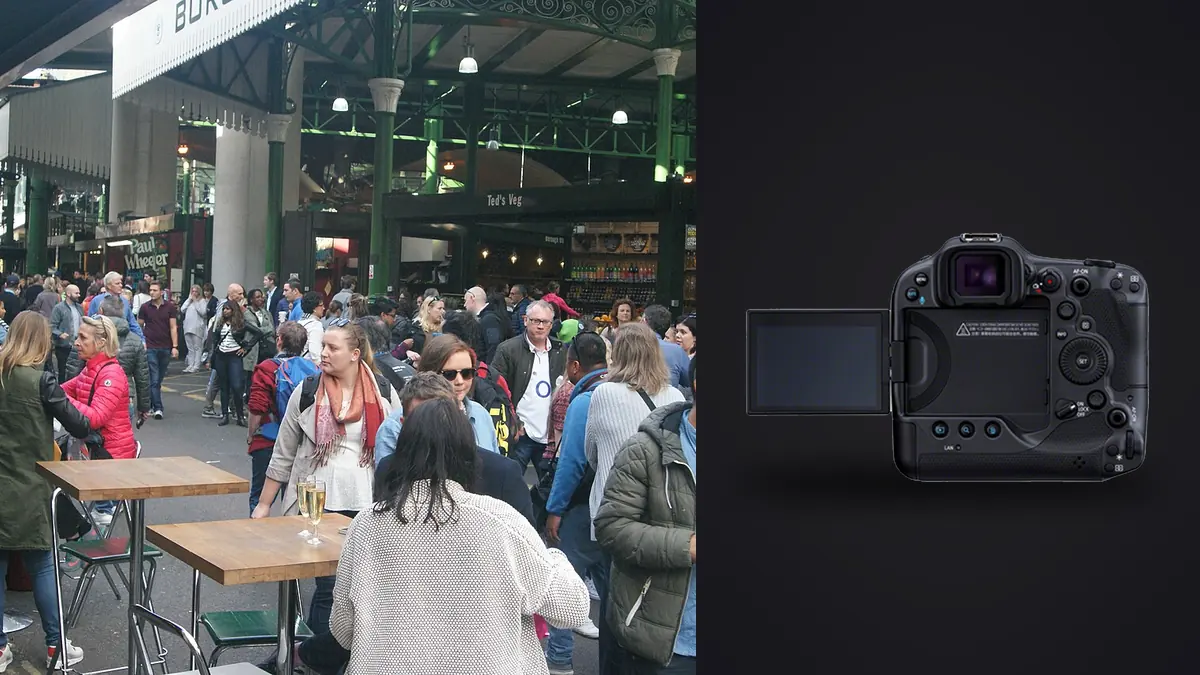
A camera nobody designed for street work
The Canon EOS R3 was built for sports and news photographers standing behind a fence with a monopod, not for someone weaving through a farmers market trying not to be noticed. It shares its body shell with the 1D X Mark III in most of the ways that matter: integrated vertical grip, a chassis you could probably use as a doorstop, and a shutter button positioned for a hand that's used to holding something this size all day. I've carried it on three separate documentary projects over the last year and a half, and every single time, the first ten minutes were spent apologizing to my shoulder.
So let's deal with the obvious objection up front. If your idea of street photography is a Fujifilm X100V slung under a jacket, the R3 is not that camera, and it never will be. At roughly 1015 grams body only, before you've mounted glass, it's closer to a small sports body than a rangefinder-style street shooter. People notice it. Some subjects stiffen up the moment they clock the size of the thing. That's a real cost, and I'm not going to pretend it isn't.
What changed my mind about using it for documentary work wasn't size, though. It was what happens in the half-second between noticing a moment and the shutter firing.
The parts that actually matter on the street
Three things on the R3 make it worth the extra weight for documentary and reportage work specifically, and none of them are the headline "30fps" spec that gets thrown around in every review.
A shutter you genuinely cannot hear
Run the R3 in fully electronic shutter mode and there is no mechanical sound at all. Not "quiet," not "muted," actually nothing. For street and documentary work where the whole point is capturing a scene before anyone reacts to the camera, this matters more than almost any other spec on the sheet. I've shot inside quiet chapels, small kitchens, and a courtroom hallway with this camera and had zero of the usual heads-turning-toward-the-clack moments that a mechanical shutter guarantees. The stacked sensor also reads out fast enough that rolling shutter distortion, the skewed verticals you get panning quickly with a slower electronic shutter, mostly isn't an issue. It shows up if you whip-pan hard across a bright window, but under normal walking-pace shooting I've never caught it in a frame worth keeping.
Autofocus that doesn't need you to think
Dual Pixel AF II with subject detection means the camera is already tracking a person's eye before you've consciously decided to press the shutter. On a crowded street corner with people crossing in three directions, that's the difference between a sharp frame and a near-miss. I don't shoot the R3 in single-point AF anymore for documentary work; I let it find the nearest face and trust it.
Eye Control AF, with a caveat
Canon's gaze-based focus point selection sounds like science fiction and, when it's calibrated well, it kind of is. You look at a person's face through the viewfinder and the focus point jumps there without a thumb movement. The catch is the calibration drifts, especially if you swap eyeglasses or shoot in bright sun with squinted eyes, and when it drifts it's actively worse than not using it at all, because it's confidently putting focus somewhere you weren't actually looking. I recalibrate before every session now. When it's dialed in it feels like cheating. When it's not, it's the first thing I turn off.
24 megapixels is the right amount, and also not enough
Canon capped the R3 at 24.1MP while its own R5 was already shipping at 45MP, and that was clearly a deliberate trade for sensor readout speed and buffer depth rather than an oversight. For documentary and editorial work, 24MP prints and publishes just fine, files move through a laptop fast, and you're not waiting on a spinning wheel every time you open a folder of a few thousand frames from a full day out. The trade-off shows up later, when you want to crop a frame you almost had framed right in the moment. There's real room to punch in on a 45MP file that just doesn't exist on a 24MP one. On the street, where you're often shooting a beat too late or a step too far away, that missing headroom is the one spec I actually miss from higher-resolution bodies.
How it stacks up against the cameras people actually reach for on the street
None of these numbers are exact to the gram or the dollar since prices move and firmware updates change burst behavior, but this is roughly where the R3 sits next to the cameras most documentary and street photographers are actually choosing between right now.
| Camera | Body weight (approx.) | Fully silent shutter | Viewfinder blackout in burst | Max burst rate | Launch price, body only |
|---|---|---|---|---|---|
| Canon EOS R3 | 1015g | Yes, electronic | None, blackout-free EVF | 30fps | $5,999 |
| Fujifilm X100V | 478g | Yes, up to 1/2000 | Minimal (hybrid VF) | 11fps | $1,399 |
| Leica Q2 | 734g | Yes, leaf shutter | Minor, EVF | 10fps | $4,995 |
| Sony A9 II | 678g | Yes, electronic | None, blackout-free EVF | 20fps | $4,498 |
| Nikon Z9 | 1340g | Yes, electronic | None, blackout-free EVF | 20fps (RAW) | $5,499 |
What jumps out from that table is that the R3 is both the heaviest body on the list by a comfortable margin and the fastest. If discretion is your top priority, the X100V or Q2 make more sense, full stop, no camera fixes that trade-off. If you're doing documentary work where you sometimes need to keep up with a moving subject in unpredictable light and can't afford a missed autofocus moment, the R3's speed and tracking start to earn back the weight penalty.
Glass that doesn't fight the body
Pair the R3 with the wrong lens and you've built a camera that's genuinely unpleasant to carry for eight hours. The RF 24-105mm f/4L is the lens I reach for most on documentary days because it covers the range you actually use on the street (a slightly wide framing for context, a mild telephoto for candid distance) without adding a second lens change into a moment that's already moving fast. For pure street work I've had better luck with the RF 35mm f/1.8, which is small enough that the whole rig stops feeling top-heavy and fast enough for the dim interiors documentary work tends to land you in. I'd steer away from the RF 50mm f/1.2L for this specific use. It's a beautiful lens on a tripod, but mounted on an already-heavy body it turns a full day of walking into a full day of regretting your choices.
Where the real time goes after the shoot
Here's the part nobody mentions in camera reviews: a 30fps burst mode is fantastic for catching the right instant, and it is an absolute nightmare for whoever has to go through the take afterward. A single three-second burst at full speed is ninety frames of the same handshake and the same three expressions repeating. Multiply that across a six-hour documentary shoot and you're looking at several thousand near-duplicate frames before you've even started actually editing anything.
This is the exact problem that pushed me to build a real culling pass into my workflow instead of scrubbing through a memory card by eye. I run the day's take through imagic before I open a single frame in an editor. Its sharpness scoring flags which frame in each burst actually has the sharpest eyes, which sounds small until you've tried to tell the difference between frame 34 and frame 35 of a walking subject at 1am with tired eyes. The duplicate and burst clustering groups those ninety near-identical frames down to the handful worth a second look, so what would have been an hour of scrolling turns into something closer to ten minutes. If you haven't looked at how automated culling actually decides what's sharp versus soft, this breakdown of how AI photo culling works covers the mechanics better than I can in a paragraph here.
The other piece that matters specifically for documentary and street work is that none of this happens in the cloud. A lot of the people you photograph on assignment, at a protest, outside a courthouse, in someone's home during a hard week, did not sign up to have their face uploaded to a third-party server before you've even decided whether the frame is a keeper. imagic runs its scoring and clustering locally on the machine, so a card full of sensitive documentary material never leaves your laptop until you choose to send it somewhere. That's not a marketing line for me, it's the reason I switched culling tools in the first place.
Once the edit is narrowed down, imagic's apply_my_style preset, trained on a set of my own previously edited photos rather than someone else's generic look, gets a consistent grade across a project fast. Documentary sets live or die on consistency: a viewer scrolling through thirty images from one shoot notices immediately if frame twelve has a different color temperature than frame eleven. Getting a first pass that already matches your own established edits, instead of starting every image from a flat baseline, saves a genuinely large chunk of the evening. For anyone still doing that first pass manually, these workflow tips are worth a look alongside whatever culling tool you land on.
Battery, cards, and actually finishing the day
The LP-E19 battery in the R3 is the same one used in Canon's 1D X line, and it shows. I've shot full twelve-hour documentary days, EVF on the whole time, without swapping batteries, something I never managed with smaller mirrorless bodies that sip power fine on paper but drain fast once you're chimping constantly and shooting bursts. Dual card slots, CFexpress Type B and SD UHS-II, mean I record RAW to the fast card and a JPEG backup to the SD card as insurance, which has saved a shoot exactly once when a CFexpress card decided to die mid-afternoon. Weather sealing is rated for the kind of rain and dust a working photographer actually runs into, and I've had it out in genuinely unpleasant drizzle without a second thought, which is not something I'd say about most cameras in this size class other than the Z9.
Frequently Asked Questions
Is the Canon EOS R3 too big and conspicuous for street photography?
For pure candid street photography where blending in is the whole strategy, yes, it's on the large end and people do notice it. It works better for documentary and reportage situations where you're an acknowledged presence (an assignment, an event, an embedded project) rather than trying to disappear into a crowd. If disappearing is the goal, a smaller fixed-lens camera will serve you better.
Does the electronic shutter cause banding or rolling shutter issues outdoors?
Banding under artificial light (LEDs, some fluorescent fixtures) can still happen with any electronic shutter, and the R3 has an anti-flicker shooting mode that helps under those specific conditions. Rolling shutter distortion from the stacked sensor's fast readout is minimal in normal use; I've only seen it during very fast pans across strong light-dark transitions, which isn't typical street shooting behavior.
Is Eye Control AF reliable enough to actually use for candid moments?
When freshly calibrated, yes, and it's genuinely useful for quickly grabbing focus on a specific face in a crowd. It degrades if you switch eyewear, shoot in strong sun, or skip recalibration for weeks at a time, and a drifted calibration is worse than useless because it places focus with false confidence. Recalibrate at the start of each session rather than trusting an old profile.
What's a realistic file count from a full day shooting documentary work on the R3?
Depending on how much you lean on burst mode, a busy twelve-hour day can easily produce three to five thousand frames, most of them near-duplicates from continuous shooting. Plan your evening around a real culling pass rather than manual review, or the backlog compounds fast across a multi-day assignment.