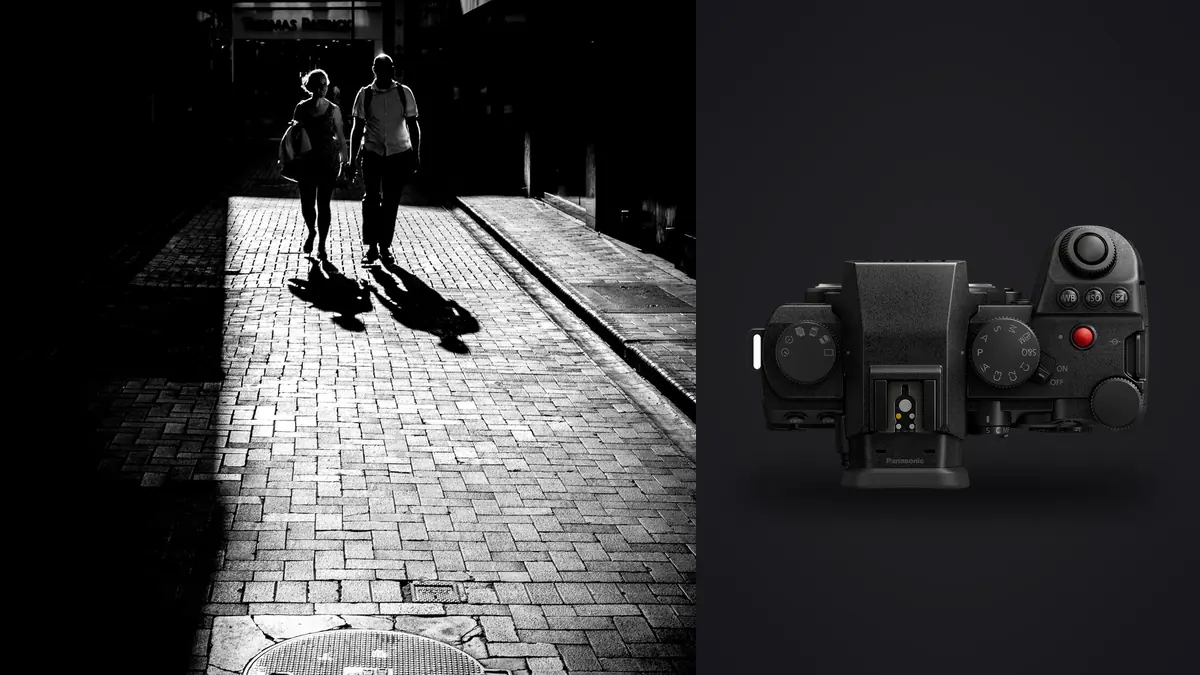
I picked up the S5IIx about eight months ago specifically to replace an aging a7 III on a long-term documentary project following a fishmongers' market through its final year before a redevelopment forced it out. I did not buy it for the video specs everyone talks about. I bought it because the original S5 I'd been renting occasionally had autofocus that felt like negotiating with a stranger, and Panasonic finally fixed that with phase-detect. Eight months and something like 40,000 frames later, here is what actually matters if you're deciding whether this camera belongs around your neck on a twelve-hour shoot day.
The body disappears faster than you'd expect from an SLR-shaped camera
Street and documentary shooters tend to gravitate toward rangefinder-style bodies for good reason: less visual bulk, less "professional photographer" signaling, faster to bring to eye. The S5IIx has a conventional DSLR-style hump and a decent-sized grip, so on paper it should read as more conspicuous than a Fuji X-Pro or an X100. In practice it doesn't, and the reason is almost entirely about the "x" variant's cosmetic choices. Panasonic dropped the red REC tally lamp that lights up on the standard S5II, and the whole body ships in a flat, non-reflective black that doesn't catch light the way a chrome-accented body does. On a dim street at dusk that matters more than you'd think. People clock movement and reflection before they clock shape.
Weight-wise it sits at roughly 740g body only, closer to 900g with a standard zoom mounted. That's heavier than an X100VI (about 478g) but lighter than most full-frame bodies with equivalent build quality and full weather sealing. I've shot with it in genuine downpours in Porto without a rain cover and had zero issues, which is not something I'd risk with several competing bodies in this price bracket.
Autofocus is the actual generational leap, not a footnote
This is worth dwelling on because it's the single biggest reason to consider the S5IIx over the original S5 or the S1 if you're specifically doing documentary or street work. Every Lumix full-frame body before this generation used contrast-detect DFD autofocus, which hunted visibly in low light and struggled with anything moving unpredictably across the frame, which is most of what happens on a street corner. The S5II and S5IIx were the first Lumix full-frame cameras to ship with on-sensor phase-detect AF, and it shows immediately the moment you point it at a person walking toward you through foot traffic.
I run subject detection on "Human" rather than full "Face/Eye" priority for most documentary work, because eye detection alone tends to lose the plot the second someone turns their head or you're shooting from a hip-level angle where faces aren't square to the lens. Human detection holds onto a torso or a partial profile well enough that I'm not chasing focus boxes around the frame while trying to also watch what's happening at the edges of the composition. It's not as sticky as Sony's latest tracking implementations, I'll say that plainly, but it's a completely different camera than the S5 was two years ago, and for the price it's genuinely competitive.
One quirk worth flagging: in dense crowds with a lot of similar-toned clothing (think a monochrome winter crowd, dark coats everywhere), the tracking box will occasionally jump to the wrong person mid-sequence. I've started shooting a slightly wider aperture than I'd like in those conditions, f/2.8 instead of f/1.4, purely to buy back some depth-of-field forgiveness for when the AF box lands on the wrong shoulder.
In-body stabilization changes what "usable shutter speed" means
The Dual IS2 system, when paired with a stabilized lens, is rated up to 6.5 stops. I don't chase that number in real shooting because handheld human subjects move regardless of how still your camera is, but the practical upshot for documentary work is that I can shoot static environmental frames, doorways, market stalls, empty alleys between the action, at 1/8s handheld and get a sharp result more often than not. That lets me keep ISO down in genuinely dark interiors (covered markets, night vendors under a single bulb) instead of pushing to 6400 and eating the noise. For anything with actual human movement in frame I still keep a floor of 1/250s, stabilization doesn't freeze a subject, only the camera shake.
Lens pairings that actually make sense for this kind of work
The L-Mount lineup has matured a lot since the alliance with Sigma and Leica solidified, and for documentary shooting I've settled into three combinations depending on the assignment:
- Sigma 35mm F2 DG DN is my default. It's small enough that the whole rig doesn't feel top-heavy, focuses fast enough to keep pace with the S5IIx's AF, and 35mm on full frame is close enough to natural perspective that environmental context stays honest rather than distorted.
- Lumix S 24-70mm F2.8 comes out for assignments where I know I'll need to work a wider range without changing glass, mostly parades, protests, anything with a lot of forward motion where I don't have time to swap lenses. It's not light, and after a full day my shoulder knows it, but the constant aperture and weather sealing match the body well.
- Lumix S 26mm F8, the tiny body-cap style pancake, is what I put on for genuinely covert candid work. It's a fixed f/8, manual focus only, and it turns the S5IIx into something closer to a point-and-shoot in terms of footprint. Image quality is fine, not exceptional, but that's not the point of carrying it.
I've also adapted a couple of older Leica M-mount primes through a cheap mechanical adapter for zone-focusing work, no autofocus obviously, but at f/8 and a hyperfocal distance marked on the barrel, that stops mattering. It's a technique from film rangefinder days that still works perfectly on a modern sensor.
How it stacks up against the obvious alternatives
| Camera | Autofocus system | Body weight | Stealth shutter option | Best suited to |
|---|---|---|---|---|
| Panasonic S5 (original) | Contrast-detect DFD only | 714g | Fully silent electronic | Static/deliberate street work, not fast-moving crowds |
| Panasonic Lumix S5IIx | Hybrid phase-detect + contrast | ~740g | Fully silent electronic, no tally lamp | Documentary work mixing stills and video, low-light interiors |
| Fujifilm X100VI | Hybrid phase-detect (APS-C) | 478g | Leaf shutter, near-silent | Pure candid street, one fixed 35mm-equivalent view |
| Sony a7C II | Hybrid phase-detect, AI subject recognition | 514g | Fully silent electronic | Smallest full-frame footprint, fastest tracking lock |
The honest read on this table: if pure candid street photography with one fixed lens is the whole job, the X100VI is smaller and arguably more discreet. If you need the smallest possible full-frame body and the fastest AI tracking money can currently buy, Sony's a7C II wins that fight. The S5IIx earns its spot when the assignment is documentary rather than purely street, meaning you're also expected to hand over video clips, work in genuinely difficult light, or you already own L-Mount glass and don't want to start a new system from zero.
The video side matters more than most street photographers admit
A growing share of documentary commissions want a short video piece alongside the stills now, and this is where the "x" designation over the plain S5II actually earns its higher price. The S5IIx can record ProRes RAW directly to an external SSD over USB-C, or output ProRes RAW via HDMI to a compatible recorder, with an active cooling fan that lets it run well past the thermal limits a lot of mirrorless bodies hit after twenty or thirty minutes. I'm not primarily a video shooter, but being able to get a few minutes of usable, gradeable footage from the same body I'm shooting stills on, without carrying a second camera, is a real advantage. It's one more thing in the bag instead of two.
What a real shoot day looks like, and where imagic fits in
Documentary work generates volume in a way that planned studio sessions never do. A single market afternoon with the S5IIx set to its 30fps electronic burst mode for fleeting moments (a hand gesture, a laugh, a transaction) can leave me with two or three thousand frames by the time I'm home, a meaningful chunk of it bursts of the same three seconds shot six or seven different ways because I wasn't sure which fraction of a second was going to land. Sorting that by eye used to eat an entire evening.
What changed my workflow was running the day's card through imagic before I even open a full editor. It's local, so a market's worth of identifiable faces never leaves my laptop, which matters to me on documentary work involving people who didn't sign a release form. It scores sharpness and focus accuracy across the burst clusters and groups near-duplicate frames automatically, so instead of clicking through eleven nearly identical shots of the same handshake I'm looking at the two or three where focus actually landed on the right person. I've also trained the apply_my_style preset on a batch of my own finished market-series edits, a particular desaturated, slightly warm grade I use for this project specifically, so a first pass rolls out across a new day's take before I go in and hand-finish the dozen frames that are actually going to press. It's cut what used to be a three or four hour culling and first-pass session down to well under an hour most days. If you're dealing with similar volume, it's worth reading up on how AI photo culling actually works before assuming it'll misjudge focus the way older "blur detection" plugins used to.
None of that is specific to this camera, any high-burst body generates the same problem, but the S5IIx's 30fps electronic mode (with a roughly one-second pre-burst buffer if you enable it, which lets you capture the half-second before you actually pressed the shutter) makes the volume problem worse than most cameras in this class, so the culling step stops being optional.
Custom modes I actually use
I keep three custom modes set on the dial. C1 is a fast aperture-priority setup at f/2.8, Human detection AF, mechanical shutter, for general walking-around work. C2 is silent electronic shutter, f/4, single-point AF, for situations where I genuinely cannot have any shutter sound (religious sites, quiet interiors, sleeping subjects). C3 is a monochrome profile using Panasonic's L.Monochrome D photo style with contrast pushed slightly, which I use to preview compositions in black and white on the EVF even though I always shoot RAW and decide color versus mono later. Seeing tonal contrast rather than color contrast in the viewfinder genuinely changes what you notice on a cluttered street.
Where it genuinely falls short
I don't want to write around the weak points. Battery life is mediocre, I get roughly 350 to 400 shots per charge in real mixed use with the EVF active most of the time, and I carry two spares on any full shoot day. There's no built-in ND filter, which is a video-side gap that matters if you're shooting the hybrid stills-and-clips workflow I described above in bright daylight and want a shallow aperture. The menu system, while much improved from older Lumix bodies, still has autofocus settings scattered across three different submenus, and I had to build a cheat sheet the first week just to remember where subject detection sensitivity lives versus where tracking speed lives. And at a street price that regularly lands north of $2,000 body only, it's not a casual purchase next to something like an X100VI if all you want is a single fixed-lens street camera.
Frequently Asked Questions
Is the S5IIx too big and loud for genuine candid street photography?
It's louder than a leaf-shutter compact in mechanical mode, but the fully silent electronic shutter option removes that concern entirely, and I use it for the majority of true candid work. Size is the bigger factor: it's not a pocket camera, and if minimal visual footprint is your top priority over everything else, a smaller fixed-lens body will still be less conspicuous. For documentary assignments where you're expected to be visibly working rather than hiding, the size stops mattering much.
Does the S5IIx's autofocus actually keep up with fast-moving crowds, or is that marketing?
It's a real improvement over the DFD-only S5, and I trust it for walking subjects, cyclists, and general crowd movement. It's not as sticky as the latest Sony tracking in genuinely chaotic scenes with occlusion (someone stepping between you and your subject), and I've had it hop to the wrong person in dense, similarly-dressed crowds. Treat it as very good, not infallible, and keep your aperture a stop or two more forgiving than you'd otherwise choose.
Do I need the "x" version specifically for street and documentary work, or is the base S5II enough?
For pure street photography with no video component, the base S5II saves you money with essentially identical stills performance and autofocus. The "x" earns its premium if you're delivering video alongside stills (ProRes RAW recording, active cooling for longer clips) or if the stealthier all-black finish and missing tally lamp genuinely matter to how you work in sensitive environments. I'd have bought the base S5II if my market project hadn't also called for short video pieces.
What's the best way to handle the volume of frames this camera produces on a busy shoot day?
Build a culling step into your workflow before you touch a full editor. Whether that's imagic's local sharpness scoring and burst clustering or another tool, the goal is the same: separate the two or three frames per burst that are actually sharp and well-timed from the rest before you start making creative decisions. Trying to eyeball two thousand frames a night is how good work gets buried. Our piece on speeding up a high-volume photo workflow covers the broader habits worth building around this, not just the software part.