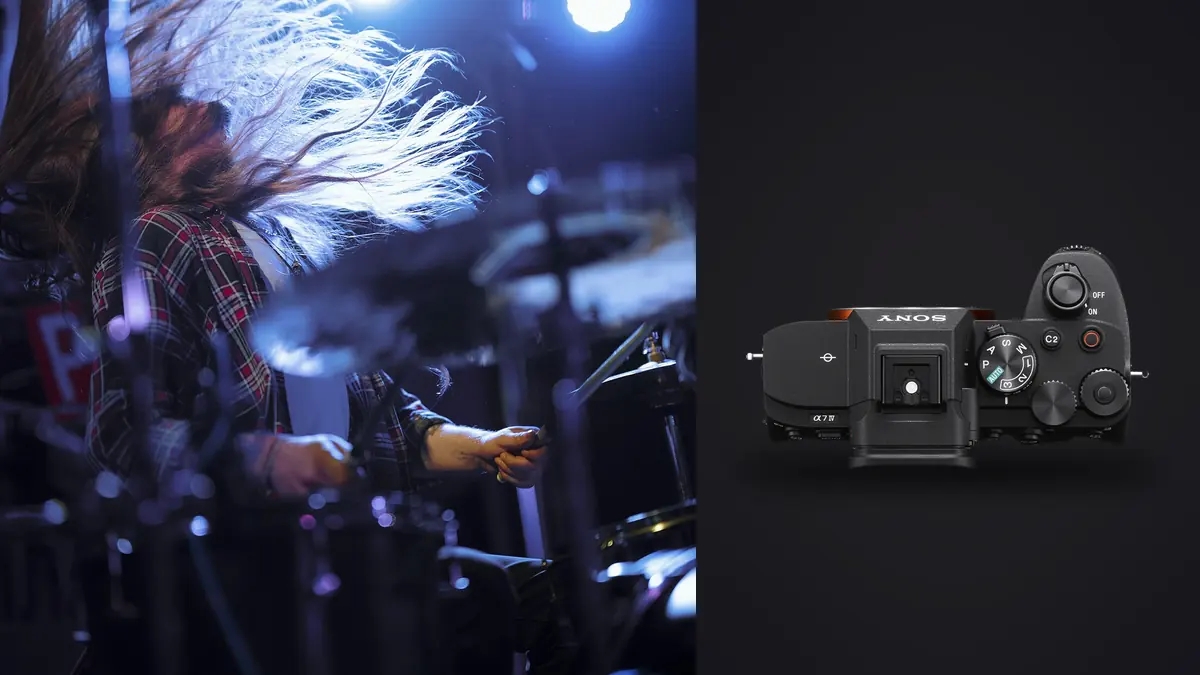
I picked up an A7 IV specifically because my old A7 III was struggling to keep a singer's face in focus once the stage lighting dropped below a couple hundred lux. Two years on, here's what I've actually learned about running this camera at gigs, not the marketing version, the version where a guitarist lunges into your lens at f/1.4 and you have half a second to not blow the shot.
This isn't a spec sheet rehash. It's the settings I dial in before doors open, the mistakes that cost me usable frames early on, and where the A7 IV genuinely earns its keep against the crowd of live music shooters who all seem to be carrying either this camera or a Z6 III these days.
Why the A7 IV Sits in an Odd Spot for Gig Work
The A7 IV is not a sports camera. Sony made that clear by keeping it at 10fps mechanical (and only in a cropped, compressed RAW mode at that) rather than giving it the A9-series stacked sensor. For concert work that's mostly fine, because unlike a football match you're not tracking a ball moving at speed across a field. You're tracking a human who moves in bursts, plants for two bars, then throws themselves at the monitor wedge. The 33MP sensor and the deeper buffer than the III matter more here than frame rate ever will.
Where it struggles is rolling shutter under fast pans with moving stage lights, and the buffer clears slower than you'd like when you're shooting compressed RAW at 10fps during an encore where everyone in the pit is firing at once. I've had the buffer choke for a solid seven or eight seconds mid-song more than once, which is exactly when the singer decides to do something interesting.
My Actual Settings Before Doors
I stopped chasing "correct" exposure a long time ago and started chasing consistency, because stage lighting swings so wildly between songs that a locked exposure setup saves you from constant recovery in post.
- Mode: Manual, with Auto ISO. I set my shutter and aperture and let ISO float, because lighting rigs change color and intensity faster than I can react manually.
- Shutter speed: 1/320s minimum for anything with a moving performer, 1/250s if the venue lighting is genuinely dim and the artist is mostly static (acoustic sets, seated performers). Anything under 1/250s and hand-waving guitarists start ghosting.
- Aperture: Wide open, almost always. f/1.8 on the 35mm f/1.4 GM or f/1.4 GM primes if I'm shooting them wide. Depth of field at 3-5 meters with a 35mm or 50mm at f/1.4 is forgiving enough that I'm not constantly missing focus by a hair.
- Auto ISO ceiling: I cap it at 12800. The A7 IV produces genuinely usable files up to that point with a bit of noise reduction in post. Past 12800 the color starts to smear under mixed LED stage lighting and I'd rather underexpose slightly and pull it in post than let the camera climb further.
- Metering: Spot metering, locked to the center point, recomposed as needed. Stage backdrops are usually black or near-black, and multi-segment metering will blow your subject's face out trying to brighten the whole frame.
Autofocus: Where the A7 IV Actually Beats Its Reputation
People still talk about the A7 IV like it's a video-first hybrid that compromised on stills AF, and that was true relative to the A1, but it's not true relative to what you need for a gig. Real-time Eye AF (Human) tracks a singer's face through hair whips, mic stand obstructions, and lighting changes far better than the phase-detect system in my old III ever did. I run Wide-area AF with Eye AF priority for most of the set and switch to a smaller Zone or Flexible Spot when the guitarist is angled away from me and the camera keeps trying to find a face that isn't pointed my way.
The one thing that trips people up is AF-C with continuous Eye AF fighting the photographer's own recomposition instincts. If you're used to focus-and-recompose from stills shooting, unlearn it here. Let the tracking box follow the eye and just frame around it. Fighting the tracking by half-pressing and recomposing repeatedly is how you end up with a stack of soft frames where the AF system re-hunts every time you release the shutter button.
Custom Button Layout I Actually Use
C1 is back-button AF-on with Eye AF (Human) locked in, so I never touch the shutter half-press for focus. C2 toggles between Wide and Flexible Spot AF area so I can shrink the tracking area instantly when someone else walks in front of my subject, which happens constantly in a three-song pit. C3 is a manual focus magnifier fallback for when the AF system is completely lost, usually during strobing lighting cues where the sensor can't get a consistent read.
Lens Choices That Actually Work at Shows
The kit lens is not an option here, full stop. You need fast glass, and the question is really zoom versatility versus raw light-gathering.
| Lens | Best for | Real tradeoff |
|---|---|---|
| Sony 24-70mm f/2.8 GM II | Photo pit access, three-song runs where you need to reframe fast | f/2.8 alone isn't enough past ISO 12800 in dim clubs; you'll lean hard on Auto ISO |
| Sony 35mm f/1.4 GM | Small venues, tight pits, wide environmental shots with crowd context | Fixed focal length means physically moving for framing, awkward in a packed photo pit |
| Sony 85mm f/1.4 GM | Isolated portraits of a lead singer from mid-distance | Too tight for anything but a solo performer, useless in cramped venues under 15 feet from stage |
| Sony 70-200mm f/2.8 GM II | Arena and theater shows where you're shooting from a riser or far pit | Heavy for a full set held up, and f/2.8 still needs ISO 6400+ in most arena lighting |
My actual bag for club shows under 500 capacity is the 35mm f/1.4 and 85mm f/1.4, swapped on the fly. For anything bigger where I've got real pit distance, the 24-70mm GM II stays on and I don't touch primes all night.
The Part Nobody Mentions: What Happens After the Set
A three-song photo pit at a decent-sized show generates 400 to 900 frames per photographer, and most of that is duplicate near-misses of the same beat in a song where you fired six frames hoping one had the eyes open and the mouth not mid-syllable. Sorting that by hand at 1am after a shoot, half-drunk on adrenaline and actual drinks, is where most photographers lose the will to live.
This is honestly the reason I started running everything through imagic before I even open Lightroom. It runs local sharpness scoring on the RAW files straight off the card, which matters a lot with A7 IV files specifically because the eye can look sharp on a 3-inch screen and be soft when you pixel-peep at 100%, especially in low light where the AF system was working at its limits. It also clusters the burst sequences from a single song section together so I'm comparing six near-identical frames of a guitar solo against each other instead of scrolling past them one at a time. Because it runs entirely on my laptop and never uploads anything, I'm not sitting in a venue parking lot waiting on a cloud service with festival wifi that barely loads Instagram. For more on how that local sharpness scoring actually works, see how AI photo culling works.
Once I've got the picks narrowed down, I built an apply_my_style preset in imagic off about forty of my previous concert edits, so the first pass of color and contrast on a new set of files already looks close to my usual look before I do any manual grading. It's not magic, it still needs tweaking per venue because lighting rigs vary wildly, but it cuts the blank-page problem down to nothing.
Battery, Cards, and the Boring Stuff That Ruins a Night
The A7 IV's NP-FZ100 battery genuinely gets you through a full club night of shooting (two or three opening acts plus a headliner, so two to three hours of active shooting) on one battery if you're not chimping constantly. I still carry two spares because a dead battery mid-headliner set is not a risk worth taking for a $60 spare.
Dual card slots matter more at gigs than almost anywhere else, because a corrupted card during a one-night-only show means the shots simply don't exist anymore, there's no reshoot. I run a CFexpress Type A in slot one for buffer speed during bursts and a fast SD in slot two set to backup, not overflow. The extra cost of CFexpress Type A cards stings, but clearing a stuffed buffer during an encore because slot one is fast enough to write through the burst is worth it more nights than not.
Frequently Asked Questions
Is the A7 IV fast enough for pit photography with three or more acts a night?
Yes for club and theater shows, more marginal for arena pits where photographers are packed shoulder to shoulder and everyone's firing at once during the same three songs. The 10fps compressed RAW mode and its buffer depth are enough to catch the moment, but you won't get the rapid-fire coverage an A9 III shooter next to you will during a fast strobe sequence. In practice, most of what separates a good gig photographer from a mediocre one is timing and anticipation, not frame rate.
Should I shoot compressed or uncompressed RAW for live music work?
Compressed RAW (or lossless compressed) almost every time. The file size difference matters when you're shooting 600+ frames a night and need the buffer to clear between songs, and the actual image quality difference is not visible in concert work where you're grading for mood and contrast rather than pulling extreme detail out of shadows.
What ISO can I actually push the A7 IV to before it looks bad on stage?
I'm comfortable publishing files up to ISO 12800 with modest noise reduction. Past that, colored stage lighting starts to smear and skin tones shift in ways that are hard to correct cleanly. If a venue's lighting forces me past 12800 consistently, I'd rather drop shutter speed to 1/200s and accept slightly more motion blur on hand gestures than push ISO further.
Does the in-body stabilization actually help for handheld gig shooting?
It helps for framing and reviewing shots on the rear screen more than it helps the actual exposure, since you're shooting fast shutter speeds to freeze performer motion anyway, well above what IBIS is compensating for. Where it genuinely helps is stabilizing the viewfinder image itself so you can track a moving performer more accurately through long sets without eye strain.
If you're weighing the A7 IV against a used A9 or a Z6 III for live music specifically, my honest take after two years is that the A7 IV's autofocus and file quality cover 90% of what you need at club and theater scale, and the 10fps ceiling only becomes a real limitation once you're shooting arena pits regularly. Buy the fast primes before you buy a second body.