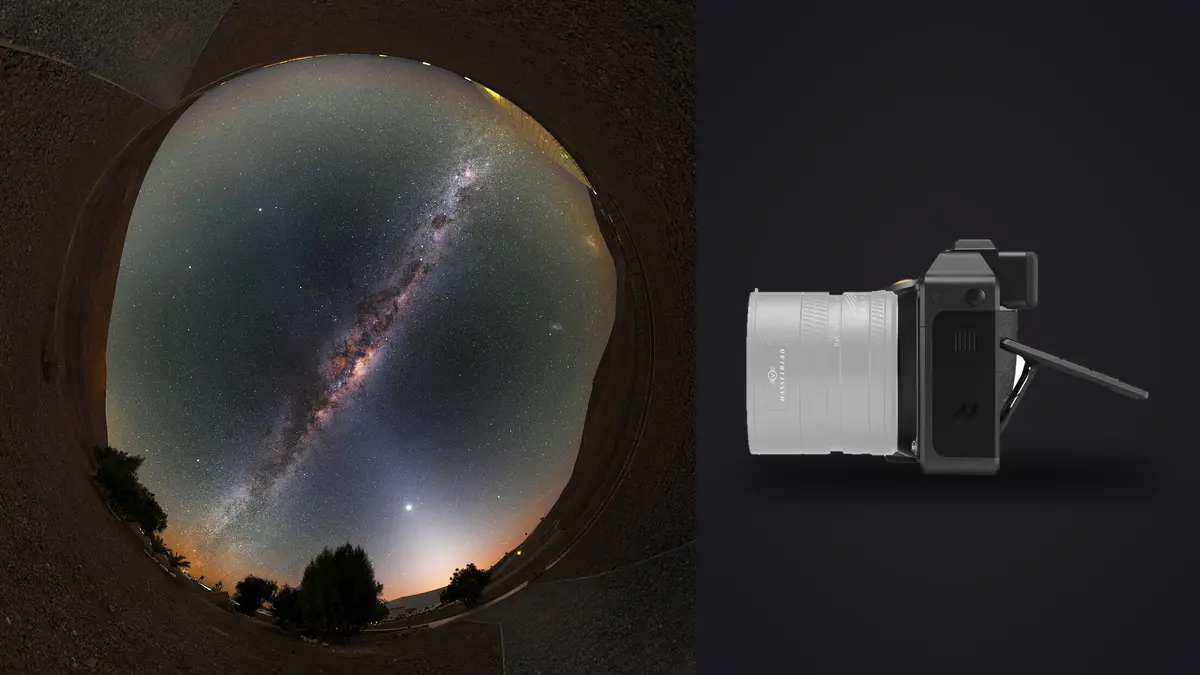
A reader emailed me last month asking whether it was worth dragging a Hasselblad X2D 100C out to a dark sky site for a star stacking project, or whether the camera was simply the wrong tool wearing an expensive badge. The honest answer took me longer to write than I expected, because the X2D is a studio and landscape camera that happens to shoot a gorgeous file, not a camera anyone at Hasselblad designed with astrophotography in mind. I have now taken it out on four separate nights, twice for wide nightscapes and twice paired with a star tracker for tighter starfield work, and the results are good enough to talk about honestly, warts included.
Why a studio sensor ends up under the stars at all
The pull is obvious on paper. The X2D 100C carries a 100-megapixel back-illuminated CMOS sensor at 43.8mm by 32.9mm, base ISO 64, and a dynamic range claim north of 15 stops. For anyone used to stacking full-frame files, that resolution is the headline. Stack forty frames of a Milky Way core at 100MP and you can crop into the galactic bulge at print resolution without the image falling apart, something a 24MP body simply cannot offer without heavy upscaling.
What the spec sheet doesn't tell you is that the pixel pitch on that sensor is roughly 3.76 microns, which is essentially identical to a 61MP full-frame sensor like the one in a Sony a7R IV. The extra resolution comes from a bigger sheet of silicon, not bigger photosites. That matters for astro because photosite size is a big part of what determines per-pixel noise at high ISO. A Sony a7R IV, which shares roughly the same pixel pitch, is a useful reference point if you already know that body's high-ISO behavior. In practice this means the X2D does not out-resolve high-ISO star fields the way its megapixel count suggests it should. You are not getting full-frame-like noise performance with medium-format headroom on top. You are getting full-frame-like noise performance with a much bigger, much heavier, much more expensive file wrapped around it.
The lens problem nobody mentions in the marketing copy
Aperture speed is where the system actually struggles for wide nightscape work. The XCD lineup leans toward f/3.5 to f/4.5 across most of the wide-to-normal range. The XCD 4/22, which is the widest rectilinear option Hasselblad makes for the system, tops out at f/4. Compare that to a full-frame 14mm f/1.8 and you are giving up more than two stops before you even factor in the crop multiplier. Speaking of which: the X2D's sensor is larger than full frame, so focal lengths translate to a roughly 0.79x full-frame equivalent rather than a crop-in multiplier. A 45mm XCD lens behaves like a 35mm on full frame, which is pleasant for landscape framing but does nothing to compensate for the missing stops of light.
The one genuinely fast lens in the lineup is the XCD 1,9/55 at f/1.9, which is excellent glass, but 55mm (about 43mm full-frame equivalent) is a normal focal length, not a wide one. It is far better suited to tracked, tighter starfield captures than to a sweeping Milky Way-over-the-ridgeline composition. If your plan is wide nightscapes with foreground interest, you are shooting at f/4 or slower and leaning on stacking and higher ISO to make up the difference, which is workable but not effortless.
Shutter behavior, battery life, and other things that bite you at 2am
The X2D has no focal-plane shutter of its own. Exposure is handled either by the leaf shutter built into most XCD lenses or by the sensor's electronic shutter for lenses without one. The electronic shutter runs out to roughly an hour on the long end, which in practice means you never need an external intervalometer or bulb cable to hold a five-minute single exposure. That is a genuine convenience for star trail work where you might want one very long single frame rather than a stacked sequence.
Battery life is the part that catches people off guard. A 100MP sensor and a bright rear screen draw more current than a typical mirrorless body, and cold temperatures make that worse. On a three-hour stacking session in October, shooting at roughly minus two degrees Celsius, I burned through two batteries where a full-frame body would have managed on one. If you're planning a long sequence, bring at least three spares and keep them warm in an inside pocket until you swap them in.
Building an exposure sequence that doesn't fight the sensor
Medium format CMOS sensors of this generation run warm on extended sequences because there's no active cooling, and heat is the enemy of clean long exposures. Amp glow and a rising hot-pixel count are noticeable by the time you're forty minutes into a stacking run in warm weather, less so once temperatures drop below about ten degrees Celsius. Two habits made a real difference for me: turning off in-body image stabilization entirely once the camera is on a tripod (IBIS units can introduce a faint drift artifact across a stacked sequence if left active on a locked-down camera), and turning off in-camera long exposure noise reduction. The latter is worth flagging specifically, because long exposure NR algorithms on several brands, this one included, are prone to interpolating away the faintest point-source stars along with the actual noise. You lose real data chasing a cleaner-looking single frame, when stacking was going to clean up that noise anyway.
Here's roughly how I split subs across the three kinds of astro shoots I've actually done with this body:
| Shoot type | Sub length | ISO | Frame count | Notes |
|---|---|---|---|---|
| Wide Milky Way nightscape, untracked | 10-13 sec (500 rule adjusted for 0.79x crop) | 1600-3200 | 25-35 sky frames + 4-6 foreground frames | Blend foreground separately; sky stack in Sequator or Starry Landscape Stacker |
| Star trail composite | 1 single 45-60 min exposure, or 90-120 x 30 sec | 200-400 | 1 long sub, or 90-120 short subs | Electronic shutter handles the single long exposure without extra hardware |
| Tracked deep sky / tight starfield (XCD 1,9/55) | 90-180 sec | 400-800 | 20-40 | Tracker payload matters; body plus lens runs 1.3-1.5kg |
Getting hundred-megapixel files off the card and into a stack
This is the part that surprised me most. The X2D writes 3FR raw files, and most star stacking software, DeepSkyStacker in particular, has no native support for Hasselblad's raw format. Sequator has spottier support too. The workaround is to batch-convert the sequence to 16-bit TIFF inside Phocus before handing it to stacking software, which is an extra step and an extra chunk of disk space every single time, since a converted TIFF from a 100MP sensor runs well over 300MB per frame. A forty-frame stacking sequence turns into more than 12GB of intermediate files before you've even started aligning.
Storage-wise, the built-in 1TB SSD is genuinely useful here, since a single night of star stacking can eat through card space fast at this file size, and swapping SD cards with cold hands in the dark is its own small misery. Before I even get to conversion, though, I run the raw sequence through imagic to sort the keepers, since its local sharpness scoring is well suited to ranking forty near-identical starfield frames by actual pinpoint focus rather than eyeballing thumbnails on a 3.6-inch screen at midnight (the mechanics of that scoring are covered in more depth in how AI photo culling actually works), and its burst and duplicate clustering groups a long stacking sequence automatically instead of leaving you to scroll through hundreds of visually identical exposures one at a time. Because everything runs locally, that sorting happens on my laptop at the campsite with no signal at all, which matters more than it sounds like it should when you're two hours from the nearest town.
Tracked work: where the resolution actually earns its keep
Untracked wide nightscapes don't lean on the sensor's resolution advantage much, since you're limited by exposure time before star trailing sets in regardless of megapixel count. Where the 100MP file genuinely pays off is tracked work, pairing the body with something like a Star Adventurer GTi or an iOptron SkyGuider Pro and shooting tighter frames of star clusters or a wider Milky Way section at 90 to 180 second subs. Stack thirty of those and you have enough resolution headroom to crop into a specific region, a nebula or cluster within the frame, and still print it at a size that would make a 24MP stack look soft by comparison.
The catch is payload. Body plus the XCD 1,9/55 runs about 1.3 to 1.5kg depending on which battery grip setup you're using, which is on the heavier end for the small consumer trackers rated around 5kg of payload once you add a ball head, an L-bracket, and any counterweight. It works, but it's closer to the edge of what those trackers handle gracefully than a mirrorless body and a compact prime would be. If you already own a heavier mount for other reasons, this is a non-issue. If you're buying a tracker specifically for this camera, budget for a sturdier one than you'd need for a lighter system.
What I'd actually tell someone shopping for this
I would not buy an X2D 100C for astrophotography. It is not built for it, the fastest wide option in the lens lineup tops out at f/4, and the workflow friction around 3FR conversion adds real time to every session. But if you already own one for studio or landscape work and you're curious whether it's worth bringing along on a dark-sky trip, the answer is yes, with the caveats above baked in. The files are stunning once you've stacked and processed them, the dynamic range gives you real latitude to bring up shadow detail in a foreground without a separate exposure blend most of the time, and once I'd built one nightscape edit I liked in Phocus and Lightroom, I ran it through imagic's apply_my_style feature to carry that same color and contrast treatment across the rest of the season's shoots without redoing the grading pass by hand each time. For a body this expensive, getting a consistent look across a handful of trips a year without repeating the manual work is a small but real point in its favor.
Frequently Asked Questions
Does the X2D 100C's in-body stabilization help with star stacking?
Not on a tripod. IBIS is genuinely useful for handheld work, Hasselblad rates it up to seven stops, but for tripod-mounted long exposures you should switch it off. Active stabilization on a camera that isn't actually moving can introduce a subtle drift between frames that shows up as slightly softened stars once you stack the sequence.
Can I use DeepSkyStacker or Sequator directly with 3FR raw files?
Not reliably. Both tools were built primarily around raw formats from Canon, Nikon, and Sony bodies, and 3FR support is inconsistent at best. The workaround that has worked for me every time is batch-converting the sequence to 16-bit TIFF in Phocus first, which adds a step and a meaningful chunk of disk space but avoids compatibility errors mid-stack.
Is the XCD 1,9/55 fast enough for Milky Way nightscapes?
It's the fastest lens in the system at f/1.9, but at roughly 43mm full-frame equivalent it's framed more like a normal lens than a wide one. It suits tighter, tracked starfield work well. For a wide Milky Way-over-landscape composition you're better served by the XCD 4/22 or XCD 3,4/25, both of which are considerably slower and need to be made up for with stacking and higher ISO.
How many exposures does a typical star stack need with this camera?
For untracked wide nightscapes I generally shoot 25 to 35 sky frames plus a handful of longer, lower-ISO foreground exposures blended in separately. For tracked, tighter starfield work I've had good results with 20 to 40 subs in the 90 to 180 second range. More frames reduce noise further, but file size adds up fast at 100MP, so I'd rather sort aggressively for sharpness before stacking than shoot an oversized sequence and cull afterward.