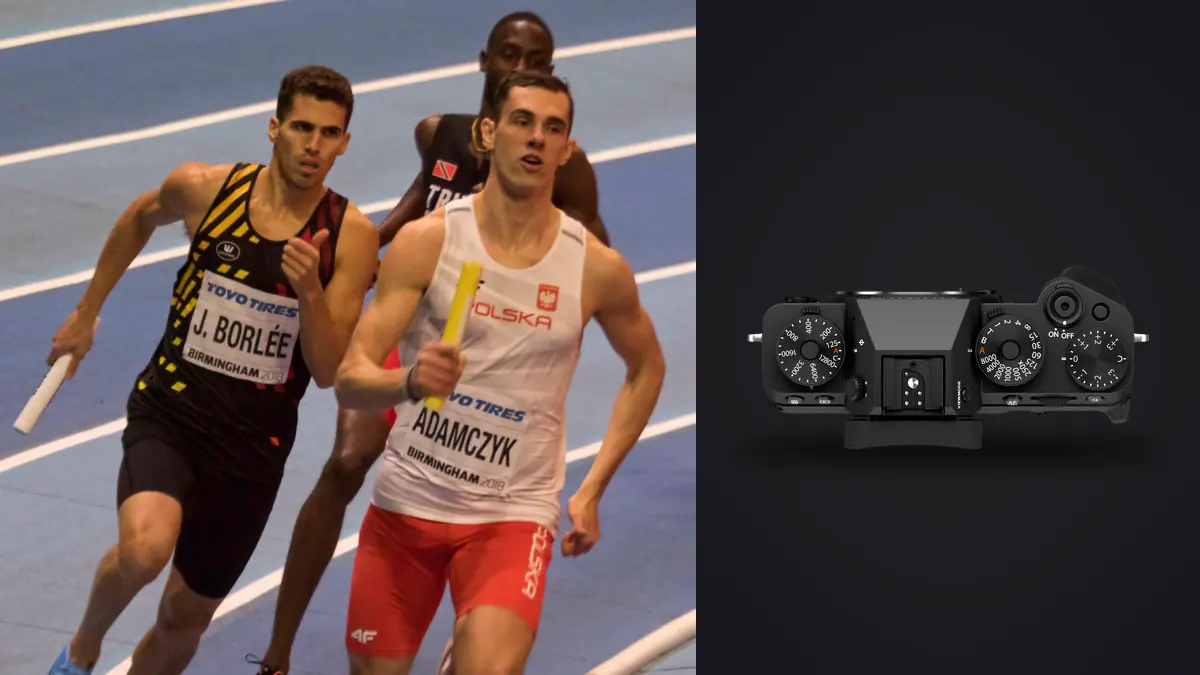
I shot my first outdoor track season with the X-T5 mostly because I already owned the glass. That is the honest reason, not some grand plan about resolution or IBIS. What I found over a dozen meets, from a rainy regional qualifier to a packed conference championship on a rubberized track that reflected every stray beam of stadium lighting, is that the X-T5 is a genuinely capable track camera with one real limitation that never fully goes away: its buffer. Everything else about it, the autofocus, the handling, the files it produces, earns its keep. The buffer is the thing you have to plan around, every single time you raise the camera.
Why a 40-Megapixel Body Is an Odd Choice for Sprints
Fujifilm built the X-T5 around a 40-megapixel X-Trans sensor, and that sensor was never designed with a sports shooter's priorities in mind. Compare it to the X-H2S, which trades resolution for a stacked, faster-reading 26-megapixel sensor with a deeper buffer and less rolling shutter. If your only job at a meet were burst-firing 100-meter finals at the highest frame rate the body allows, the X-H2S is the better tool, full stop. But most of us shooting track aren't chasing 40 clean frames a second on every race. We're covering long jump run-ups, hurdle clearances, relay exchanges, throwing events, and the occasional dramatic finish-line dip, and for that mix the X-T5's resolution actually pays off. Cropping a 40-megapixel file to isolate a single hurdler mid-flight still leaves you with a file north of 15 megapixels, plenty for a web gallery or even a modest print. That flexibility matters more at a track meet than it does at, say, a football game, because you're often shooting from a fixed position in the stands or behind a rope line with no ability to physically move closer to the action on the far side of the oval.
The Buffer Problem, in Real Numbers
Here's where I have to be blunt. The X-T5's buffer is shallow enough that it changes how you shoot. At the highest continuous rates, especially in the cropped electronic shutter mode, I've watched the frame rate visibly stutter mid-burst when I held the shutter down through an entire 400-meter sprint from the final curve to the tape. The camera doesn't stop shooting, but it slows, and the slowdown lands exactly when you don't want it, in the final stride before the line. This table reflects what I logged across several meets shooting a mix of UHS-II cards, not manufacturer marketing numbers.
| Shutter mode | Frame rate | Sensor crop | Usable burst before slowdown | Best use at a meet |
|---|---|---|---|---|
| Mechanical | 15 fps | None | Roughly 1.1-1.3 seconds of full-speed shooting | Field events, relay handoffs, anything with a predictable peak moment |
| Electronic, full width | 10 fps | None | Longer runway, closer to 2 seconds, but rolling shutter shows on fast lateral motion | Distance races, warm-ups, situations where silence matters (indoor meets) |
| Electronic, cropped | 20 fps | 1.29x | Under 1 second before visible slowdown on a 40MP body | Short, decisive moments only: a hurdle clearance, a baton pass, a finish lean |
The practical takeaway is that you cannot treat the X-T5 like a machine gun for an entire race. I've moved almost entirely to short, deliberate bursts timed to the moment rather than holding the shutter from gun to tape. For the 100m and 110m hurdles that means starting the burst as the athlete crests the second-to-last hurdle, not at the gun. For distance races, where the outcome develops more slowly, I switch to single-shot or short 3-4 frame bursts at key laps and save the buffer for the final straight.
Setting Up Autofocus for Runners
The X-T5 doesn't have a dedicated "human sports" subject-detection mode the way its AI-driven detection handles animals, birds, or vehicles. For people, you're working with the standard phase-detection AF-C system, and it's genuinely good once it's configured correctly, but the default settings undersell it. I run Zone AF with a medium-sized zone (roughly 5x3 points) rather than the widest tracking area, because a large zone on a crowded track tends to grab the runner in the next lane instead of the one I'm following. For field events like long jump and triple jump, where the subject moves along a single predictable line toward the camera, I switch to a smaller zone, sometimes even a single point, because the background clutter of a sand pit and officials standing nearby confuses wider zones. I also set custom AF-C presets rather than relying on the single generic tracking behavior. Preset 3 (the "ignore obstacles" leaning preset) works well for hurdlers, where the hurdle itself briefly enters the frame between the camera and the athlete. Without that setting, the AF system sometimes locks onto the hurdle rail instead of holding on the runner's torso.
Back-Button Focus Is Not Optional Here
I know back-button focus gets recommended for every genre, but at a track meet it solves a specific problem: false starts and recalls. If your finger is glued to a half-press-to-focus habit, you waste a fraction of a second re-establishing AF lock every time an athlete settles into the blocks, stands back up, and settles in again. Decoupling focus from the shutter button means the system stays locked on your chosen zone through the entire pre-race sequence, and you're not fighting the camera in the two seconds that actually matter.
Glass That Actually Covers a Track
Track infields are big, and stadium seating rules mean you rarely get to choose your distance from the action. I've settled on two lenses that cover almost everything. The XF 70-300mm F4-5.6 handles field events and the home straight from a reasonable seat, and it's light enough to hand-hold for an entire meet without the fatigue that a bigger zoom brings. For the back straight and far turns, where 300mm on the APS-C sensor (450mm equivalent) still isn't quite enough, I've borrowed the XF 150-600mm a few times and it's a different experience entirely, heavier, slower to swing between lanes, but it pulls detail out of the far side of an oval that the 70-300 simply can't reach. If you only shoot one lens and one meet a season, the 70-300 is the more sensible buy; if you're covering conference or state-level meets regularly, the 150-600 earns its weight.
Field Events Need a Completely Different Rhythm
Sprints reward burst shooting and fast AF tracking. Field events reward patience and pre-focus. For pole vault and high jump, I pre-focus on the bar itself using a single AF point, switch briefly to manual, and wait for the athlete to enter that plane rather than trying to track them through the entire run-up. The X-T5's IBIS genuinely helps here, since I'm often shooting handheld at slower shutter speeds than I'd like in shaded stadium sections, and the 5-axis stabilization buys me a stop or two I wouldn't otherwise have without bumping ISO into territory the X-Trans sensor handles less gracefully. Throwing events (shot put, discus, javelin) are the one category where I still miss a longer buffer, because the release moment is fast and unpredictable, and a shallow buffer means you sometimes catch the wind-up beautifully and then stutter right through the release.
Indoor Meets and the Flicker Problem
If you shoot any indoor track season, the X-T5's flicker reduction mode is worth turning on before you even think about it again. Indoor facilities running fluorescent or older LED banks introduce banding that ruins a otherwise sharp frame, especially at the faster shutter speeds sprint photography demands. Flicker reduction costs you a small amount of frame rate consistency, but it's a trade I take every time, because a technically perfect frame with a visible band across the athlete's chest is a frame I'm deleting anyway.
Getting From a Full Card to a Usable Edit
A single 800-meter race at 15fps mechanical, shot the way most people actually hold the shutter, can leave you with 300-400 frames of two runners in nearly identical positions from one frame to the next. Multiply that by six or seven events in an afternoon and sorting by hand becomes the real bottleneck of meet-day photography, more than any camera setting. This is where I've leaned on imagic to get through a memory card without losing the rest of my evening. It runs entirely on my laptop with no upload step, which matters at a stadium with no reliable WiFi and cell service that drops the moment the stands fill up. Its local sharpness scoring flags the two or three genuinely crisp frames out of a 40-frame hurdle burst, and the burst clustering groups near-identical sprint sequences together instead of making me click through every single one. For the actual grade, I built an apply_my_style preset from a season's worth of track edits I was already happy with, and now new imports land close to my usual look before I touch a slider, which saves real time when you're editing between events instead of the next morning.
If you're new to the idea of software doing the first pass of sorting for you, the mechanics are worth understanding before you trust it with a full meet's worth of images. We cover the general approach in how AI photo culling works, and if you're comparing tools rather than committing to one, the photo culling software comparison lays out the tradeoffs between the local-first approach and the cloud-based competitors.
What I'd Tell Someone Buying an X-T5 Specifically for Track
Buy it if you shoot a mix of events, not just sprints, and if you value a smaller, lighter body you'll actually carry to every meet rather than leave in the closet before a long away trip. Skip it, or at least budget for the X-H2S instead, if your primary subject is exclusively fast, unpredictable bursts like the 100m final or a photo finish where every millisecond of buffer counts. For everything in between, hurdles, relays, jumps, throws, distance events, the X-T5 does the job well once you stop expecting it to behave like a stacked-sensor sports body and start shooting around its actual strengths.
Frequently Asked Questions
Is the Fujifilm X-T5 fast enough to freeze a sprinter's stride?
Yes, at typical shutter speeds of 1/2000s or faster the X-T5 freezes sprint motion cleanly. The limitation isn't shutter speed, it's buffer depth during sustained bursts, which is a separate issue from image sharpness on any individual frame.
Do I need the XF 150-600mm for track, or is a shorter zoom enough?
It depends on your seating access. If you can get track-side or low-level credentials, the XF 70-300mm covers most of a standard oval. If you're shooting from general admission seating far from the action, the extra reach of the 150-600mm becomes much more useful, particularly on the far turns.
Why does my X-T5 slow down mid-burst during a race?
That's the buffer filling. At 40 megapixels, sustained high-speed bursts fill the buffer faster than lower-resolution sports-oriented bodies. Shooting shorter, timed bursts around the actual peak moment rather than holding the shutter for an entire race avoids the worst of it.
What's the fastest way to sort a full memory card after a meet?
Automated sharpness scoring and burst clustering handle the bulk of the sorting, letting you focus your own attention on choosing between the handful of genuinely strong frames each software pass surfaces rather than scrolling through hundreds of near-duplicates. It's worth pairing with a faster overall editing routine too; our tips for a faster photo workflow cover the parts of the process beyond just culling.