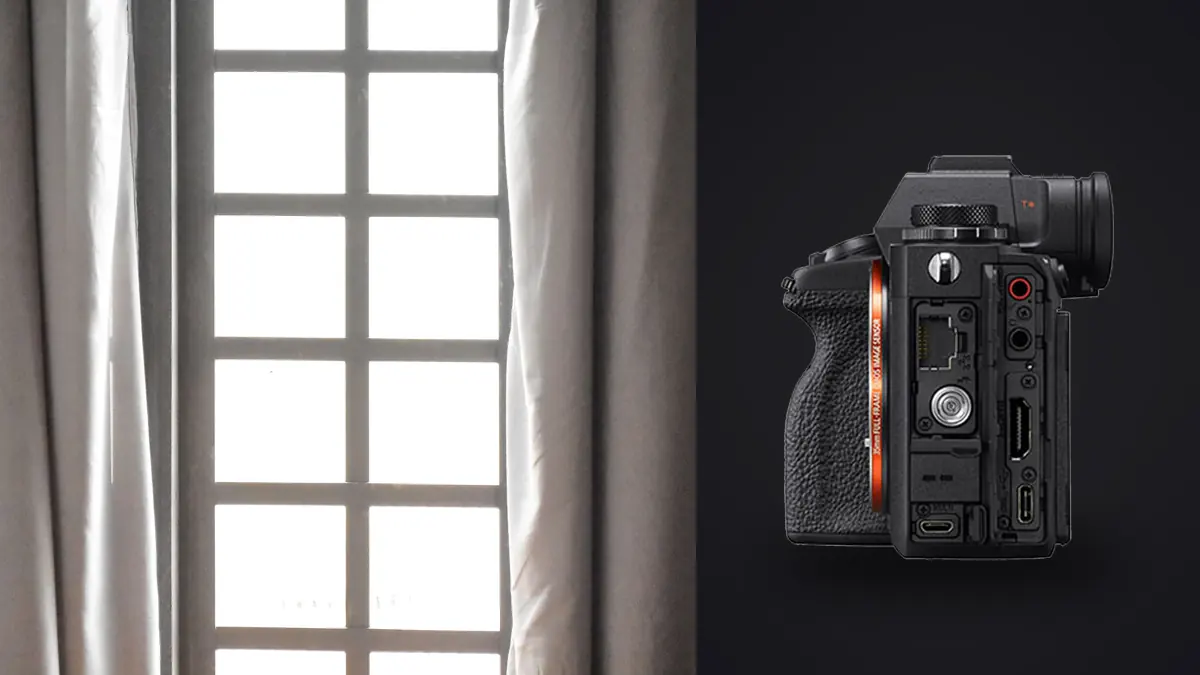
A flagship body is an odd thing to bring into a small bedroom. Most of what the Sony A1 is famous for, 30fps bursts, 8K video, a buffer deep enough to shoot a whole soccer match without pausing, has nothing to do with photographing one person sitting on the edge of a bed in soft window light. Picture someone who picked up the A1 for general shooting and only started using it for boudoir sessions when a returning subject asked why it sounded "less clicky" than the DSLR used for her first session. An offhand comment like that sends you down a rabbit hole into what actually matters in this specific genre, and the answer has very little to do with the spec sheet items Sony puts on the box.
The one spec that actually changes the room
The A1's fully electronic shutter is properly silent, not a "quiet mode" that still ticks faintly. In a bedroom or a small rented suite with the client three feet away, that difference is the whole story. A mechanical shutter slap on every frame is a small, repeated reminder that a machine is documenting the moment, and it breaks the mood in a way that's hard to shoot your way back out of. Switch to silent electronic and you can run a continuous sequence through a slow exhale, a shift of the shoulders, a change of hand position, without a sound in the room besides your own voice. That single feature has done more for my keeper rate on this kind of session than any lens purchase.
The second thing worth mentioning is less obvious: the electronic viewfinder stays blackout-free during a burst. You keep visual, unbroken contact with the client's face while firing off a run of frames instead of the finder strobing dark on every shot, which matters more than it sounds like it should when you're trying to hold eye contact and coach someone through a pose at the same time. Add in eye tracking that locks onto the near eye and holds through small movements, and you spend a lot less time glancing down at the LCD to confirm focus, which keeps the pacing of the session calm instead of stop-start.
Dual card slots earn their place here for a reason that's specific to this genre rather than generic redundancy advice: an unrecoverable card failure on a boudoir shoot isn't just a lost job, it's a broken promise to a client who trusted you with something personal. I run CFexpress Type A in the primary slot and mirror to SD in the second on every single shoot, no exceptions, and I've never once regretted the extra ten seconds it takes to confirm both cards wrote correctly before the session wraps.
Lens choices when you're never more than a few feet away
Boudoir sessions happen at close range almost by definition, usually somewhere between three and six feet, often inside rooms that aren't large to begin with. That reshuffles which lenses in a Sony kit actually earn their keep compared to what you'd pack for a studio portrait day with more space to work in.
| Lens | Focal length | Max aperture | Best for | Trade-off in a small room |
|---|---|---|---|---|
| FE 35mm F1.4 GM | 35mm | f/1.4 | Environmental frames showing the bed, the window, the light itself | Picks up every wrinkle and stray cable; demands more room styling |
| FE 50mm F1.2 GM | 50mm | f/1.2 | The default lens for most of a session; natural, undistorted perspective | Heaviest of the four; noticeable in your wrist after 90 minutes handheld |
| FE 85mm F1.4 GM | 85mm | f/1.4 | Tight detail frames with soft falloff toward the end of a shoot | Needs working distance a cramped corner or bathroom setup may not have |
| FE 24-70mm F2.8 GM II | 24-70mm | f/2.8 | Fast pose and location changes without stopping to swap glass | Gives up a stop of light and some prime character wide open |
In practice the 50mm carries most of a session because its perspective reads as natural rather than compressed or stretched, and it lets me stand close enough to talk quietly without raising my voice across the room. The 85mm comes out later, once the client has relaxed into the session, for two or three tighter frames destined for the final gallery. The 35mm gets used less than I expected when I first bought it. It's tempting because it captures atmosphere and the whole room at once, but that same width also captures every bit of clutter behind the client, so it only earns its place when the room has been properly styled beforehand.
Light that doesn't announce itself
A strobe popping and a modeling light cycling between shots is a fine setup for a commercial job with a subject used to being photographed. It works against you in an intimate session. My default now is a single continuous LED panel through a diffusion scrim, sometimes two if the room has the space, run quiet enough that the subject can see roughly what the final light looks like before I've even raised the camera. It pairs naturally with the A1's silent shutter too, since there's no flash sync ceiling to plan around and no popping sound to time frames between.
Window light still wins whenever the location has it. North-facing or diffused light through a sheer curtain gives skin a softness that's genuinely hard to match artificially, and it costs nothing to set up, which matters when a chunk of the session budget already went to travel or a rented suite. The LED panel comes out when the window faces the wrong direction or the light runs out partway through.
What's actually in the bag
- One continuous LED panel, roughly 300W-equivalent, with a softbox or diffusion panel
- A 5-in-1 reflector for quick fill that doesn't require another light stand in a tight room
- A small clip light or LED wand for rim or accent detail on the last few frames
- Spare batteries for everything; you can't pause a session to hunt for an outlet without losing the pace you spent twenty minutes building
Directing without a crew in the room
Most boudoir sessions run with one photographer and nobody else, occasionally a second shooter for part of the day but rarely a full crew adjusting lights between poses. That changes what you need from the gear. You're directing, adjusting your own light, and reading the client's comfort level all at once, so anything that requires fiddling costs you attention you'd rather spend on the person in front of you. This is the real case for the A1's autofocus reliability over most of what else is on the spec sheet: when eye tracking holds on its own through a pose change, you get to keep talking instead of hunting for focus confirmation.
Skin tones out of the camera versus skin tones out of the edit
Sony's default rendering has a reputation, not entirely undeserved, for reading slightly cool and occasionally waxy on skin under mixed lighting. Shooting raw sidesteps most of it, but that shifts the correction work into post, and consistency across a session that might run 400 to 600 frames becomes the real challenge rather than any single image. I built a personal edit that warms midtones a touch and softens the default contrast curve specifically on skin, and applying that by hand frame by frame is a completely different time commitment than having it apply automatically across the whole set.
That's where imagic's apply_my_style feature changed my actual workflow rather than just speeding up something I was already doing manually. It trains on edits I've already made to my own images, so a fresh batch of raw files comes back close to my established tone and contrast treatment before I touch anything by hand, instead of pushing a generic look onto every file regardless of what it needs. For a genre where the final gallery has to feel like one consistent body of work rather than forty separate edits, that consistency has mattered more day to day than another stop of dynamic range would have.
The workflow problem nobody mentions until it bites them
Here's the part that took me the longest to figure out, and that almost nobody writing about camera gear for this genre brings up: culling a boudoir session is a privacy problem before it's a workflow problem. A typical two-hour shoot on the A1's silent burst mode produces somewhere between 400 and 700 frames, a lot of them near-duplicates from short runs through a single held pose. Sorting that by hand is slow, and sorting it with a browser-based or cloud-synced culling tool means uploading hundreds of intimate images of a paying client to a server you don't control, which isn't a risk worth taking no matter what the retention policy claims.
That's the actual reason I moved this part of the workflow to imagic rather than any of the tools that get recommended for wedding or event culling. Everything runs locally on the machine; nothing gets uploaded anywhere during the sharpness and focus scoring or during the duplicate pass, and the subject's files never leave the same drive they landed on when the card came out of the camera. The duplicate and burst clustering groups those near-identical frames from a held pose automatically, so instead of scrubbing through a dozen nearly identical shots one at a time, I'm comparing a handful of clusters and pulling the sharpest, best-expression frame from each. If you want the mechanics of how that scoring actually works, this piece on how AI photo culling works covers it in more depth than fits here.
A rough version of the pass after every session:
- Import both cards and confirm the SD backup matches the CFexpress card before working from anything else
- Run a local culling pass to flag soft frames and group bursts into clusters
- Pick one to three frames per cluster on expression and hand or body position, since the software narrows the field but the final call on which pose reads best is still a human one
- Apply the trained edit style to the shortlist, then hand-finish the dozen or so images going into the delivered gallery
That sequence used to take most of an evening. It now runs closer to forty-five minutes for the culling and batch pass, with the rest of the time going to the handful of frames that get individual retouching attention, which is where that effort belongs anyway.
Frequently Asked Questions
Is the Sony A1 overkill for boudoir photography?
On paper, yes. Most of what the A1 is known for, 30fps, 8K video, an enormous buffer, goes unused in this genre. What earns its keep is the combination of a truly silent shutter and dependable eye tracking, both of which you can also get on cheaper bodies in Sony's A7 line. The A1 makes sense if you already own the lenses and want one body that covers other paid work too, not as a requirement for shooting boudoir well.
Do I need a silent shutter specifically, or does quiet mode on a cheaper body do the job?
Quiet mode on most Sony bodies still has a faint mechanical sound to it, which is noticeably different from a true electronic silent shutter with no moving parts at all. In a small, quiet room the difference is audible and it does change how present the camera feels. If budget is tight, any recent mirrorless body with a genuine electronic silent shutter option gets you most of the benefit, even without the A1's burst speed or buffer.
What ISO range actually holds up for skin tones on the A1?
I stay comfortable through ISO 3200 for finished images and will push to 6400 for detail frames that get heavier noise reduction anyway. Past that, color noise starts showing up specifically in shadow areas of skin, which reads worse than plain luminance grain does. Good window or continuous light keeps most of a session under ISO 1600 regardless of the ceiling.
Should boudoir photographers stay away from cloud-based culling and editing tools?
I'd avoid them for this genre specifically. It's less that every cloud tool is poorly secured and more that uploading hundreds of intimate images of a paying client to a server outside your control adds real risk for no real upside once local tools can do the same culling and batch-editing job. This comparison of photo culling software is a reasonable starting point for seeing how the local-only and cloud-based options actually differ.