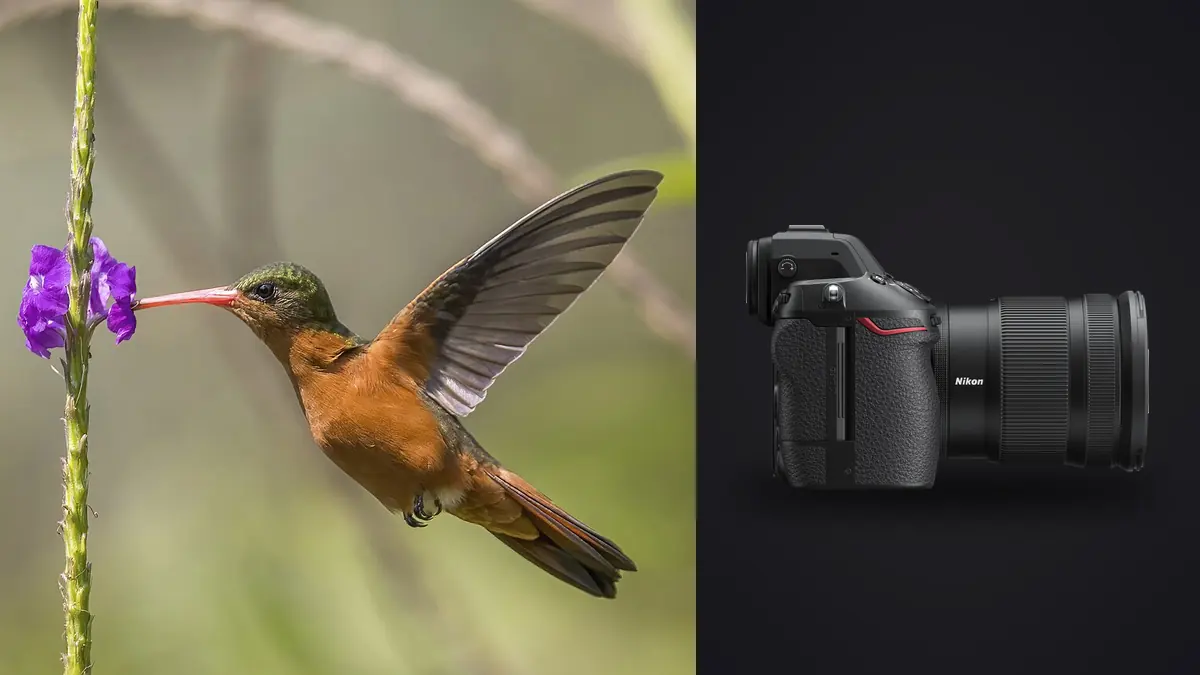
I spent most of last spring parked at the edge of a reservoir waiting for ospreys to stoop, and the thing that finally sold me on the Nikon Z8 for this kind of work wasn't the resolution or the size of it in the hand. It was the moment a bird dropped out of a hover twenty feet from where I'd guessed it would, and the camera just kept the box locked on it through the splash and the climb-out with a fish, without me touching a single AF setting mid-sequence. That doesn't happen by accident. It happens because you've spent time before the trip getting the body configured for erratic, fast, low-contrast subjects against skies that fool most autofocus systems.
This isn't a spec-sheet rundown. Nikon's own pages cover the megapixel count and the shutter speed range well enough. What I want to get into is what actually changes when you point this body at a bird that's moving in three dimensions at speed, because that's a different problem than tracking a runner on a track or a car on a straight.
What the Z8 actually gets right for this
The stacked sensor is the whole story here, more than any single menu setting. Because there's no mechanical shutter to slap up and down, there's no viewfinder blackout between frames, which sounds like a minor convenience until you're trying to follow a swift changing direction four times a second. With a DSLR or an older mirrorless body, you lose the bird for a fraction of a second on every frame and your brain has to reconstruct its position. On the Z8 you watch continuous motion the entire time you're holding the shutter, and that changes how well you can pan with something unpredictable.
The subject-detection system is the other half. Nikon's animal-detection mode (the same engine that handles dogs and cats on the ground) picks up birds well enough at moderate distance, and it's noticeably better at finding a bird's head and locking there than earlier Nikon bodies were. Where it struggles is small birds far off against a busy background of branches or reeds; the system will sometimes grab a twig instead. That's not a knock on the camera so much as a reminder that subject detection is a tool, not a replacement for choosing your AF area deliberately.
Setting up autofocus for erratic flight
3D-tracking versus wide-area with detection on
For predictable flight lines, a heron working a shoreline, gulls riding a headwind, I leave the camera in wide-area AF with animal detection enabled and let it find the bird on its own. For anything that changes direction hard (terns diving, swallows hawking insects low over water) I switch to 3D-tracking and place the initial point on the bird myself before it commits to the maneuver. 3D-tracking on the Z8 holds onto a placed subject through direction changes better than the fully automatic wide-area mode does, because you've told it exactly what to follow rather than asking it to keep guessing.
Back-button focus, but with a twist
I run back-button AF-C the way I would on any body, but I've started using the front sub-selector to recentre the focus point mid-sequence rather than reframing with my whole arm. On a 500mm-plus effective focal length, physically panning to recentre a point costs you smoothness. A thumb nudge on the joystick doesn't.
Where I've been burned
Full-time AF with eye detection sounds ideal until the bird banks and you're suddenly looking at its back, at which point the system sometimes drifts to whatever's sharpest in frame, usually the wingtip. I've lost a handful of otherwise great sequences that way. Now I watch the AF box in the viewfinder rather than trusting it blindly, and if I see it drift I'm quick to recentre rather than hoping it corrects itself.
Drive mode, shutter speed, and the buffer question people actually care about
Everyone asks about frame rate before they ask about anything else, so let's deal with it. The Z8 shoots full-resolution 14-bit raw at up to 20fps, and the high-speed C30/C120 modes push higher frame rates using a smaller file (12-bit, and a crop at the top end) with pre-release capture that starts buffering up to roughly a second before you fully press the shutter. That pre-release feature has saved me more good launch shots than any AF setting, because a bird's takeoff is the one moment in BIF work where your own reaction time is the limiting factor, not the camera's.
The buffer itself, with a fast CFexpress Type B card, is deep enough that I genuinely stopped thinking about it. In three seasons I've filled it exactly twice, both times holding the shutter down through an entire prolonged dogfight between two ospreys over a fish. For a normal five-to-eight frame burst on a single pass, you will not hit the ceiling.
| Scenario | AF area mode | Drive setting | Shutter speed | Notes |
|---|---|---|---|---|
| Raptor soaring against open sky | Wide-area (Animal detect) | 20fps H+ | 1/2000 | High contrast, detection rarely loses it; slower shutter is fine since motion across frame is gradual |
| Small songbird against foliage | 3D-tracking, manual point | 20fps H+ | 1/3200 | Detection grabs branches; place the point yourself and expect a lower keeper rate |
| Bird launching from a perch | 3D-tracking | C30 with pre-release | 1/2500 | Pre-release capture is the difference between catching the launch and missing it entirely |
| Diving tern or kingfisher | 3D-tracking, manual point | C30 | 1/4000 | Direction changes too fast for automatic detection to keep up reliably |
| Golden-hour low light BIF | Wide-area (Animal detect) | 20fps H+ | 1/1600, ISO floating to 6400+ | Detection accuracy drops as light falls; 20fps raw over C30 for cleaner files to push in post |
Lens pairing that actually holds up
I've run the Z8 with three different long glass options and they behave differently enough that it's worth being specific. The 100-400mm S is the one that comes off the shoulder easiest for hand-holding on a moving boat or while walking a trail, and it autofocuses fast enough that I don't feel like I'm giving anything up against the primes for most flight work. The 800mm f/6.3 PF is a different animal: extraordinary reach for perched birds and distant raptors, but at that focal length your margin for panning error shrinks to almost nothing, and I wouldn't recommend it as a first BIF lens for anyone who hasn't already put in time tracking birds at shorter focal lengths. The 180-600mm sits in between and has become my default for a full day out, because the versatility to go from a perched kingfisher at 600mm to a wide flock shot at 180mm without a lens change matters more in practice than I expected it to.
Whatever you pair the body with, shoot handheld where you can rather than on a gimbal head for erratic subjects. A gimbal is wonderful for a soaring eagle tracing slow circles. It's a liability for a swallow.
Field craft the camera can't fix for you
None of the above matters if you're set up wrong relative to the light and the bird's likely flight path, and this is the part that took me longer to learn than any menu setting. Shoot with the sun behind you or at worst side-on; backlit birds against a bright sky force the meter and the sensor's dynamic range into a fight you'll lose in post. Watch the wind, not the bird, when you're waiting near a perch, because most birds take off and land into the wind, which tells you which direction the flight path will run before the bird moves at all.
I also stopped trying to frame tight from the first frame. I start a burst slightly loose and let the animal-detection system find the subject, then trust the sensor's resolution to let me crop in post rather than trying to nail a tight frame on a subject accelerating unpredictably. That one habit change did more for my keeper rate than any AF customization did.
The part nobody warns you about: what happens after the shoot
A good afternoon on the reservoir with the buffer running at 20fps produces somewhere between two and four thousand frames, most of them near-duplicates of a bird mid-wingbeat with one frame in twenty actually sharp on the eye. Going through that manually at full resolution, frame by frame, is a miserable way to spend an evening, and it's the reason a lot of people with excellent gear never actually finish editing their best sequences.
This is where I've leaned on imagic for the last several months. It runs entirely on the machine, no upload queue, which matters when I'm processing a day's shoot from a cabin with no real signal. The sharpness scoring looks at actual focus data rather than just exposure or composition guesses, which is exactly what a BIF burst needs, since the difference between a keeper and a reject in a wingbeat sequence usually comes down to which single frame has the eye critically sharp. It also clusters the burst sequences together so I'm not scrolling past nine hundred near-identical frames of the same pass to find the one with the wings in the right position; I can look at a cluster, pick the best two or three, and move on.
The other piece I didn't expect to use as much as I do is the apply_my_style preset. I trained it on a batch of my own edited raptor shots from earlier in the season, the contrast curve and color balance I actually kept using across dozens of files by hand, and now new bursts come in already close to how I'd have graded them myself. It's not doing the editing for me so much as skipping the fifteen minutes I used to spend re-deriving the same look on every new session. If you're trying to get through a genuinely large volume of flight sequences without losing a weekend to it, that combination of local scoring and a personal preset is worth reading up on; there's a longer breakdown of how the culling side works at how AI photo culling works if you want the mechanics.
For anyone still doing this the old way, dragging every frame into a folder and squinting at thumbnails, it's worth comparing how much of a shoot day actually goes to editing versus sorting. Most of the workflow advice out there focuses on the shoot itself; there's a good general rundown on the sorting side at 10 tips for a faster photo workflow that applies whether you're shooting birds or anything else with a high burst count.
Mistakes worth skipping
I over-relied on full auto-area AF with detection for my first month with the camera and lost more sequences than I'd like to admit to focus locking onto the nearest branch instead of the bird. I also shot everything at maximum frame rate out of habit, which just meant more frames to sort later without actually improving my hit rate; on slower, more predictable subjects like a heron gliding a straight line, dropping to 10fps gives you plenty of coverage and a much smaller pile to go through that evening. And I underestimated how much a monopod helps even with a relatively light lens like the 100-400mm; my arms held up fine for twenty minutes and then my hit rate fell off a cliff for the last hour of a session, which is exactly when the light gets good.
Frequently Asked Questions
How many raw frames can the Z8 actually hold in a single burst?
With a fast CFexpress Type B card and full-resolution 14-bit raw at 20fps, you're looking at well over a hundred frames before anything slows down in practice, and realistically most BIF passes are five to fifteen frames long. I've only hit a hard buffer ceiling twice in three seasons, both during unusually long continuous sequences well past what a single flight pass would need.
Is the C30 or C120 high-speed mode worth using over standard 20fps raw?
For the pre-release capture feature alone, yes, particularly for launches and landings where the moment happens faster than you can react. For a bird already in level flight that you're tracking smoothly, I'd rather have the full raw file at 20fps than the reduced-bit-depth capture at higher frame rates, since I'd rather push a slightly smaller number of higher-quality files in post.
Does animal-detection AF track a bird's eye reliably at long range?
At moderate distance against clean backgrounds, it's genuinely good, noticeably better than what Nikon had before this generation of stacked sensor. Past a certain distance, or against a cluttered background like reeds or branches, it starts grabbing the nearest high-contrast edge instead, which is why I still place the AF point manually for small or distant subjects rather than trusting full auto-area detection.
What's the fastest way to get through a few thousand flight frames afterward without losing a whole evening?
Cull on focus first, not composition. Group the near-identical frames from each burst together so you're comparing five real candidates instead of ninety near-duplicates, and only then start thinking about which wing position or head angle looks best. That's the workflow imagic's local sharpness scoring and burst clustering are built around, and it's the single biggest time saver I've found for high-volume flight shooting specifically.