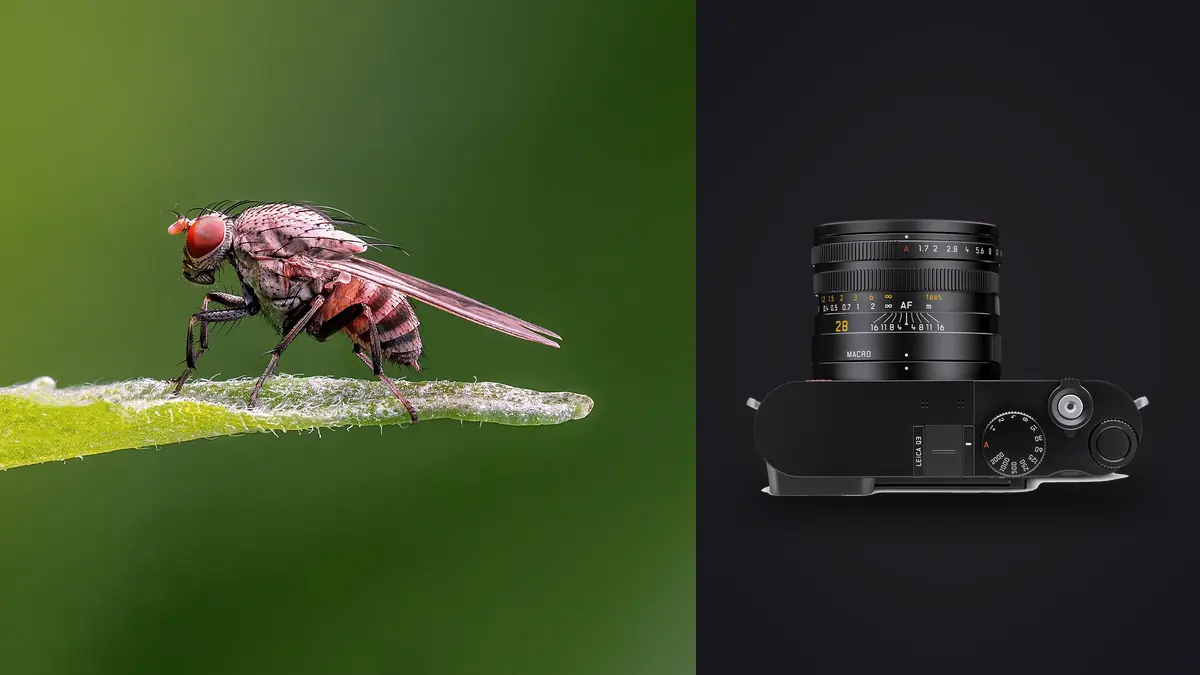
I did not buy a Leica Q3 to photograph insects. I bought it as a walk-around camera for street work and everyday shooting, and the macro switch on the focus ring sat unused for the better part of a year. It was a slow Tuesday at a botanical garden outside Munich, waiting for better light on a building I was scouting, that I finally twisted that collar out of curiosity and pointed the lens at a hoverfly working a coneflower. What came out of that afternoon is most of what follows here: not a lab test, but a season of actually trying to make this fixed 28mm camera do a job it was never really designed for.
A 28mm fixed lens is a strange starting point for bugs
Most macro work happens on 90mm to 105mm lenses for a reason: working distance. You want the front element far enough from a bee or a jumping spider that your shadow, your breath, and the lens barrel itself do not send it flying before the shutter fires. The Q3's Summilux 28mm ASPH lens gives you none of that flattery. Its macro range brings the closest focus distance down to roughly 17cm from the sensor plane, which in practice puts the front of the lens hood something like 6 to 8cm from the subject. That is close. Uncomfortably close for anything that startles easily.
What the Q3 does have going for it is the 60-megapixel sensor. Because the file is enormous, you can shoot a bit wider than you'd like and crop hard in post without the image falling apart the way an 18MP compact's file would. That single fact changes how I approach the whole exercise: instead of fighting for true 1:1 magnification, I let the sensor do some of the magnifying after the fact.
What actually happens when you twist the macro collar
The Q3's focus ring has two zones separated by a small tab you push to unlock. Standard range runs from about 0.3m to infinity. Push past that stop and you're in macro, which recalculates the focus scale down to 0.17m. Leica lists the reproduction ratio at roughly 1:3.4 in that range, so you are nowhere near the 1:1 life-size magnification a true macro lens delivers. A ladybird fills maybe a fifth of the frame width at closest focus, not the two-thirds a dedicated 100mm macro would give you at its own closest distance.
The switch itself is stiff by design, so it will not creep during a shoot, but that stiffness means you commit to macro mode before you start stalking a subject rather than adjusting on the fly. I've missed shots fumbling for the tab while a dragonfly held a perfect pose for three seconds and then didn't.
Framing distance by subject, and why it matters
Different insects tolerate different approach distances, and that determines whether the Q3's short reach is workable or a dealbreaker. Here's roughly what I've found holds true across a season of trying.
| Subject | Realistic approach distance | Q3 macro mode result | Better tool for the job |
|---|---|---|---|
| Garden snails, slow beetles | 5-10cm | Workable, good detail on shell texture | Q3 is fine as-is |
| Bumblebees on flowers | 8-15cm | Usable if you approach from the side, not from above | Q3 is fine with patience |
| Dragonflies perched | 15-30cm before flush | Marginal, subject often fills under a third of the frame | 90mm macro lens, or the Q3's 90mm digital crop |
| Jumping spiders | 20-40cm before they bolt | Too far for true macro detail | Dedicated macro lens with extension tubes |
| Butterflies feeding | 10-20cm if wind is calm | Good wing scale detail when it works | Q3 is fine, wind is the real enemy |
The pattern that emerges: anything that lets you get inside 15cm without spooking is genuinely usable on the Q3. Anything more cautious than that, and you're better served either cropping hard from the 90mm digital mode or accepting that this camera is not going to give you a dragonfly's compound eye filling the frame the way a rented 100mm macro would.
Depth of field gets brutal at these distances
This is the part nobody mentions until they've wasted a memory card finding out. At 17cm and f/1.7, your in-focus zone on an insect is measured in single millimeters, sometimes less across an antenna. Stopping down to f/8 or f/11 helps, but diffraction on that 60MP sensor starts softening detail noticeably past f/11, and by f/16 you're trading focus depth for resolution loss that mostly cancels out the benefit. My working aperture for anything with legs and antennae ended up being f/8, occasionally f/9, accepting that a bee's far wing or hind legs will drop out of focus while the eyes and thorax stay sharp.
The Q3 has no in-camera focus stacking, which a lot of purpose-built macro setups now include. If you want a stacked, front-to-back sharp insect image, you're doing it manually: multiple frames at slightly different focus points, merged later in software that supports stacking. I do this occasionally for stationary subjects like a resting moth, never for anything mobile, because by frame four the moth has usually shifted its antenna and the stack falls apart.
Handheld, in wind, without a ring light
I don't carry a ring flash or diffuser rig for this. The Q3 wasn't bought as a macro system and I'm not going to build one around it. That means natural light only, which works well in early morning when insects are sluggish from the cold and hold still longer, and works badly by midday when the light goes harsh and the bugs get skittish from the heat.
Wind is the bigger enemy than light, honestly. A coneflower swaying two centimeters in a breeze moves your subject out of that razor-thin focus plane faster than you can react. I shoot in bursts of four or five frames rather than single shots specifically because of this: the flower sways back through the focus plane on its own rhythm, and one frame out of the burst usually lands sharp even when the first two don't. That habit produces a lot of near-duplicate frames by the end of a session, which is a sorting problem I've stopped trying to solve by eye. More on that below.
The 90mm crop mode as a stand-in for extra reach
Because the Q3's sensor is 60 megapixels, the in-camera crop modes that simulate 35mm, 50mm, 75mm, and 90mm framing aren't just a viewfinder overlay, they output a genuinely cropped, full-resolution-within-that-crop JPEG (and the RAW file still holds the full sensor data if you want to recompose later). For a dragonfly that won't tolerate anything closer than 25cm, switching to the 90mm crop and standing further back gets you a usable frame without risking flushing it. You lose resolution, the 90mm crop nets you around 19 megapixels instead of 60, but 19 megapixels of a sharp dragonfly beats 60 megapixels of an empty perch where the dragonfly used to be.
This is not a substitute for real magnification. It's a substitute for walking closer when walking closer isn't an option. Worth knowing the difference before you rely on it.
Sorting a macro insect session afterward
A single hour in a garden with the burst habit described above produces somewhere between 400 and 700 frames, most of them near-duplicates of the same three or four poses with the focus point drifting a few millimeters between them. Reviewing that by eye, zooming into each frame at 100% to check whether the compound eyes landed sharp, is the part of macro work nobody enjoys and the part I used to put off for days.
I run the card through imagic before I touch anything else now. Its sharpness scoring runs locally on the machine, no upload, which matters when I'm doing this from a laptop at a campsite with no signal, and it's blunt enough to tell me which frame in a burst actually has the eye in focus rather than the wing tip, which is the single detail that decides whether an insect macro shot is worth keeping. The burst and duplicate clustering groups those four-or-five-frame runs together automatically, so instead of scrolling through 500 nearly identical thumbnails I'm looking at maybe 90 distinct clusters and picking the sharpest from each. It's not doing anything I couldn't do myself with a loupe and patience, it's just doing it in the time it takes to make coffee instead of an evening. There's a decent explanation of the general mechanics at how AI photo culling works if that's of interest.
The other habit that's saved time is imagic's apply_my_style feature. I fed it a batch of insect macro shots I'd graded by hand, mostly pulling down highlight clipping on shiny beetle shells and warming the greens slightly, and it picked up on that pattern well enough to apply a reasonable starting point to a new batch automatically. It's not perfect on every frame, backlit shots especially still need manual correction, but it cuts the baseline editing pass down considerably on a day with hundreds of similar-looking frames. If you're trying to tighten up a workflow like this generally, not just for insects, 10 tips for a faster photo workflow covers a lot of the same ground.
Comparing the Q3 against what a dedicated macro setup actually gets you
| Leica Q3 macro mode | Dedicated 100mm f/2.8 macro lens | Q3 with clip-on diopter | |
|---|---|---|---|
| Max magnification | ~1:3.4 | 1:1 (life-size) | Roughly 1:1.5 to 1:2, diopter-dependent |
| Working distance at max magnification | ~6-8cm from lens hood | 10-15cm | ~4-5cm, even tighter |
| Autofocus on small moving subjects | Decent, hunts occasionally at f/1.7 | Fast on modern bodies, purpose-built | Manual focus recommended, AF struggles |
| Extra gear required | None, built into the lens | Separate lens, extra weight and cost | One small screw-on element |
| Best suited to | Tolerant subjects, travel-light days | Serious insect and product macro work | Occasional close-ups without buying a lens |
If insect macro were the main reason I shot, I'd own a 100mm macro lens and not pretend otherwise. What the Q3 gives you is a genuinely usable secondary capability bolted onto a camera you're already carrying for everything else, which is a different value proposition than a dedicated macro rig and worth judging on those terms rather than against a system built for one job.
A few habits that made the biggest difference
Shoot from the side, not from above. Insects seem to register an overhead shadow as a predator far more readily than something approaching at eye level, and side approaches also happen to look better compositionally against a blurred background instead of a flattened top-down view.
Pre-focus and rock forward instead of relying on autofocus to nail it at 17cm. The lens will hunt at that distance more than it will out on a street scene, and by the time it locks, a bee has usually moved to the next flower. I set the ring to roughly the right macro distance, frame loosely, and lean my whole body forward a centimeter at a time until the eye of the subject snaps into the thin focus band, firing a burst as it does.
Shoot early. Insects are noticeably calmer and slower before the air warms past around 18°C. Some of my sharpest frames from this year came from a 7am session when a bee visibly could not fly fast enough to leave the flower I was photographing.
Frequently Asked Questions
Does the Leica Q3's macro mode need an add-on lens to work?
No. The macro range is built into the Summilux 28mm ASPH lens itself and activated by pushing the focus ring past its normal stop. You don't need extension tubes, a diopter, or any accessory to get to the 0.17m closest focus. What you don't get is 1:1 magnification, so if true life-size reproduction matters to you, an add-on diopter or a different lens system is the honest answer.
Is the Q3 fast enough to autofocus on a moving insect?
It's acceptable, not exceptional, for this specific use. Contrast-based hunting becomes more noticeable at macro distances than it is in normal shooting, especially wide open. For anything that's actually crawling or flying rather than perched still, I get better hit rates pre-focusing manually and moving my body to find focus than trusting continuous autofocus to track it.
How much detail do you actually lose compared to a real macro lens?
A meaningful amount, mostly in magnification rather than sharpness. The lens itself resolves plenty of fine detail, and the sensor has more resolution than most dedicated macro bodies. What you can't manufacture is the reproduction ratio: a 100mm macro lens at 1:1 fills the frame with a bee's head in a way the Q3's 1:3.4 simply cannot match without heavy cropping afterward.
Is 60 megapixels enough to crop into insect shots after the fact?
For moderate crops, yes, comfortably. Cropping a 60MP file down to something equivalent to an 18-24MP output still leaves plenty of resolution for web use or a reasonably sized print. Push much past a 50 percent crop on a subject that was already small in frame and you start seeing softness and noise in shadow areas, so it's a useful safety net rather than a replacement for getting the framing closer to right in camera.
None of this makes the Leica Q3 a macro camera in the way a dedicated system is one. It makes it a camera that can do respectable close-up work on tolerant, patient subjects without asking you to carry a second lens, provided you accept its limits on magnification and working distance going in. For the days when insects are the whole point of going out, I still reach for glass built specifically for that job. For the days when a hoverfly happens to land in frame while I'm shooting something else entirely, the macro collar earns its place on the lens.