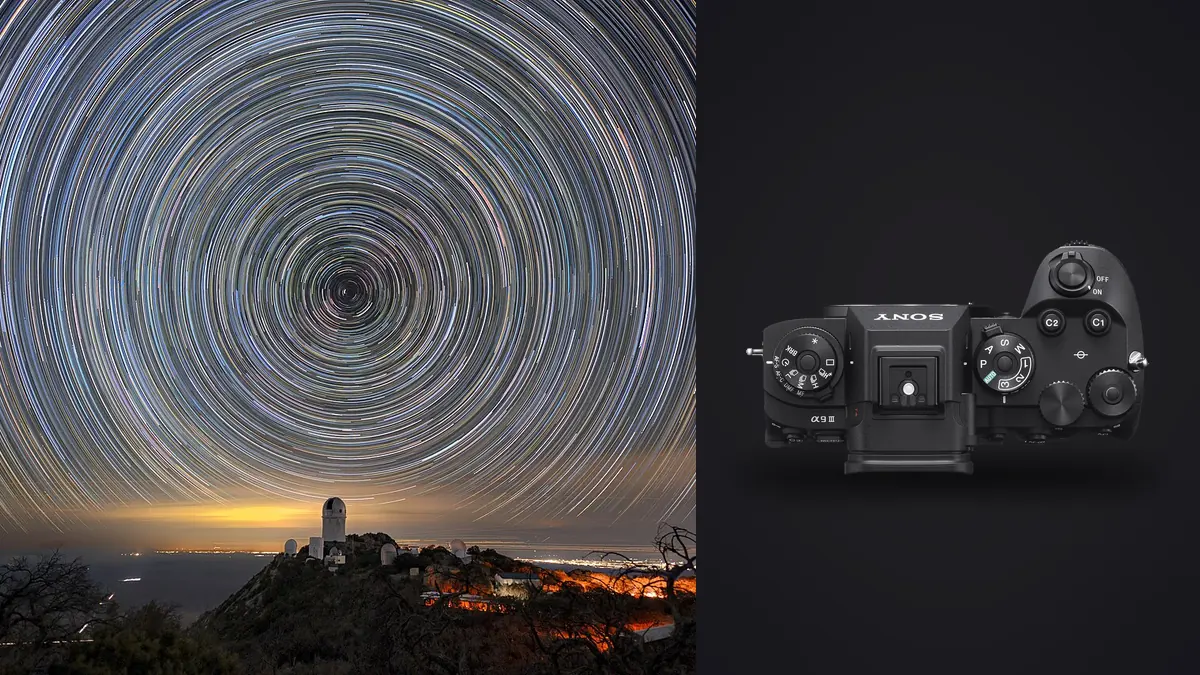
I bought the Sony A9 III for fast sports like lacrosse, not for the sky. It sat in the bag for four months doing exactly what it was designed for: freezing fast-moving athletes with a global shutter and no blackout. Then another trip fell through in late June, I already had three nights blocked off at Great Basin National Park in Nevada, one of the darkest Bortle 2 sites reachable by paved road in the lower 48, and I decided to bring the A9 III instead of my usual a7S III body just to see what would happen. This is what happened, with the settings, the failures, and the actual stacked results.
The global shutter isn't the story you'd expect
Everyone who talks about the A9 III's stacked global shutter sensor focuses on rolling shutter elimination, which matters for panning shots and electronic flash sync, not for a camera bolted to a tripod pointed at Polaris. For star stacking, the sensor's readout architecture matters for a completely different reason: noise floor. Global shutter sensors need extra circuitry on every pixel to hold the charge simultaneously across the whole array, and that circuitry eats into the photosensitive area and adds read noise compared to a conventional stacked sensor of the same generation. Sony's own numbers show it: the A9 III's native ISO floor is 250, not 100, because anything lower doesn't clear the sensor's noise floor cleanly. That matters a lot for astro. A 24.6-megapixel full-frame sensor with a 250 base ISO is going to show more shadow noise per pixel at ISO 6400 than the 12.1-megapixel a7S III, whose enormous 8.4-micron photosites were built specifically for low-light gathering. I shot identical compositions on both bodies back to back at Great Basin, same lens, same exposure, same ISO, and the a7S III files needed noticeably less noise reduction to reach a clean 60-frame stack. The A9 III wasn't bad. It just isn't the tool Sony built for this.
Where the extra resolution actually helps
The flip side is that 24.6 megapixels gives you real cropping room on Milky Way core detail that the a7S III's 12.1 megapixels can't match, and after stacking sixty frames the noise gap closes substantially because stacking software averages out random noise regardless of how loud each individual frame is. If you're printing large or you need to crop into the core for a composite, the A9 III's file has more to work with once the stack is assembled. Single-frame astro landscape work is where the a7S III still wins outright.
Settings I landed on after burning through the first night
My first night was mostly wasted figuring out the interval shooting function's quirks on this body. Here's what I ran for nights two and three, using a Sony 24mm f/1.4 GM on a fixed tripod, no star tracker:
- Shutter: 15 seconds (I tested 20 seconds at 24mm and got visible elongation on Vega at 100% crop, so I pulled back)
- Aperture: f/2.0, stopped down one third from wide open to tame coma in the corners
- ISO: 3200 for the stack frames, after testing showed ISO 6400 clipped more highlights in the core than it was worth
- Long exposure NR: off. With it on, faint stars under magnitude 5 were visibly softer in a way that looked like more than ordinary noise reduction smoothing, and I didn't want to risk losing real data I couldn't get back. I'd rather deal with a handful of hot pixels in post than lose actual stars.
- Drive mode: Interval Shoot Function, 65 frames, 1-second interval between exposures, mechanical shutter disabled in favor of the electronic shutter (no benefit to mechanical here and it saves shutter cycles)
- Focus: manual, magnified live view on the brightest star in frame, then gaffer tape over the focus ring
Battery life was the other lesson. Great Basin in June still dropped to around 4°C overnight, and the NP-FZ100 in the A9 III lost noticeably more capacity per hour than it does shooting a normal event in mild weather. I got through about 90 minutes of continuous interval shooting plus screen-on framing before the first battery tapped out. Bring three, not two, if you're doing a full stack sequence somewhere cold.
Comparing bodies for this specific job
I don't think a spec sheet from Sony's marketing page tells you what you need to know here, so this is built from actually shooting stacks on three of these four bodies (the a7R V numbers are from a friend who ran the same site the following month with matching settings).
| Camera | Resolution | Native ISO range | Approx. pixel pitch | Stack-relevant strength | Stack-relevant weakness |
|---|---|---|---|---|---|
| Sony A9 III | 24.6MP | 250-25600 | ~4.4 micron | Deep buffer, fast interval cycling, good detail after stacking | Highest per-frame noise floor of this group, base ISO 250 limits headroom |
| Sony a7S III | 12.1MP | 80-102400 | ~8.4 micron | Cleanest single frames, least post-processing needed per stack | Low resolution limits cropping and large prints |
| Sony a7 IV | 33MP | 100-51200 | ~5.0 micron | Balanced resolution and noise, cheapest of the four | Middling dynamic range compared to the others at high ISO |
| Sony a7R V | 61MP | 100-32000 | ~3.76 micron | Extreme resolution for huge prints or heavy crops | Smallest pixels of the group, noisiest per-pixel before stacking |
The a7 IV, which nobody thinks of as an astro camera either, actually turned out to be the sweet spot on paper for anyone buying specifically for this. But that's a different article. This one is about making the A9 III work, since a lot of sports and wildlife shooters who already own one are going to want to point it at the sky occasionally rather than buy a second body.
Building the stack
I shot the sky frames and the foreground separately, which is the standard approach for anyone not using a star tracker. Sixty-five 15-second frames of the sky at ISO 3200, then a single 4-minute foreground exposure at ISO 800 with a headlamp doing a slow light-paint pass across the boulder field in the foreground, blended in afterward. For calibration frames I shot ten dark frames immediately after the light frames, same settings, lens cap on, sensor still warm from the sequence (temperature-matched darks matter more than people give them credit for). I skipped flat frames since I wasn't seeing meaningful vignetting at f/2.0 on this lens. Stacking itself went through DeepSkyStacker, which handles star alignment across the 65 frames and averages out the random noise. Sixty-five frames sounds like a lot until you're staring at the folder afterward: that's 65 nearly identical dark frames of the same patch of sky, all needing to get from the memory card into the stacking software without accidentally including a frame where a plane crossed the frame, or one where trailing wind shook the tripod. On the third night a gust caught the tripod legs on frame 40, and having something to quickly flag which frames actually held sharp star points versus which one had a visible wobble saved me from feeding a soft frame into the stack and dragging the whole average down. That's actually where I've started using imagic's local sharpness scoring on these sequences before they ever touch stacking software. It runs the focus and sharpness analysis entirely on my laptop, no upload, which matters more than it sounds like it should when you're at a site with no cell signal for three days straight and you don't want to be waiting on a cloud service that isn't going to connect anyway. It flagged the wind-shake frame from night three in about the time it took me to pour coffee, and I pulled it before it went into the stack. For anyone unfamiliar with how that kind of automated culling actually separates a sharp frame from a soft one, this piece on how AI photo culling works covers the mechanics in more depth than I will here.
The part nobody warns you about: file management
Three nights of interval sequences plus test frames plus the a7S III comparison shots left me with just over 1,400 raw files by the time I got home, and a huge fraction of them were visually indistinguishable bursts of the same 20-second patch of sky, shot minutes apart as I adjusted framing. Sorting that by eye is a bad use of an evening. I ran imagic's duplicate and burst clustering over the folder before doing anything else, which grouped the near-identical interval sequences together so I could pick the cleanest handful from each group instead of scrolling past 65 copies of the same star field one at a time. It's not a glamorous feature, but it's the difference between an hour of culling and an evening of it, and it ties into a broader point about night photography workflows that I go into in this rundown on speeding up a photo workflow if file volume like this is a recurring problem for you.
Where the A9 III genuinely struggles
I want to be specific about the failure points instead of just saying "it's not built for this," because some of them are fixable in the field and some aren't. The base ISO of 250 is the one you can't work around. On a body with a true ISO 100 floor, you get more highlight headroom before the brightest stars start clipping, and you can push exposure in post with less penalty. At ISO 250 minimum, every stack frame starts a little hotter than I'd like, and I found myself pulling highlights down in post more aggressively on the A9 III files than I ever do on the a7S III's. Rolling shutter elimination, the entire reason this sensor exists, buys you nothing on a tripod. You're not panning, there's no distortion to correct, and the deep buffer that lets it shoot 120 frames per second in sports mode is wasted when you're deliberately spacing exposures a second apart. You're carrying (and paying for) speed capability this genre never uses. And the body runs warm during long interval sequences in a way my a7S III doesn't, which raises sensor temperature and with it, thermal noise, over a long stacking run. It wasn't dramatic at Great Basin's cool overnight temperatures, but I'd be more cautious using this body for astro in a warm-climate summer shoot.
Where it earned its keep
Two things surprised me in the A9 III's favor. First, autofocus assist for framing: even in near-total darkness, the AI-driven subject recognition occasionally locked onto bright stars well enough to give me a usable focus starting point before I switched to manual fine-tuning, which isn't something older Sony bodies did reliably. Second, the articulating screen made composing straight overhead at the zenith, which is where a lot of the best Milky Way core framing happens in early summer, far less of a neck-craning exercise than the a7S III's more limited tilt screen. After processing, I ran my usual night sky edit as an imagic apply_my_style preset built from a set of astro edits I'd trained it on from a previous trip, and it carried the same color balance and contrast curve across both the A9 III and a7S III stacks without me manually matching grades between two different camera profiles. That consistency mattered more than I expected once I was comparing final images side by side.
Frequently Asked Questions
Does the Sony A9 III's global shutter cause any visible problems in star field images?
Not directly, no smearing or distortion artifacts show up from the global shutter design itself in stationary tripod work. The relevant downside is indirect: the extra per-pixel circuitry global shutter sensors require raises the noise floor and pushes the native ISO minimum to 250, which means slightly noisier individual frames than a conventional stacked sensor at the same ISO, not any shutter-specific artifact in the stars.
How many frames do I actually need for a clean Milky Way stack with this camera?
I settled on 60 to 65 frames at 15 seconds each as a workable minimum given the A9 III's noise floor. Fewer than 40 and the stack still showed visible noise in the darker parts of the frame after processing. If you're working with a cleaner low-light body like the a7S III, you can often get away with fewer frames for a similar result.
Is the A9 III worth buying specifically for astrophotography?
No. If astro landscape work is your primary reason for a purchase, the a7S III's low-light pixel design or even the a7 IV's balance of resolution and noise will serve you better per dollar. The A9 III makes sense here only if you already own one for sports, wildlife, or event work and want to use the same body occasionally under the stars rather than buy a dedicated second camera.
Should I turn off long exposure noise reduction for star stacking?
I did, and I'd recommend testing it on your own copy before committing to a long shoot. With long exposure NR enabled, I saw faint stars near the edge of visibility soften more than felt like ordinary noise smoothing, which risks losing real data. Shooting with it off means dealing with a few hot pixels, which are easy to remove with dark frame calibration or basic spot healing, a trade I'd rather make than lose stars I can't get back.