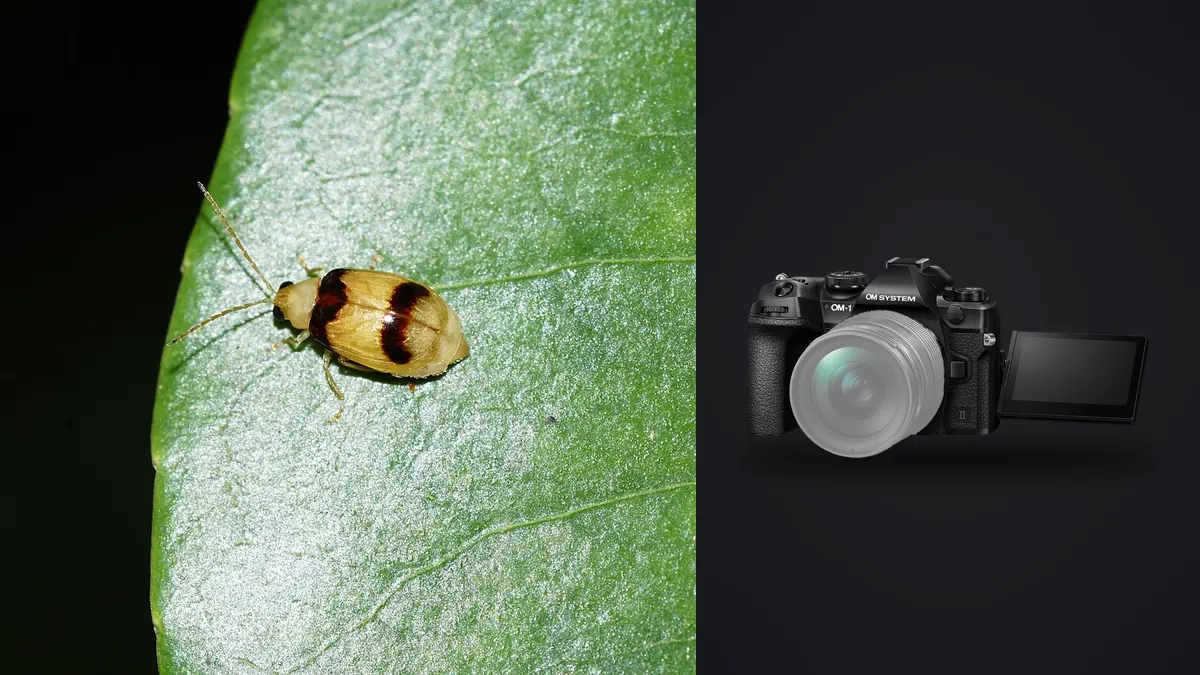
I spent four mornings this spring on my knees in wet grass, an OM System OM-1 Mark II braced on a beanbag, trying to get a clean frame of a leafcutter bee that kept ducking into a hollow fence post before I could nail focus. That's the kind of shoot where a camera's spec sheet stops mattering and its actual behavior in your hands starts to matter a great deal. The OM-1 Mark II gets recommended constantly for insect macro, usually with a short list of buzzwords attached (focus stacking, Pro Capture, weather sealing) and not much explanation of what those features actually do for you when a jumping spider decides it's done posing.
The Sensor Size Argument, and Why It's Not the Whole Story
Micro Four Thirds gets dismissed by full-frame shooters as a compromise, and for a lot of genres that's a fair criticism. For insect macro specifically, the smaller sensor buys you something real: at any given magnification and working distance, a Four Thirds sensor crops into a tighter slice of the scene than a full-frame sensor would, which means your subject occupies more of the frame without you having to close the physical distance. For a mantis that bolts the second your shadow crosses it, that extra working distance is worth more than a stop of dynamic range.
What the smaller sensor does not do is increase optical magnification. A lens rated 1:1 is 1:1 regardless of what's behind it; magnification is a property of the glass, not the sensor. Where people get tripped up is confusing "more reach for a given framing" with "more magnification," and those are different things. The real tradeoff on Four Thirds is diffraction. Because the pixels are smaller, softening from diffraction becomes visible around f/8 to f/11, noticeably earlier than on a full-frame body. In practice this matters less than it sounds, because macro shooters on any format are usually stopping down for depth of field anyway, and the smaller sensor needs less absolute aperture to hit an equivalent depth of field. The two effects roughly cancel out, but it took me a full season of comparing test shots against a friend's full-frame macro setup before I actually believed that instead of just repeating it.
Autofocus for Bugs: No Dedicated Insect Mode, and That's Fine
The OM-1 Mark II's subject detection AI recognizes birds, mammals, cars, motorcycles, trains, and planes. Insects are conspicuously absent from that list, and I've stopped expecting a firmware update to fix it. For macro work this turns out to matter less than you'd think, because at high magnification the depth of field is often thinner than the insect itself, so subject-tracking AF across a whole compound eye or wingspan isn't useful anyway. You want a single small AF point parked exactly where you want it, usually the near eye or the leading edge of the head, and you want to nudge that point around the frame quickly.
What I actually use most of the time is small-target AF combined with back-button focus, focusing once, locking, and rocking my own body weight forward and back a few millimeters to walk the focal plane onto the target. It sounds primitive next to "AI subject detection," but it's faster and more reliable for anything smaller than a fingernail. If you're running the 90mm f/3.5 Macro PRO, the focus limiter switch is worth setting to the near range the moment you're working inside 50cm; it cuts out a huge amount of hunting when the lens would otherwise rack all the way to infinity looking for contrast.
In-Camera Focus Stacking Versus Bracketing for Software
At life-size magnification, depth of field on an insect can be a fraction of a millimeter, so single-frame shots of anything but a flat subject are mostly an exercise in choosing which body part stays sharp. The OM-1 Mark II handles this two ways. Focus stacking shoots a sequence and blends it into a single finished JPEG in-camera, up to 15 frames, with adjustable focus differential between shots. Focus bracketing shoots the same kind of sequence, up to several hundred frames, but hands you the raw files to blend yourself in software.
I use the in-camera stack for quick documentation shots I might post that day, and I use bracketing for anything I actually care about. The built-in blending algorithm does a reasonable job on hard-edged subjects but tends to leave halos or soft transitions around fine structures like antennae, leg hairs, and wing veins, exactly the detail that makes an insect photo interesting instead of just identifiable. Running the same bracket through Helicon Focus or Zerene Stacker gives noticeably cleaner results around those edges, at the cost of a workflow step you can't skip.
| Method | Max frames | Output | Edge handling on fine detail | Best for |
|---|---|---|---|---|
| In-camera focus stack | 15 | Single blended JPEG | Soft halos on hairs/antennae | Quick field checks, social posts |
| Focus bracket + Helicon Focus | Up to several hundred | Full RAW set + blended TIFF | Clean, minimal retouching needed | Prints, portfolio work |
| Focus bracket + Zerene Stacker | Up to several hundred | Full RAW set + blended TIFF | Strong on retouching individual frames | Subjects with reflective or transparent wings |
| Handheld single frame | 1 | Single RAW | N/A | Fast-moving subjects, wide-DOF compositions |
Pro Capture and the Dragonfly Problem
Dragonflies, robber flies, and most jumping spiders share a trait that ruins macro shoots: they give almost no warning before they move. By the time your eye registers the wind-up, the shutter finger is already too slow. Pro Capture solves this by continuously buffering frames the moment you half-press the shutter, then saving a chunk of frames from before the full press along with everything after it. Set it up on a perched dragonfly, half-press and hold, and when it launches you've already captured the takeoff instead of an empty patch of reed.
The catch for macro use specifically is that Pro Capture at its fastest frame rates locks focus and exposure to the first frame, which is a problem when your depth of field is a fraction of a millimeter and the subject is closing distance or changing angle. I get better keeper rates using a moderate Pro Capture rate with continuous AF enabled, accepting a slower burst in exchange for focus that's still tracking when the interesting moment happens.
Weather Sealing and the Reality of Dawn Shoots
Most of my productive macro time happens in the first ninety minutes after sunrise, when insects are still cold and sluggish and dew has pinned a lot of them in place. That also means shooting through wet grass, condensation on every surface, and occasionally actual drizzle. The OM-1 Mark II's IP53 rating isn't a marketing number I've had to think about twice; I've had the body soaked from crouching in dew-heavy meadow grass and never had a functional issue. The smaller, lighter body also matters more than people expect once you've spent an hour holding a camera at odd angles low to the ground. A full-frame macro rig with an equivalent telephoto macro lens gets heavy fast when you're contorting to get a bee's-eye-level shot; the OM-1 Mark II with the 90mm PRO stays manageable for that whole session.
Matching Glass to the Body
The body is only half the equation, and for insect work the lens choice arguably matters more than the camera it's attached to. Four options come up constantly in Micro Four Thirds macro circles, and they behave differently enough that picking the wrong one for your subject will cost you shots.
| Lens | Max magnification | Weight | Weather sealed | Best suited to |
|---|---|---|---|---|
| M.Zuiko 60mm f/2.8 Macro | 1:1 | 185g | No | Flowers, stationary subjects, tight budgets |
| M.Zuiko 90mm f/3.5 Macro IS PRO | 2:1 (4x with in-camera multiplier) | 453g | Yes | Skittish insects needing working distance |
| Laowa 50mm f/2.8 2X Macro | 2:1 | 230g | No | Very small subjects, controlled setups |
| Laowa 100mm f/2.8 2X APO Macro | 2:1 | 638g | No | Extreme close-ups with more standoff distance |
I reach for the 90mm PRO for anything that might fly off, which in practice means most of what I photograph. Its built-in image stabilization and the body's sensor-shift IS work together well enough that I can shoot handheld well below the shutter speeds I'd need on a stabilized full-frame body, which matters because a tripod is often useless when you're chasing something moving through undergrowth.
What Happens After You Get Home
A single productive morning with focus bracketing enabled leaves me with somewhere between six hundred and two thousand raw files, most of them near-duplicates from stacking sequences that only differ by which millimeter of the frame is sharp. Sorting that by eye used to eat as much time as the shoot itself. I run everything through imagic before I open a single frame in an editor, mostly because its duplicate and burst clustering groups those stacking sequences automatically instead of leaving me to scroll through forty visually identical thumbnails one at a time. On the frames where I decide not to blend a full stack and just want the single sharpest shot, the local sharpness scoring picks out the frame with the crispest eye focus faster than I can judge it myself at thumbnail size, and because it runs entirely offline, I've been able to do a first pass on a laptop with no signal at all, sitting in a car in a nature reserve parking lot before driving home. If you're working through a similar backlog problem, the breakdown at how AI photo culling works covers the mechanics in more depth than I can here.
Once the culling pass is done, I lean on imagic's apply_my_style preset for the first editing pass on insect shots specifically, because macro subjects tend to want a consistent look, controlled highlights on chitin and wing membrane, punchy but not oversaturated greens in the background. Training that preset on a batch of macro edits I'd already finished by hand meant the next few hundred images from a shoot got a consistent starting point instead of me re-deciding white balance and contrast on every single frame. Between the clustering and that preset step, a shoot that used to take most of an evening to get through now takes under an hour before I'm doing the actual creative edits. There's a broader rundown of that kind of time savings at 10 tips for a faster photo workflow if the backlog problem sounds familiar.
Frequently Asked Questions
Do I need the 90mm PRO lens, or is the 60mm macro good enough for insects?
It depends entirely on what you're photographing. The 60mm is sharp and inexpensive, but its working distance at 1:1 is short enough that most insects treat your lens hood as a threat and leave before you get the shot. The 90mm PRO's extra reach and 2x native magnification (4x with the in-camera teleconverter) make it worth the added cost and weight for anything that can fly, jump, or bite.
Is the lack of dedicated insect-detection AI actually a problem?
Less than the marketing gap suggests. At macro magnifications the depth of field is so shallow that whole-subject tracking isn't especially useful anyway; you need precision on a single point, not recognition of the whole animal. Small-target AF with back-button focus does the job.
How many frames should I shoot in a focus bracket for a typical insect?
For something roughly the size of a bee at 1:1 magnification, I usually shoot 20 to 40 frames with a moderate focus step. Smaller subjects photographed at 2x magnification, like a jumping spider's face, can need 60 or more to get clean coverage front to back.
Does Pro Capture drain the battery faster during a macro session?
Noticeably, yes. Holding a half-press for extended stretches while Pro Capture buffers frames pulls more power than normal shooting. I carry at least two spare batteries for any full morning session and treat the buffer as something to trigger deliberately rather than leave running continuously.
Is the OM-1 Mark II worth it over the original OM-1 for macro specifically?
The autofocus refinements and improved stabilization help handheld macro work more than most other genres would notice, since you're fighting both subject and camera movement simultaneously at high magnification. If you're already invested in Micro Four Thirds glass, the upgrade is worth it for macro before almost any other use case OM System markets it for.