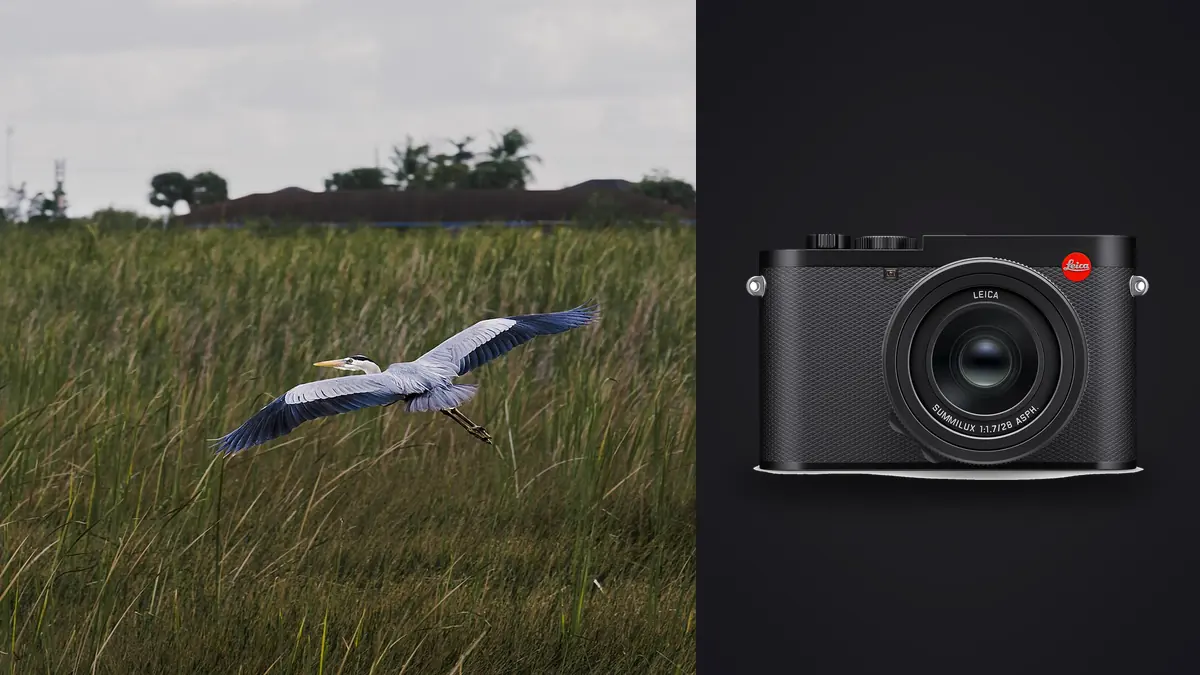
A reliable Leica Q3 wildlife and birds-in-flight photography RAW Workflow is a chain of decisions, not a preset applied after the card is full. Capture settings determine which detail survives, file organization protects the evidence, selection identifies the frames that answer the brief, and development prepares those frames for a defined destination. This guide keeps those stages connected so a correction in one stage does not create an avoidable problem in the next.
The Leica Q3 pairs a 60.3 megapixel full-frame sensor with a fixed 28mm f/1.7 lens, optical stabilization, DNG capture, and one UHS-II SD slot. It is not a substitute for a long wildlife lens. Its credible strengths are environmental wildlife, large nearby subjects at a safe distance, and occasional flight within a broad scene, not tightly framed distant birds created through extreme cropping.
Translate the assignment into file requirements
Define the result before choosing a Leica Q3 RAW setting. Record the final image count, likely crop ratios, largest output, color space, delivery format, metadata requirements, and whether the photographs must work as a sequence. For wildlife and birds-in-flight photography, also identify the visual facts that technical scoring cannot infer, such as subject identity, gesture, spatial accuracy, garment continuity, species behavior, or the order of an event. These criteria become the basis for the edit.
Define the species, behavior, habitat context, ethical distance, permitted access, output size, and location-disclosure policy. Decide whether the fixed wide view supports the assignment. A bird small enough to require a severe crop may not carry identification detail at delivery size. Plan hides, public paths, or naturally close viewpoints that do not bait, flush, crowd, or redirect wildlife for the sake of scale.
| File | Purpose | Handling rule |
|---|---|---|
| DNG original | Reversible camera evidence | Keep unchanged |
| Review derivative | Fast comparison or proofing | Label as a derivative |
| Working edit | Adjustment and version history | Keep linked to its source |
| Delivery export | Use in the approved destination | Build to a written specification |
Capture RAW files that remain editable
Use a shutter speed that matches wing or body motion and accept the ISO required to protect that choice. A short high-speed sequence can cover a predictable takeoff inside the 28mm frame, but continuous firing will not make a distant subject larger. Test electronic shutter with fast lateral movement, and favor a mode that keeps shape credible. Stop when the animal changes behavior in response to the photographer.
Use animal or general tracking when the subject is large and separated enough for detection, then keep a smaller area available for cluttered habitat. A wide scene can contain many high-contrast branches or people, so verify that focus reached the intended head or body rather than a nearer edge. For a known flight path, pre-focus on a zone and leave enough depth for small timing errors.
Make a representative test with the Leica Q3 under the actual light, then inspect the intended focus plane, subject movement, brightest color channel, darkest important texture, and frame edges at full resolution. A bright rear display can hide clipping, while a small preview can disguise motion or focus error. Stabilization can reduce camera movement, but it cannot stop a moving wildlife and birds-in-flight photography subject. Subject recognition can help acquisition, but it cannot decide which subject matters.
Assign separate jobs to lens, position, and light
The fixed 28mm lens makes position and subject choice the entire lens strategy. Use foreground and landscape to explain habitat, leave flight space, and keep the animal away from stretched frame corners. Digital crop modes can preview a tighter composition, but they do not change perspective or add captured detail. Retain the full DNG and decide the final crop after focus and output size are known.
Record a neutral reference whenever the Leica Q3 wildlife and birds-in-flight photography lighting changes materially, and leave that frame beside the photographs it describes. The reference should establish a starting point rather than erase an intentional cast. Protect important highlights with the histogram and channel warnings instead of relying on screen brightness. RAW latitude can reshape recoverable tones, but it cannot recreate texture after a channel is fully clipped.
Preserve the RAW sequence during ingest
The Q3 has one SD slot, so use tested media and make two verified copies as soon as the session ends. Separate locations and observation periods while preserving capture order. Record species uncertainty, behavior, and general location notes beside frame ranges. Remove exact coordinates from public derivatives when disclosure could increase disturbance, and do not confuse internal crop previews with separate original files.
JOB_CODE/
  PURPOSE_WILDLIFE_AND_BIRDS_IN_FLIGHT_PHOTOGRAPHY/
  01_CAMERA_ORIGINALS/
    CAMERA_CARD_001/
  02_VERIFIED_COPY/
  03_REVIEW/
  04_WORKING_EDITS/
  05_EXPORTS/
  06_DELIVERY_NOTES/
Copy each Leica Q3 wildlife and birds-in-flight photography card or storage unit as a complete, uniquely named folder. Record the expected file count, create a second independent copy, and verify both before returning media to use. Keep separate camera folders until duplicate filenames, clock offsets, and sequence boundaries are resolved. Review files and exported JPEGs should never sit where they can be mistaken for the only DNG master.
imagic supports Leica DNG for local culling and non-destructive editing. It can help compare a short Q3 sequence, but it cannot add telephoto detail, verify species, judge ethical distance, or protect sensitive location metadata without a human policy.
Cull by sequence before judging isolated frames
Group the Leica Q3 photographs by action, pose, bracket, lighting setup, location, or composition before assigning selects. Remove obvious accidents from the working view first, including unintended releases, blocked frames, unrecoverable clipping, focus on the wrong plane, and duplicates with no independent value. Use a reversible reject status rather than deleting originals. The second pass can then compare technically viable alternatives against the wildlife and birds-in-flight photography brief.
First judge whether the animal is large and detailed enough for the intended use. Then compare focus on the eye or head, wing and body position, habitat relationships, edge stretching, background intersections, and behavior. A wider frame with clear environmental meaning can be stronger than a severe crop with weak detail. Keep short behavioral progressions when sequence matters, and reject misleading or disturbed behavior.
imagic can score sharpness, exposure, closed eyes, and composition while grouping bursts and near-duplicates on the local Windows or macOS computer. In this Leica Q3 wildlife and birds-in-flight photography RAW Workflow, those results are an ordered review aid, not an editorial verdict. Privacy-sensitive files stay on the machine, and culling changes a status rather than deleting the camera original. Human review still decides meaning, consent, continuity, and intentional technical departures.
Develop the master in a stable order
Open the DNG with restrained sharpening, establish white balance from the actual environment, and protect pale feathers, water, or bright sky. Apply lens corrections before choosing a crop, then inspect the subject at intended output size rather than judging only a 100 percent view. Noise reduction should preserve foliage, fur, and feather structure. Do not use upscaling or aggressive texture to imply detail the lens did not record.
Apply broad corrections before local ones in the Leica Q3 wildlife and birds-in-flight photography set. A practical order is input profile, white balance, exposure, highlight and shadow placement, tone curve, color, lens correction, noise treatment, and capture sharpening. Revisit earlier controls after a major profile or exposure change. Judge sharpening at an appropriate magnification and inspect both a critical detail and a smooth area, since settings that clarify an edge can also turn noise or skin texture into a distraction.
Control color without erasing the scene
Wide environmental frames often include sky, foliage, water, and reflected ground color around a comparatively small subject. Balance the whole scene while keeping species color plausible. Check iridescent or saturated plumage by channel and allow real reflection to vary with angle. Avoid local saturation that makes the subject look pasted onto its habitat, and retain natural atmospheric depth between camera and animal.
Build adjustment groups from real Leica Q3 wildlife and birds-in-flight photography capture conditions rather than applying one correction to the entire job. A new room, weather state, stage act, light source, lens, or exposure method can justify a new baseline. Synchronize controls that should match, then inspect the first, middle, and last keeper in every group. Crop, aggressive recovery, local masks, and subject-specific cleanup generally need individual confirmation.
Keep brackets, bursts, and composites traceable
A Q3 flight sequence should show distinct phases within the environment, not act as raw material for a synthetic close-up. Keep adjacent frames until behavior and timing are understood, then choose the clearest relationship. Do not clone additional birds, alter wing positions, or remove habitat evidence in editorial work. Record ordinary dust cleanup separately from changes that would affect biological interpretation.
Any Leica Q3 wildlife and birds-in-flight photography composite or multi-frame result should remain traceable to all of its components. Normalize shared settings before alignment or blending, preserve unused edge area until geometry is final, and inspect seams at meaningful detail. If a frame was captured at a different time or exposure for a foreground, window, background, or moving subject, keep that distinction in the working notes and disclose it when the destination's editorial rules require disclosure.
Run quality control at image and set level
Inspect each approved Leica Q3 wildlife and birds-in-flight photography photograph at three scales. Full image view reveals composition and tonal balance, a practical output view reveals how the destination will look, and a critical detail view reveals focus, motion, noise, halos, dust, and masking defects. Then compare the set as a sequence. White point, black placement, saturation, crop logic, and sharpening should feel coherent without forcing unlike lighting conditions into an artificial match.
- Source check: confirm every edit points to the intended DNG original.
- Technical check: inspect focus, motion, clipping, noise, lens correction, and composite edges.
- Editorial check: confirm subject identity, sequence meaning, consent, and requested exclusions.
- Consistency check: compare neighboring keepers under the same capture condition.
- Output check: open a rendered file outside the editing view before delivery.
Export for the stated destination
Export only at a size the selected crop can support, with restrained output sharpening and an embedded profile. Inspect the animal, high-contrast branches, sky gradients, and corrected corners after resizing. Include species and behavior captions only at the confidence available, generalize sensitive locations, and preserve the uncropped DNG because its environmental context is often the strongest reason to use the Q3.
Set dimensions, profile, bit depth, compression, metadata, naming, and output sharpening for the Leica Q3 wildlife and birds-in-flight photography files from the delivery note. JPEG suits many web and gallery uses, while TIFF can preserve more information for a print or downstream retouching stage. Keep a full-resolution approved master when future derivatives are likely. Verify pixel dimensions and embedded profile, open representative files, and compare the delivered count with the approved selection.
The desktop photo workflow explains local processing boundaries, the single-photo editor offers a focused derivative workflow, and the Workflow & Editing collection connects this process to related photography systems. These references support the Leica Q3 plan, but the written wildlife and birds-in-flight photography brief remains the authority for the job.
Use a final RAW Workflow checklist
- Write the purpose, crop, output, sequence, and privacy requirements.
- Confirm DNG, compression, card role, focus method, and shutter behavior.
- Make a focus, motion, highlight, and color-reference test under working light.
- Keep each card or storage unit intact inside a unique camera-original folder.
- Create and verify two independent copies before reusing media.
- Group related Leica Q3 frames before comparing technical and editorial value.
- Normalize global development by real capture condition, then inspect exceptions.
- Preserve every required component of a bracket, stack, burst, or composite.
- Render to the delivery specification and inspect files outside the editor.
- Archive the originals, adjustment records, approvals, and export recipe.
Frequently asked questions
Should every Leica Q3 wildlife and birds-in-flight photography photograph be recorded as RAW?
RAW is appropriate for the Leica Q3 wildlife and birds-in-flight photography job when it needs recoverable white balance, highlight control, substantial tonal work, or a durable editing master. A JPEG-only choice can be reasonable for a controlled immediate use, but it should be tested against the actual output and kept clearly identified as the camera-rendered source.
Can automated scoring choose the final wildlife and birds-in-flight photography selection?
No. Scoring and duplicate grouping can narrow technically repetitive Leica Q3 wildlife and birds-in-flight photography files, but they do not know which moment, subject, relationship, garment, behavior, or spatial fact answers the brief. A photographer or editor must make the final editorial choice.
When is the Leica Q3 RAW Workflow complete?
The Leica Q3 wildlife and birds-in-flight photography process is complete when approved images have been rendered to specification, opened and checked, counted against the selection, delivered through a verified copy, and archived with the DNG originals and adjustment records. An edit that has not survived output verification is still unfinished.