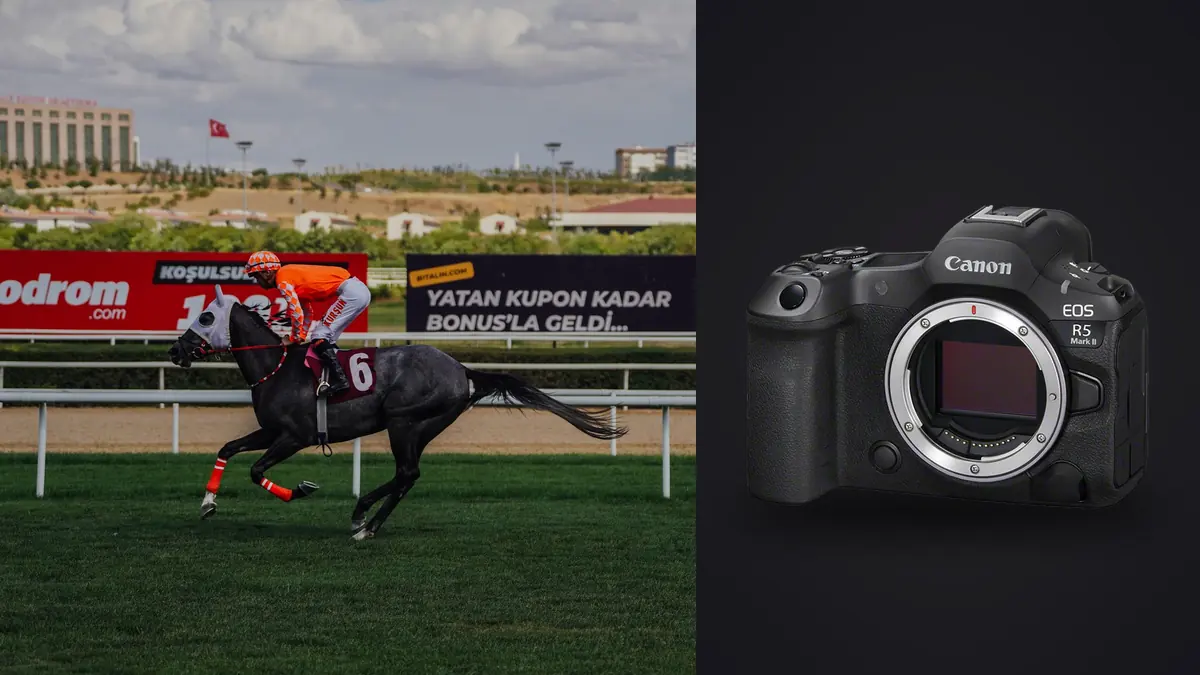
I shot my first track meet with the R5 Mark II at a regional qualifier in cold, flat morning light, the kind where every athlete looks slightly gray and every finish line photo needs a stop of exposure compensation dialed in fast. By the third heat I had stopped thinking about the camera and started thinking about the sport again, which is really the only compliment that matters for a body you're going to carry through an eight-hour meet. This isn't a spec dump. It's what changed in my actual workflow moving from an R3 to the Mark II for a full season of sprints, jumps, and throws.
The sensor and the buffer are what actually matter here
Track and field is unforgiving in a way that a lot of other sports aren't. A 100m final is over in under 10 seconds. A pole vault clearance happens in a window of maybe half a second where the bar either stays up or doesn't. You don't get a second chance to reframe, and you rarely get to ask an athlete to do it again. So the two numbers that matter most on the R5 Mark II are the 45MP stacked sensor's readout speed and the buffer depth at full resolution burst.
At 30fps electronic shutter with a fast CFexpress Type B card, I've clocked well over 200 raw frames before the buffer starts to slow, which for a single race is more than enough. The catch is that 30fps only makes sense for the start and the finish, where the difference between frames is measured in inches of foot strike or torso lean. For the middle of a 400m or 800m race, 30fps just fills your card with near-identical frames of a runner's mid-stride cadence, and you'll spend an evening scrolling through duplicates that all look the same. I dial back to 15fps mechanical for the bulk of a distance race and save the electronic top speed for starts, exchanges, and finishes.
Lens choice depends entirely on where you're allowed to stand
Access changes everything at a track meet more than it does at almost any other sport I shoot. If you have infield credentials, a 400mm f/2.8 or the RF 100-500mm with the 1.4x extender gets you tight on a 100m start without moving. If you're confined to the stands or a fixed photo position along the home straight, you need something that covers a much wider working range because the subject distance changes by 30+ meters over the course of one race.
My honest go-to for stands-only access is the RF 70-200mm f/2.8 on the body plus a second body with the RF 100-400mm hanging off my shoulder, because switching lenses mid-race isn't an option. The R5 Mark II's 1.8x crop mode (APS-C-ish, effectively giving you extra reach while still recording at a respectable resolution) is genuinely useful here. I use it on field events like javelin and discus, where the athlete works from a fixed circle and I can afford to lock the crop in and not worry about losing frame edges when they step outside a full-frame composition. For sprints where the subject is closing distance toward me at speed, I stay in full-frame mode because the crop makes focus tracking of a fast-approaching subject noticeably twitchier.
Event-by-event settings that have actually worked for me
This is the cheat sheet I built after a season of getting it wrong in specific, avoidable ways (mostly shutter speed too slow for throws, and AF case settings tuned for sprinting applied to jumps where they made the system hunt).
| Event | Shutter speed | Drive mode | AF Case | Notes |
|---|---|---|---|---|
| 100m / 200m sprint | 1/2500s or faster | 30fps electronic (start and finish only) | Case 2 (ignore obstacles, keep tracking) | Subject moves in a straight line toward or across you, minimal need for the AF to switch targets |
| 400m / 800m | 1/2000s | 15fps mechanical | Case 1 (general purpose) | Save the electronic top speed for the final 50m, shoot mechanical through the bulk of the lap to avoid a bloated take |
| Long jump / triple jump | 1/3200s | 20fps electronic | Case 4 (accelerate/decelerate quickly) | Approach speed builds fast then the athlete leaves the board; the AF needs to react to that abrupt change, not smooth over it |
| High jump / pole vault | 1/2000s | 15fps mechanical | Case 3 (subject changes speed instantly) | Manual pre-focus on the bar height is often more reliable than tracking through the arch of the jump |
| Shot put / discus / hammer | 1/4000s | 20fps electronic | Case 1 | Fast rotational movement close to the camera; rolling shutter skew is a real risk here, see below |
| Javelin | 1/3200s | 15fps mechanical | Case 2 | Mechanical shutter avoids the rolling shutter warp you'll see on a javelin shaft moving fast across the frame with electronic |
| 4x100 / 4x400 relay exchange | 1/2500s | 30fps electronic | Case 5 (subjects that are hard to catch) | Two runners in frame moving at different speeds during the handoff; this is where AI subject switching gets tested hardest |
Rolling shutter is the electronic shutter's real tax
The stacked sensor readout on the Mark II is fast enough that I rarely see rolling shutter artifacts on runners, but I do still see it on discus and hammer throws where a rigid object moves through the frame at extreme angular velocity close to the lens. A discus mid-spin can show a very slight banana-shaped warp at 30fps electronic that isn't there at 20fps, and it disappears entirely on mechanical. If you're shooting throws for a client who will print or crop tight on the implement itself, don't default to full electronic just because the fps number is bigger. I learned this the annoying way, delivering a set where a hammer looked subtly curved to an athlete who noticed immediately because it was her own release.
Autofocus behavior specific to running subjects
Canon's people-detection AF on this body prioritizes the eye, then the head, then the torso when the eye isn't resolvable, and at a track meet the eye is very often not resolvable because runners are moving away from you, wearing sunglasses, or their head is turned mid-stride. What I've found works better than fighting the eye-priority setting is switching subject detection to a wider torso-and-body tracking box for sprint starts specifically, since the block start has the athlete's head down and their eye simply isn't visible for the first two strides. For everything after the first 20 meters, eye detection catches up fine because the head comes up.
Tracking sensitivity is the other dial I actually touch race to race. On a straightaway with one runner clearly ahead, I keep it locked (low sensitivity, resistant to switching) so the AF doesn't jump to a second runner entering frame from behind. In a pack race like the 800m or 1500m where runners overlap and jostle for position, I bump sensitivity up so the system can find the lead runner again quickly if my panning drifts and another athlete crosses in front.
Stadium lighting and the flicker problem
Evening meets under floodlights are where this camera's anti-flicker shooting mode earns its keep. Most stadium lighting rigs pulse at a frequency tied to the local power grid, and if you're shooting at 1/2000s or faster without flicker detection enabled, you'll get inconsistent exposure and color temperature between consecutive frames in the same burst, sometimes a visibly darker or greener frame right in the middle of your best sequence. Turn on anti-flicker shooting before the sun goes down, not after you notice the problem in a burst you can't reshoot. It costs you nothing in frame rate on this body, which wasn't always true on older Canon bodies where flicker detection could throttle your fps.
Color temperature under mixed sodium-vapor and newer LED stadium lighting also drifts meet to meet and even section to section of the same stadium if they've upgraded fixtures unevenly. I shoot raw specifically because of this. Setting a fixed custom white balance for one section of a track and carrying it into another under different fixtures has burned me before.
What actually happens after the meet
A single day covering a mid-size invitational with heats, finals, and field events easily produces four to six thousand frames across two bodies. Most of those are near-duplicate bursts from the same 30fps sequence, which is exactly the kind of set that takes forever to review by eye and is exactly what I run through imagic before I open anything in an editor. It scores sharpness per frame locally on the machine (nothing leaves my laptop, which matters a lot when a set includes minors from a youth meet and I'm not willing to route that through a cloud service), and it groups the burst sequences from a single start or a single vault attempt so I'm choosing between six visually similar frames instead of scrolling past six hundred to find them.
The other piece that's saved me actual editing hours is training an apply_my_style preset on a batch of finish-line shots I'd already graded. Stadium lighting casts are consistent within a venue, so once I had a preset trained on how I like that particular sodium-and-LED mix corrected, applying it across the rest of the day's take got me most of the way to a finished edit before I'd touched a single slider by hand. It's not a substitute for actually looking at every image that goes out the door, but it removes the repetitive part of the process that was never the interesting part anyway. If you haven't compared how different culling approaches actually save time versus just feeling faster, it's worth reading through how AI photo culling works before you build a workflow around any single tool, including this one.
For the actual shoot-day logistics, I've also found a lot of the general advice in tips for a faster photo workflow applies directly to a track meet's compressed turnaround, especially around card management between events when you don't have time to sit and review anything until the meet is over.
Frequently Asked Questions
Is 30fps overkill for track and field, or does it actually help?
It helps at exactly two moments in most events: the start and the finish. Everywhere else in a race it mostly just multiplies your culling workload without giving you meaningfully different frames, since a runner's mid-race cadence doesn't change fast enough to need 30 samples per second to capture well. I treat 30fps as a tool for specific two-second windows, not a default setting for the whole event.
Which AF Case setting is best for a runner coming out of the blocks?
Case 2 has worked most reliably for me, tuned to ignore momentary obstacles and hold focus on the tracked subject rather than switching. A sprint start is a straight line with a single subject and no crossing traffic in most lanes, so you don't need the system to be quick to re-target, you need it to be stubborn about staying locked once it's found the athlete.
How do I stop stadium floodlights from causing banding or flicker in bursts?
Enable anti-flicker shooting in the menu before the meet starts, not mid-shoot. It syncs your exposures to the peak of the light source's pulse cycle so consecutive frames in a burst stay consistent in brightness and color, which matters most under older sodium-vapor fixtures and any mixed-lighting stadium where different sections were upgraded to LED at different times.
Do I need a second body, or can one camera cover a whole meet?
One body can cover a meet if you're only shooting one event type or have generous access to move around. If you're stuck in one fixed photo position for the whole meet and need both a tight sprint lens and a wider field-event lens, a second body saves you from missing an event while you swap glass. I run a 70-200mm on one body and a 100-400mm on the second specifically so a long jump attempt and a 200m final that happen ten minutes apart don't force a lens change I don't have time for.