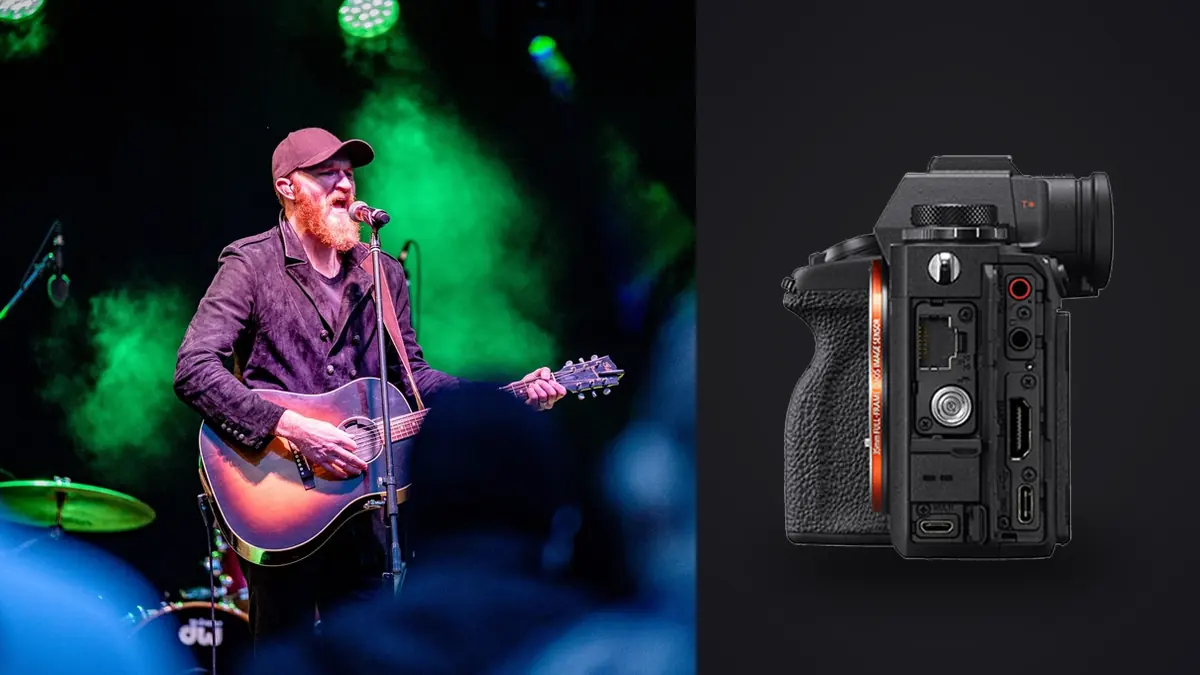
Three songs, no flash, barrier to backstage in ninety seconds if security decides your lanyard looks wrong. That's the reality the Sony A1 has to survive at most shows, and it's a very different test than the studio and landscape work most reviews put it through. I've carried one into small clubs where the stage lighting is a single moving head and a smoke machine, and into arena pits where the rig above the stage could power a small town. The camera behaves differently in each, and most of what matters for concert work never shows up in a spec sheet comparison.
Autofocus is the whole story, not the 50 megapixels
Everyone talks about the A1's resolution first, and for concert work that's backwards. What actually decides whether you come home with usable frames is how the autofocus holds onto a moving singer under gobo lighting that's cutting their face in and out of shadow ten times a second. Sony's eye AF on the A1 is genuinely good at locking onto a human face even when half of it is in silhouette, but it will hunt the moment a spotlight sweeps directly into the lens or when a performer turns their back to hit a monitor wedge. I run continuous AF with a narrow tracking box rather than the widest zone setting, because in a pit full of moving bodies (bassist stepping in front, a fan's arm reaching up, a photographer next to you leaning into frame) the wide zone will happily jump to whatever's closest and brightest instead of staying on your subject.
Back button focus is not optional here. Shutter-button AF means every half-press during a fast pan re-hunts, and you lose the one clean frame where the singer's mic comes up to their mouth right as the light hits blue instead of red. Separate the two and you keep continuous tracking running the whole set instead of resetting it every time you recompose.
What 30fps electronic shutter actually buys you
The A1's headline burst rate is 30 frames per second with full AF and AE tracking, and it is real, not a crop-mode party trick. The catch is what happens after you hold the trigger down. With 14-bit uncompressed RAW at 50 megapixels, you're pushing a huge amount of data per frame, and the buffer will fill faster than you expect if you're not on the right card. On a CFexpress Type A card I can hold the shutter through most of a chorus, somewhere around 150 frames, before the write speed catches up and the burst rate visibly drops. Drop down to a fast SD UHS-II card in the second slot and that number falls off a cliff, closer to 80-90 frames before things bog down. If you're still shooting SD-only in 2026 with an A1, you're leaving half the camera's speed on the table during exactly the moment you need it most, which is usually the last chorus when the lighting designer throws everything at once.
In practice I don't shoot at 30fps for most of a set anyway. It produces an absurd number of near-duplicate frames from three songs, and reviewing them later becomes its own job. I sit around 10-15fps for verse and bridge sections and only push to the top speed for the chorus hits, jumps, and any pyro or confetti cue the tour manager has warned me about in advance.
ISO, banding, and the lighting rig working against you
Stage lighting for touring acts is built around LED fixtures now almost everywhere, and LEDs flicker at a rate that plays badly with fast shutter speeds and electronic shutters. The A1 has an anti-flicker shooting mode that times the exposure to the light source's refresh rate, and it helps, but it doesn't eliminate banding entirely, especially on cheaper house rigs in smaller venues where the flicker frequency isn't consistent across every fixture on the truss. I've had shows where half my frames from a chorus with rapid strobing needed a pass to deal with visible banding across the highlights, and no camera setting fully prevents that when the light source itself is inconsistent.
ISO performance is genuinely strong up through about 12800, with usable detail and manageable noise that cleans up fine for web and even most print use. Push to 25600 and you can still get a keeper if the moment demands it (a single dramatic beat lit only by a follow spot), but you're trading some texture and shadow detail to get there. I treat anything past 25600 as a last resort, not a working setting, and I'd rather open up the aperture or accept a slower shutter speed on a static moment than live there for a whole set.
How the A1 compares against other Sony bodies photographers actually bring into a pit
| Camera | Max e-shutter burst | Realistic RAW buffer | Usable ISO ceiling for arena shows | Body price | Where it fits |
|---|---|---|---|---|---|
| Sony A1 | 30 fps | ~150 frames (CFexpress A) | ISO 12800, pushable to 25600 | ~$6,500 | One body doing both stills and 8K reel footage for the same tour |
| Sony A9 II | 20 fps | ~230+ frames | ISO 12800 | ~$4,500 | Purpose-built pit body, cheaper, deeper buffer, no video ambitions needed |
| Sony A7 IV | 10 fps | ~85 frames (compressed RAW) | ISO 6400 comfortably | ~$2,500 | Fine for club shows and slower-moving acoustic sets, strains on fast arena acts |
| Sony A7S III | 10 fps | 1,000+ frames (12MP files) | ISO 25600, genuinely clean | ~$3,500 | Best low-light ISO of the group but 12MP is thin for crop-heavy editorial use |
If I'm being honest about value, the A9 II is the more sensible buy for a photographer who only shoots concerts and never needs the A1's video specs. The extra $2,000 for the A1 only makes sense once you're also delivering behind-the-scenes 8K footage or need the resolution headroom to crop a wide stage shot down to a tight portrait for a magazine cover.
Glass that actually earns its place at the barrier
My kit for a typical pit call is the 24-70mm f/2.8 GM II on the A1 body and a 70-200mm f/2.8 GM II on a second body, because three songs doesn't leave time for a lens swap once you're locked into position. The 24-70 covers wide stage shots and crowd context from the barrier, and the 70-200 handles tight face shots when the barrier is thirty feet back from the stage, which is common at bigger venues. A 16-35mm occasionally comes out for wide environmental shots from front-of-house or from a side stage position, but it rarely earns its place inside the actual pit where you're too close to the stage to use anything that wide without distorting the performer.
Monopods are mostly unnecessary for pit work since you're handheld the entire time and mobility matters more than stability. In-body stabilization on the A1 is good enough for the shutter speeds you're already using (1/250 or faster to freeze movement) that a monopod just becomes something to trip over or catch an elbow from the photographer next to you.
The part nobody mentions: what happens after the last song
A three-song set at 15-20fps average, with a few chorus bursts at 30fps, easily produces 2,000 to 4,000 frames. Multiply that across a five-band festival bill or a multi-night tour leg and you're staring down tens of thousands of RAW files by the weekend, most of them near-duplicates from the same burst with only a fraction of a second between them. This is where the actual bottleneck in concert photography lives, and it has nothing to do with the camera. I run those RAW folders through imagic, which scores focus and sharpness locally on the frame itself rather than guessing from a thumbnail, so the pass where I'm deciding which of eleven near-identical frames from a chorus jump actually has the singer's eyes sharp gets cut down from an hour to about ten minutes. The burst clustering groups those near-duplicate sequences together automatically instead of making me scroll through them one at a time in a folder that looks like the same photo repeated forty times.
Because it runs entirely on my laptop with nothing leaving the machine, I'm not uploading forty or fifty gigabytes of RAW files to some cloud culling service after a show that ends at midnight and a call time of 9am the next morning. That offline processing matters more on tour than it does in a studio setting, where you're often on hotel wifi that can't handle a real upload in a reasonable timeframe anyway. Once the first pass is done, I've also built out a preset from my own past tour edits using imagic's apply_my_style feature, so the color grade I settled on for my last three tours gets applied consistently across a new batch without me manually matching white balance and contrast on every single frame from scratch. If you're trying to speed up the rest of that workflow, our breakdown of how AI photo culling actually works covers the technical side of what's happening during that scoring pass, and the tips for a faster photo workflow piece has more on structuring the whole night from shoot to delivery.
Battery life and the logistics nobody plans for
The NP-FZ100 battery gets you through a headline set comfortably, usually two to three full sets before I swap, but I still carry three spares in a pit bag because there's rarely a good moment to charge between bands at a festival. Dual card slots (CFexpress Type A and SD) mean I run simultaneous RAW backup during anything I can't reshoot, which for concert work is basically everything, since there's no second chance at a headliner's only song without pyro.
Weight matters more than people admit after a four-hour night holding the camera up over your head to shoot past the barrier rail. The A1 with the 70-200 GM II attached isn't light, and by the third band of a festival night my shoulder knows it. It's not a dealbreaker, but if you're coming from a smaller mirrorless body, budget a few shows to adjust before you judge the handling fairly.
Frequently Asked Questions
Do you really need 50 megapixels to shoot a concert?
Not for the photo itself, but for the crop flexibility, yes it helps. Photo pits are often thirty to fifty feet from the stage at arena shows, and having 50 megapixels means I can crop a wide shot down to a tight portrait after the fact instead of needing a 400mm lens I can't physically use at that distance in a crowded pit. If you mostly shoot small clubs where you're five feet from the stage, the extra resolution matters a lot less.
Is the A1 too loud or noticeable for pit work?
No, and that's actually one of its strengths. In fully silent electronic shutter mode there's zero mechanical noise, which matters at acoustic sets or quieter moments in a set where a mechanical shutter clack would be audible over the music and distracting to both the artist and nearby fans. Some venues and artist teams specifically require silent shooting, and the A1 handles that without the rolling shutter distortion that made early mirrorless silent modes unusable for fast-moving subjects.
What's the single biggest weakness of the A1 for live music specifically?
Cost relative to what you actually use. Most of the A1's headline features (8K video, extreme burst depth, flagship autofocus) are built for photographers who need one body to do everything from sports to video to stills. If concerts are your only use case, you're paying a significant premium over an A9 II for capabilities you may rarely touch, since a three-song pit call doesn't require 8K footage or a 30fps burst sustained for more than a few seconds at a time.
Should I just buy a used A9 II instead?
If concert and event work is genuinely all you shoot, I'd tell most photographers to save the money and go A9 II. The autofocus tracking is nearly as good in practice, the buffer is actually deeper for RAW bursts, and the savings can go toward a second body or better glass, which does more for your keeper rate at a show than the extra 20 megapixels ever will.