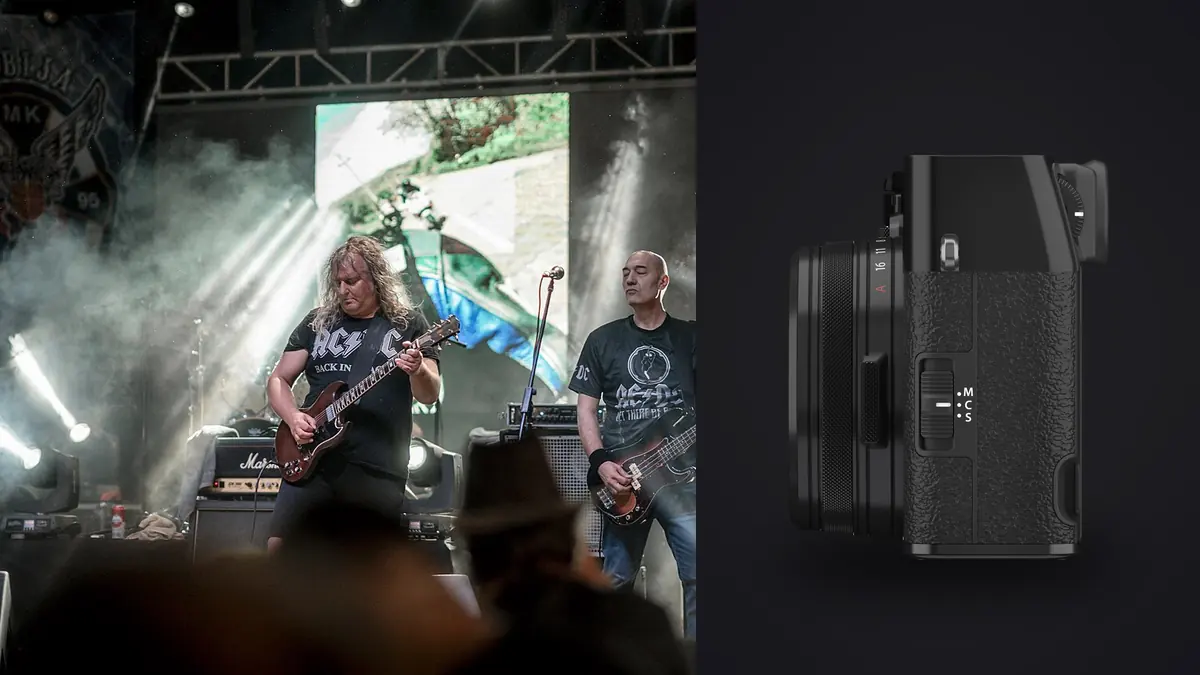
I ran the X100VI as my only camera for four shows in a row this summer, a 300-cap punk bill, a seated jazz trio, a two-night run at a mid-size theater, and a rain-soaked festival set. No second body, no zoom, no flash. The goal wasn't a spec sheet review, it was to find out whether a fixed 35mm-equivalent rangefinder-style camera, the same one everyone was fighting over on resale sites in 2024, actually holds up when a singer is three feet from your face one second and across the stage the next. Some of it surprised me. Some of it confirmed exactly what I'd been warned about.
Why the Fixed 35mm Lens Changes How You Work a Show
There's no getting around this one: 35mm equivalent is a wide-normal focal length, and it puts you in a very specific relationship with the stage. At a 300-cap club with no barrier, it's close to ideal, you're basically shooting from where you'd naturally be standing anyway, and the environmental context (the crowd's hands, the low ceiling, the mess of cables) reads as part of the frame instead of clutter to crop out. At a theater with a proper photo pit, 35mm reads as painfully wide for anything beyond a three-quarter band shot. You will not get a tight vocalist portrait from the rail at a 1,500-seat room without cropping hard, and cropping hard on a wide lens means dragging in perspective distortion you didn't ask for.
What changed my mind about the limitation was accepting that the X100VI isn't trying to be a telephoto tool, it's forcing you to shoot the way photographers shot before 70-200mm lenses became the default kit for pit photography: get closer, use the wide angle on purpose, let the environment do some of the storytelling. That's a real stylistic shift, not a workaround. If your editor wants tight headshots of the lead singer for every gallery, this is the wrong tool. If they want frames that feel like you were actually standing in the room, it's a genuinely good one.
Autofocus in the Pit: Where It Holds Up and Where It Falls Apart
Fuji's subject detection on this sensor is a real improvement over the X100V, and in daylight or a well-lit theater it tracks a moving vocalist competently. The trouble starts under the lighting concerts actually use. Saturated red and magenta stage washes, which are everywhere in modern lighting rigs, reduce contrast enough that the AF starts hunting, particularly with the aperture open near f/2 where depth of field gives it almost no margin for error. During a fast strobe sequence at the punk show, I lost focus lock completely for a few seconds, twice, on frames I really wanted.
The workaround I settled on: stop down to f/2.8 or f/4 whenever the lighting allows it, even though it costs you a stop or two of light you don't have to spare. The extra depth of field buys enough forgiveness that a slightly-off focus point still lands usably sharp, which matters more at a show than technically nailing focus on the eye and missing everything else. Wide open at f/2 under bad stage light, the miss rate climbed noticeably in my results, especially during the guitarist's habit of lunging toward the crowd on every chorus.
Shutter Choice Matters More at a Concert Than Anywhere Else
This is the part nobody mentions in the marketing copy, and it's the single biggest technical trap for anyone bringing this camera into a venue with LED lighting, which by now is nearly every venue. The X100VI's electronic shutter is genuinely silent and can hit absurd speeds, which sounds perfect for a hushed acoustic set where a mechanical click would be rude. But electronic shutter on this sensor reads line by line, and LED stage lighting flickers at a rate that doesn't always play nicely with that scan. The result is banding, visible horizontal stripes across the frame that show up especially in wide color washes, and it's not subtle once you see it.
| Shutter Mode | Max Speed | Noise at the Show | Banding Risk Under LED/Strobe | When I Actually Use It |
|---|---|---|---|---|
| Mechanical (leaf) | 1/4000 sec | Quiet leaf-shutter click, audible in a silent room | None, no rolling readout | Default for 90% of a set, especially anything with moving colored lights |
| Electronic | Up to 1/180,000 sec | Completely silent | High under LED panels and strobes | Only for quiet acoustic sets with steady, warm lighting |
| Auto | Switches between the two | Unpredictable | Moderate, inherits electronic risk at high shutter speeds | Never for a paid gig, too easy to get caught out mid-set |
I burned through the first two songs at the jazz trio show on electronic before I noticed the banding on a chorus-pedal-lit background and switched back to mechanical for the rest of the set. Lesson learned the hard way: pick your shutter mode before the first note, based on the lighting rig you can see from the pit, and don't trust auto to make that call for you mid-song.
Getting More Reach Without Carrying a Second Lens
The 40.2-megapixel sensor gives you room to crop that older X100 bodies never had, and Fuji leans into that with a built-in digital teleconverter that simulates 50mm and 70mm equivalent framing by cropping and recording a smaller file straight out of camera. It's not optical magic, it's the same crop you could do yourself in post, but having it mapped to a function button means you can punch in without stopping to think about it mid-song.
| Framing | Approx. Output Resolution | Typical Use From the Pit |
|---|---|---|
| 35mm (native) | ~40 MP | Full band shots, crowd context, wide stage shots |
| 50mm equivalent crop | ~20 MP | Single performer, waist-up, still plenty of resolution for a full-page print |
| 70mm equivalent crop | ~10 MP | Tight face shots from the rail, fine for web and social but thin for large prints |
In practice I used 50mm crop constantly and treated 70mm as an emergency option. Ten megapixels is enough for an Instagram gallery or a review write-up, but if the venue's press office wants a print-ready hero image, you want the resolution headroom of the native 35mm frame and a proper crop done in post instead, where you can judge the composition properly rather than guessing through a small EVF.
High ISO, IBIS, and a Trade-Off Worth Knowing About
In-body stabilization is new to the X100 line as of this model, and it's a legitimate reason to consider it over the X100V if you shoot in dark rooms. Rated around 6 stops, it let me hand-hold usable frames at 1/30 sec during a moody, blue-lit ballad section where I'd normally have bumped ISO hard just to protect shutter speed. The catch is obvious but worth saying anyway: IBIS stabilizes the camera, not the singer. A slow shutter speed still turns a headbanging drummer into a smear, stabilization or not. It's a tool for static or slow-moving subjects in low light, not a substitute for a fast shutter when the band is actually moving.
On ISO, I stayed comfortable up to about 6400 for web and social delivery, with noise that cleaned up fine in post. Past 12800, especially on shadow-heavy frames from a poorly lit support-act set, the 40-megapixel pixel pitch starts showing its cost, grain gets coarse enough that I'd rather downsample the file than push exposure recovery further. If a venue's lighting tech is stingy (small rooms with a single wash and no gobos are the worst offenders), plan on shooting at f/2, ISO 6400, and accepting slower shutter speeds than you'd like, or lean on the crop modes less and the wide native frame more, since noise reads less obviously at full resolution than after a heavy crop.
Getting the Camera Into the Building
This is a genuinely underrated advantage. A lot of small and mid-size venues have informal policies against "professional cameras," meaning anything with an interchangeable lens or a body that looks like a DSLR, even for fans without a photo pass. A compact fixed-lens body that looks closer to a premium point-and-shoot has, more than once, gotten waved through security at door checks where a camera bag with a 70-200mm would have been turned away. This isn't a guarantee, and it's absolutely not a substitute for an actual photo pass at a bigger show where accreditation is checked, but for smaller club gigs where you're shooting as a fan-slash-photographer, the low profile matters more than people give it credit for.
What Happens to the Files After Load-Out
Here's the part of the workflow that the camera itself doesn't solve. A three-band bill with a three-song shoot window per act still produces two to three thousand frames once you count the burst sequences fired during every chorus hit and stage-diving lunge, and a huge share of those are near-duplicates: five frames of the same jump, four of the same guitar swing, all clustered a fraction of a second apart. Sorting that by eye at 1am in a hotel room, with a deadline for the venue's socials before the next morning, is where most of the actual time on a concert shoot goes, not the shooting itself.
This is where I've leaned on imagic for the culling pass. It runs the sharpness scoring locally on the laptop, no upload, no waiting on a hotel wifi connection that's usually terrible after a show anyway, and groups those burst sequences so you're picking the one sharp frame out of each cluster instead of scrolling through all of them individually. Given how much of a concert file dump is genuinely near-duplicate frames from AF hunting under bad stage light, that clustering step alone probably saves me half the editing night. If you want the mechanics of how that kind of sharpness-based sorting actually works, this breakdown of AI photo culling covers it in more depth than I can here.
The other piece that's saved real time: training imagic's apply_my_style preset on a batch of my own graded concert edits, so the base color and contrast treatment gets applied automatically across a new gig before I go in and adjust individual frames. It doesn't replace judgment on a per-image basis, stage lighting varies too much show to show for that, but it kills the tedious part of starting every gallery from a flat baseline. For anyone trying to tighten up the gap between "shot the show" and "gallery is live," it's worth pairing whatever camera you're using with a faster culling step; these workflow tips cover more of that ground beyond just the culling stage.
So Is It Worth Buying Just for Live Music?
If concert work is your only reason for buying a camera, I'd hesitate to recommend the X100VI as a first purchase. A used APS-C body with a fast 23mm or 35mm prime and room to add a longer lens later will serve a dedicated pit photographer better, especially anyone shooting bigger venues where reach matters more than discretion. But if you already shoot other things with it, street work, travel, documentary style projects, and want one camera that can also credibly cover a club show without hauling a second kit, it earns its place. The leaf shutter's quiet operation, the IBIS for dim rooms, and the crop modes for extra reach add up to a camera that's more capable at this specific job than its "compact everyday camera" reputation suggests. Just go in knowing the shutter-mode trap under LED lighting, and don't expect it to replace a 70-200mm at an arena show.
Frequently Asked Questions
Can the X100VI actually get frame-filling shots from a photo pit at a normal-size venue?
At most pits, which sit six to ten feet back from the stage lip, 35mm equivalent gives you three-quarter band shots, not tight portraits. Use the 50mm digital crop for single-performer framing and expect to do additional cropping in post for anything tighter, keeping in mind that heavier crops eat into the resolution you have to work with.
Does the built-in ND filter help for daytime festival sets?
Yes, and it's one of the more useful features for outdoor daytime shows specifically. It lets you keep the aperture near f/2 for shallow depth of field in bright sun without blowing highlights or forcing absurdly fast shutter speeds, which matters if you want a separated, portrait-style look from a daytime festival stage rather than the deep-focus look you get stopped down.
Is the electronic shutter safe to use for a whole set?
Not under most modern stage lighting. LED panels and moving-head strobes can cause visible banding with the electronic shutter's rolling readout. Stick to the mechanical leaf shutter for anything with active colored lighting, and reserve electronic shutter for quiet, steady-lit acoustic sets where silence matters more than banding risk.
How much of a problem is battery life across a multi-band bill?
It's a real consideration. Between chimping shots on the tilting screen, burst sequences, and EVF use in dark rooms, a single NP-W126S battery got me through roughly two full support-act sets plus a headliner before needing a swap on the nights I shot heaviest. Carrying at least one charged spare for anything beyond a single-act show is worth the pocket space.