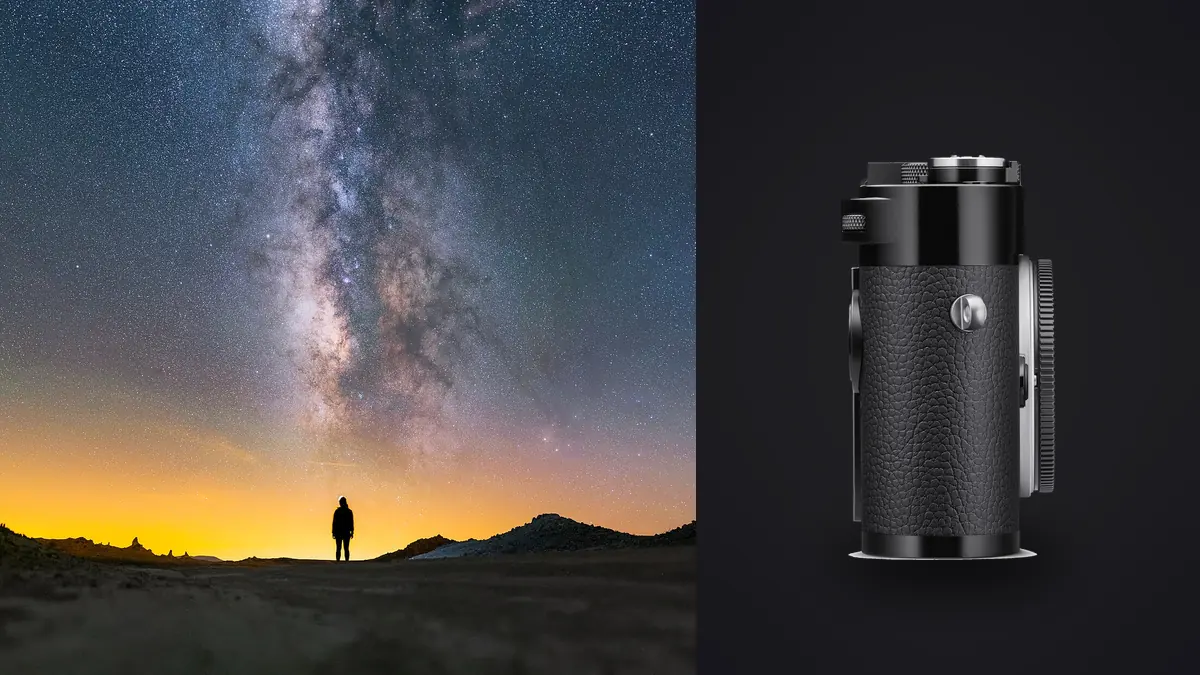
I'll say the unpopular thing first: a Leica M11 is not the camera most people would recommend for astrophotography. There's no autofocus, no built-in intervalometer, no dedicated astro mode, and a rangefinder patch that is functionally useless once you point it at anything dimmer than the Moon. And yet I've shot three separate Milky Way seasons with mine, because the files it produces once you've worked around all of that are genuinely worth the friction. This is a guide to the actual workaround, not a spec sheet.
Why the rangefinder mechanism stops helping you after dark
The M11's rangefinder focuses by overlaying two images of the same subject and asking you to slide them into alignment. That works because daylight subjects have edges and contrast for the two patches to lock onto. A star is a single point of light with almost no discernible edge in the viewfinder, so the coincidence patch just sits there doing nothing useful. You can sometimes get a lock on Venus or Jupiter when they're bright enough, and on a first-quarter Moon it works fine, but for the actual star field you're photographing, forget it.
What actually works is the rear screen. Switch to Live View, zoom in digitally (the M11 gives you a solid 5x and 10x magnification step), point the lens at the brightest star you can find near your composition, and turn the focus ring until the point of light shrinks to its smallest, tightest size. Do this slowly. The transition from "slightly bloated" to "pinpoint" happens over a very small arc of the focus ring, smaller than it feels like it should be given how far you can rack an M-mount lens from near focus to infinity. Once it's locked, I put a strip of gaffer tape across the focus ring and onto the lens barrel so a stray knee or tripod leg bump doesn't undo twenty minutes of work.
A second method I use when the sky is hazy or the stars are too faint to rack focus on directly: focus on a distant streetlight or a lit window a mile or more away before the sky is fully dark, tape the ring, and don't touch it again. Most M-mount glass has a genuine hard stop at infinity, but I still check it against a star once the sky is dark rather than trusting the stop blindly, because a couple of my older Voigtlander lenses drift very slightly past true infinity in cold weather.
The 60-megapixel sensor cuts both ways
The M11's 60MP BSI sensor resolves an enormous amount of fine detail in a Milky Way frame, which is exactly what you want when you're going to crop into a stacked composite later. The tradeoff is pixel pitch: at roughly 3.76 microns, individual photosites are small enough that star trailing becomes visible at shutter speeds that would look perfectly clean on a lower-resolution body. If you've shot astro on an older 24MP full-frame camera and you're used to using the "500 rule" (500 divided by focal length) as your ceiling for pinpoint stars, throw that number out here. On the M11 I'm cutting those numbers by roughly a third to keep stars looking like points rather than short commas when I view the file at 100%.
This matters more with wide, fast M-mount primes than it might on other systems, because that's the lens category most people actually buy an M11 to pair with a night sky. Here's what I've measured in the field with the lenses I actually own and use for this, not a formula, just what held up on the LCD histogram and on the laptop later:
| Lens (M-mount) | Focal length | Ceiling before visible star trailing on the 60MP file | What I actually shoot at in the field |
|---|---|---|---|
| Voigtlander 15mm f/4.5 Super Wide Heliar III | 15mm | ~20 seconds | 15-18s, ISO 4000, f/4.5 (wide open, no choice) |
| Voigtlander 21mm f/1.4 Nokton | 21mm | ~14 seconds | 10-13s, ISO 3200, f/1.7 |
| Leica Summilux-M 35mm f/1.4 ASPH | 35mm | ~8 seconds | 6-8s, ISO 6400, f/2 |
| Voigtlander 40mm f/1.2 Nokton | 40mm | ~7 seconds | 5-6s, ISO 6400, f/1.4 (tracker recommended past this) |
The 15mm is the lens I reach for most because it buys the most exposure time per frame, which matters a lot once you're trying to accumulate thirty or forty clean subs in a single night with a battery that hates the cold.
The intervalometer problem nobody warns you about
This is the thing that actually tripped me up the first time I tried to stack a sequence on this camera. The M11 doesn't have a standard 2.5mm or 3.5mm remote port that a cheap third-party intervalometer plugs into. What you get is the traditional Leica mechanical cable release thread in the shutter button, and wireless bulb triggering through the Leica FOTOS app over Bluetooth. Neither of those gives you a straightforward "fire 40 exposures of 15 seconds each with a 2-second gap" sequence the way a Sony or Nikon body with a proper intervalometer port does.
In practice I run bulb mode through FOTOS on my phone, start a stopwatch, and manually trigger each frame. It's slower and a lot more hands-on than I'd like, and phone batteries do not enjoy sub-zero temperatures any more than camera batteries do, so I keep the phone in an inside jacket pocket between triggers. If you're coming from a camera system with a built-in interval timer, budget extra patience for this part specifically. It's the single biggest workflow gap between the M11 and a purpose-built astro setup.
Long exposure noise reduction is worth turning off entirely for a stacking session. It doubles your time per frame (a 15-second exposure becomes a 30-second round trip once the dark frame capture runs), and since you're going to calibrate the stack with your own dark frame library in stacking software anyway, there's no reason to burn your limited dark-sky window twice per shot.
Battery reality in the field
The BP-SCL7 is rated around 700 shots under CIPA testing, a number that has almost no relationship to what you'll actually see on a winter night shooting long bulb exposures with the screen lit for manual focus checks the whole time. On a cold night around freezing I typically get somewhere between 150 and 200 usable long exposures per battery before it drops off a cliff. I carry four batteries and keep the spares in an inside pocket rather than a camera bag pocket, because a fully charged battery left in a bag at -5°C will read half-dead by the time you swap it in.
What happens after the shutter closes
A single stacking session on the M11 leaves you with a genuinely unwieldy number of nearly identical DNG files: the light frames themselves, several test exposures from the focus-check process, a handful of frames a passing headlamp or a gust of wind ruined, and if you shot any dark frames separately, those too. Going through three hundred frames that all look the same at a glance to find the eight or ten that are actually soft, or the ones with a satellite trail cutting through the frame, is not a fun way to spend the following afternoon.
This is where I actually use imagic rather than just scrolling through Lightroom's grid view. It runs its sharpness scoring locally on the machine, no upload step, which matters to me on nights I've been shooting on a property I don't own and would rather not put those RAW files anywhere near a cloud service. It groups the visually near-identical frames from a stacking sequence together instead of making me click through each one individually, so the actual job becomes: open each cluster, glance at the two or three flagged as noticeably softer than their neighbors, decide whether they're worth keeping in the stack or dropping. For a guide on how that clustering and scoring actually works under the hood, this piece on how AI photo culling works goes into more detail than I will here.
Once the light frames are culled down to the keepers, the actual stacking happens in dedicated software, not in imagic. Leica DNGs are standard, uncompressed (or losslessly compressed, if you turned that firmware option on before the shoot) Adobe DNG files, so they open cleanly in Sequator, DeepSkyStacker, or Starry Landscape Stacker without any format headaches. Turning on DNG compression before a stacking session is worth doing specifically because of the file count involved. Full-resolution 60MP M11 DNGs run close to 80MB uncompressed; compressed, they drop by roughly a third, which adds up fast when a single session might produce four or five gigabytes of subframes.
If you shoot foreground plates for blended nightscapes, meaning a separate exposure of the landscape at blue hour that gets composited under the stacked sky, imagic's apply_my_style feature is useful for a narrower reason than the culling. I trained mine on a folder of finished nightscape edits, and now new foreground plates get pushed toward that same base grade automatically before I open them in Photoshop for the actual sky-to-foreground blend and noise cleanup on the stack. It doesn't do the creative part, it just removes the repetitive base-grading pass so the time I actually spend at the computer goes toward the blend, not toward re-deriving the same white balance and contrast curve I've already landed on a hundred times before.
What I'd tell someone considering this camera specifically for night sky work
If you already own M-mount glass and you're drawn to the M11 for everyday work, it's a genuinely capable second tool for astro on nights when you have the patience for the manual workflow. If astrophotography is the primary reason you're shopping for a camera, I'd be honest that a body with a real intervalometer port, in-body stabilization for handheld twilight work, and autofocus assist for daytime scouting is going to get you to a finished image faster, most nights. The M11 rewards patience and punishes rushing. Manual focus in the dark, manual interval timing, and a sensor that doesn't forgive sloppy shutter speed choices are not a beginner-friendly combination.
What you get in exchange, when it works, is a genuinely quiet, compact rig on a tripod (no mirror slap, no big body blocking wind for your foreground), and files with enough resolution to print a Milky Way panorama at a size that makes people stop and look closely. That tradeoff has been worth it for me. Whether it's worth it for you depends mostly on how much you already value the rest of what a rangefinder body does for the other 90% of your shooting.
Frequently Asked Questions
Does the Leica M11's rangefinder patch work for focusing on stars at all?
Not reliably. The coincidence patch needs contrast and edges to lock onto, and a star is a dimensionless point of light. It can occasionally lock onto the Moon or a bright planet like Venus or Jupiter, but for actual star fields you'll get a cleaner result using the rear screen's Live View magnification instead.
Can you run a star stacking sequence without a proper intervalometer?
Yes, but expect it to be manual. The M11 has no standard remote port for third-party interval timers. You're triggering bulb exposures through the Leica FOTOS app over Bluetooth or a mechanical cable release, timing each frame yourself against a stopwatch rather than programming a sequence in advance.
Is the 60-megapixel sensor actually a disadvantage for night sky shooting?
It's a tradeoff rather than a straightforward downside. The extra resolution is great for cropping and printing large, but the smaller pixel pitch means star trailing shows up at shorter shutter speeds than it would on a lower-resolution full-frame body, so you have to shoot shorter subs and lean more on ISO or a tracker.
Which M-mount lenses actually hold up for astrophotography on this body?
Wide, fast primes from Voigtlander's Nokton and Heliar lines are the practical choice for most people, since genuine ultra-wide Leica glass in this focal range gets expensive fast. A 15mm f/4.5 or a 21mm f/1.4 covers most Milky Way compositions and buys enough exposure time per frame to make a stacking session realistic in a single night.
Does a stacking session produce more files to sort through than normal shooting?
Considerably more. Between light frames, focus test shots, and anything ruined by wind or a passing headlamp, a single night can leave you with hundreds of near-identical DNGs. Running that folder through imagic's local sharpness scoring and clustering before you touch stacking software saves a genuinely painful amount of manual review, and it's worth pairing with a faster general review pass too, which this piece on speeding up a photo workflow covers from a broader angle.