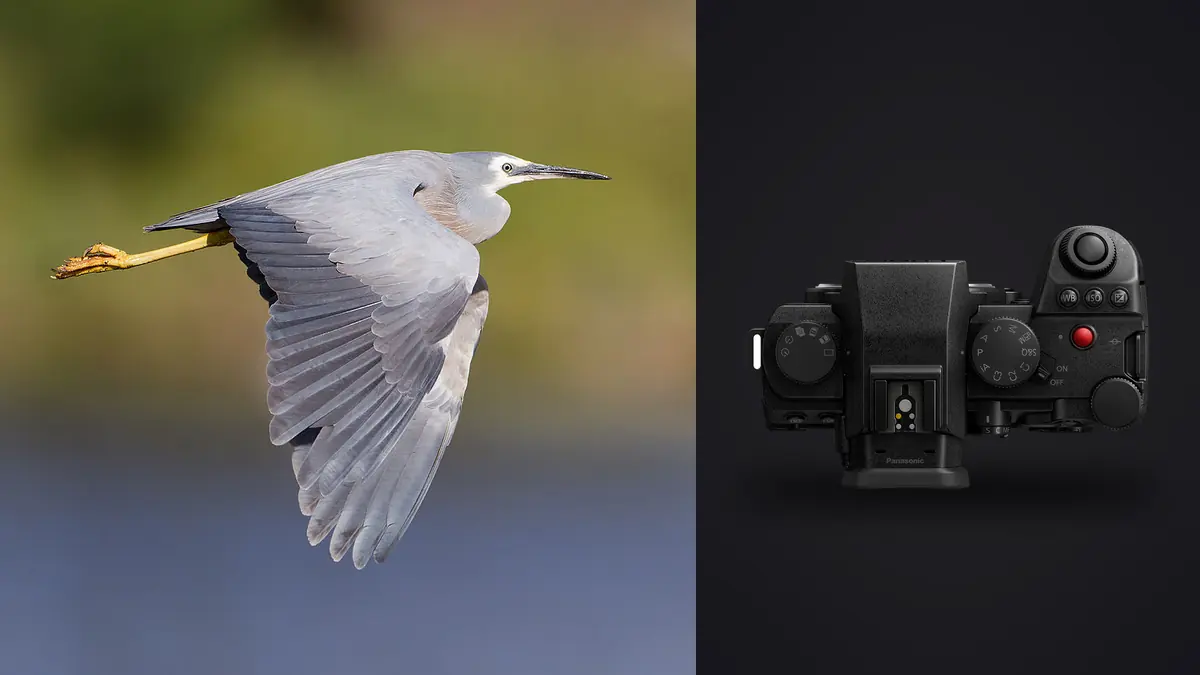
I took an S5IIx out to a tern colony on the Suffolk coast in June, mostly because I already owned the body for video work and wanted to know whether I'd need to carry a second, stills-dedicated camera on a wildlife trip later that summer. That's the real question most people asking about this camera and birds in flight actually want answered. Not "is it good," but "can it replace something else in my bag." The short version: it handles a meaningful slice of birding work, but it asks you to work around a few real limitations rather than pretending they don't exist.
The S5IIx and the plain S5II share the same sensor, the same autofocus hardware, and the same burst ceilings. The x variant adds video-centric extras (internal ProRes, USB-SSD recording, a fuller streaming toolkit) and nothing that changes how it tracks a gull cutting across a grey sky. If you're deciding between the two purely for wildlife, that fact alone should save you some money, and I'll come back to it in the FAQ below.
What Actually Changed for Autofocus
Panasonic's full-frame line ran on contrast-detect autofocus for years, which is why older S-series bodies had a reputation for AF that pulsed and hunted on anything moving unpredictably. The S5II generation (and by extension the S5IIx) switched to phase-hybrid detection, Panasonic's first phase-detect system on a full-frame body. That single change is the difference between "usable for birds" and "don't bother," because contrast-only AF simply cannot react fast enough to a bird changing direction mid-frame.
In practice, the phase-detect points do a competent job holding focus on a bird against open sky. Where it gets shakier is a bird crossing in front of trees, reeds, or a busy shoreline. The animal-detection mode (which includes birds, and will pick out an eye or head when the subject is close and clean enough) locks confidently against uncluttered backgrounds. Drop that same bird into a hedge line or a mixed flock and the AF will occasionally jump to the background or to a neighboring bird. That's not a defect unique to Panasonic, most hybrid AF systems below the flagship tier struggle with the same scenario, but it's worth knowing before you plan a morning around a busy heronry rather than open water.
Burst Speed and Buffer, the Real Numbers
This is where the S5IIx starts to show its video-first priorities. The mechanical shutter tops out at a modest rate with full continuous AF, which is fine for a heron's unhurried wingbeat and not fine for a peregrine stoop. The electronic shutter mode advertises a much higher ceiling, but it locks focus and exposure from the first frame, which makes it far less useful for anything accelerating or changing altitude. Here's what I actually logged shooting raw + JPEG on a UHS-II SD card over several sessions:
| Shutter mode | Frame rate | AF between frames | Rolling shutter risk | Buffer before slowdown |
|---|---|---|---|---|
| Mechanical, continuous AF | ~7 fps | Full AF/AE tracking | None | Roughly 100 raw frames |
| Electronic, high-speed burst | Up to 30 fps | Locked from frame one (single-AF only) | High, wingtips smear on fast wingbeats | Fills in under 3 seconds |
| Electronic, continuous AF | ~10 fps (lens dependent) | Full AF/AE tracking | Moderate | Roughly 60-70 raw frames |
The practical read: mechanical shutter with continuous AF is the setting I actually keep for flight sequences. It's slower on paper than the electronic modes, but it's the only one that keeps refocusing while the bird is in the air, and the buffer holds up long enough for a real pass rather than a two-second burst. The 30 fps electronic mode is fun for a bird that's already gliding in a predictable line and roughly pre-focused, like a gannet on a fixed dive line, but it's the wrong tool for anything erratic.
Rolling Shutter Is the Quiet Dealbreaker
Nobody talks about this enough when comparing spec sheets. The S5IIx's sensor readout in electronic shutter mode is on the slower side for a body being marketed toward action work, and it shows up as skewed wingtips and slightly warped propellers on fast-moving subjects. Wood pigeons flushing off a field, or anything with a rapid wingbeat frequency, will show visible distortion in the outer thirds of the frame at the higher electronic burst rates. It's rarely a problem at the edges of a static perched shot, but it's the first thing I check when reviewing a flight sequence shot electronically, because a skewed wing can ruin an otherwise sharp frame in a way that's hard to fix after the fact.
Lens Pairings That Make Sense on L-Mount
The S-series L-mount lineup for telephoto reach used to be thin. That's improved a lot over the last two years, and the lens you pick matters more for birding results than any menu setting on the body. Four options cover most budgets and use cases:
| Lens | Focal length | Approx. weight | Best for |
|---|---|---|---|
| Panasonic Lumix S 100-400mm f/4-6.3 | 100-400mm | ~1,140g | All-round flight work, handholdable for a full morning |
| Panasonic Lumix S 200-600mm f/5.6-8 | 200-600mm | ~1,955g | Distant raptors and shoreline birds where reach beats speed |
| Sigma 100-400mm f/5-6.3 DG DN | 100-400mm | ~1,140g | Budget entry into BIF without a big AF speed penalty |
| Tamron 50-400mm f/4.5-6.3 Di III VXD | 50-400mm | ~1,155g | One lens covering habitat shots, perched portraits, and flight |
My honest pick for most people starting out is the Panasonic 100-400mm. It's light enough to hand-hold through a three-hour session without your shoulder giving out, and its focus motor keeps pace with the body's AF system rather than lagging behind it, which happens with a few older third-party lenses adapted onto L-mount. The 200-600mm earns its weight when you're shooting ospreys over open water from a hide 80 meters back, but I wouldn't want to hand-hold it through a whole session of erratic small-bird flight, where you need to swing the lens fast.
Field Settings I Actually Use
A few adjustments made a bigger difference than anything in the spec sheet:
- Back-button focus, always. Separating focus from the shutter button means a missed AF lock on a bad frame doesn't force a refocus hunt on the next one.
- Minimum shutter speed floor around 1/2000s for small fast fliers like terns or swallows, dropping to 1/1250s for something heavier and slower like a heron or swan.
- Tracking sensitivity turned toward "quick" rather than the sticky/steady end of the scale. The steady setting is built for a subject that won't suddenly change direction, which describes almost nothing in flight.
- Wide AF area with animal detection on, rather than a small single point. A single point demands you keep a fast, small subject centered manually, which is a losing battle even for experienced panners.
After the Shoot: Culling Ten Minutes of Bursts
Here's the part nobody mentions when they're evaluating a camera for birding: a single good pass at a tern colony, shot mechanical burst with continuous AF, can produce four or five hundred frames in under fifteen minutes. Most of them are near-duplicates of the same bird a few centimeters apart in the frame, and only a handful are actually sharp on the eye. Sorting that by hand is the part of wildlife photography nobody enjoys.
This is where I've stopped doing it manually. I run the day's card through imagic, which clusters near-identical burst frames together instead of making me scroll past forty variations of the same wingbeat, and its local sharpness scoring flags which frame in each cluster actually nailed focus on the eye rather than the wingtip or the water behind it. Because it runs entirely offline, there's no upload wait between a day in a hide and having a shortlist ready to edit, which matters when you've shot several hundred raw files on a slow rural connection. Once I've got the keepers picked, I apply the same edit look I use for all my flight shots through imagic's apply_my_style feature, which was trained on my own past edits rather than a generic wildlife preset, so ten keepers from a scattered burst end up graded consistently in a couple of minutes instead of file by file. If your workflow is still built around scrubbing through every frame in a folder, it's worth reading up on how AI photo culling actually works before your next big shoot, since the time saved scales directly with how many frames a session like this produces.
Where It Still Loses to a Dedicated Stills Body
I want to be fair about this rather than oversell it. Bodies built primarily for action, the Sony A9 III with its global shutter, the OM-1 II with its stacked sensor and 50 fps raw tracking, or Canon's R5 II, will out-track the S5IIx on a fast, erratic subject and clear their buffers faster. If your primary photography is competition-grade raptor-in-a-stoop work, this isn't the body that wins that fight, and I wouldn't pretend otherwise to make a better pitch for it.
What the S5IIx offers instead is a genuinely usable secondary role. If you already own one for video, or you shoot a mix of landscapes, portraits, and the occasional flight sequence rather than birding as your main pursuit, it covers that ground without forcing a second full-frame system into your bag. The gap between "flagship action camera" and "capable generalist that can hold its own on a good morning" is exactly where this body sits, and knowing that going in saves you from disappointment on the one weekend a peregrine actually shows up.
Frequently Asked Questions
Does the S5IIx have bird-eye autofocus like Sony or Canon?
It has animal detection that includes birds and will lock onto an eye or head when the subject is reasonably close and unobstructed. It's less consistent than Sony's or Canon's bird-eye implementations against cluttered backgrounds, but against open sky or water it performs close to what you'd expect from those systems.
Is 7 fps mechanical shutter really enough for birds in flight?
For most species it's workable, particularly anything with a moderate wingbeat like herons, gulls, or raptors. For small, erratic fliers like swallows or terns changing direction constantly, you'll miss the exact peak-action frame more often than you would with a body shooting 15-20 fps with full AF. Shooting in short, deliberate bursts rather than holding the shutter down helps close that gap somewhat.
Should I buy the S5IIx over the regular S5II for wildlife photography?
No, not for this specific purpose. The autofocus system, burst rates, and buffer depth are identical between the two. The S5IIx's extra money buys video features (internal ProRes, USB-SSD recording, expanded streaming) that a birder shooting stills will never touch. Buy the S5II and put the difference toward a longer lens instead.
What lens gives the best value for someone starting out with BIF on this body?
The Panasonic 100-400mm f/4-6.3 is the sensible starting point. It's light enough to hand-hold all day, its AF motor keeps pace with the body rather than lagging, and 400mm covers the majority of shoreline and garden-bird flight work. Step up to the 200-600mm only once you find yourself consistently wishing for more reach on distant raptors.