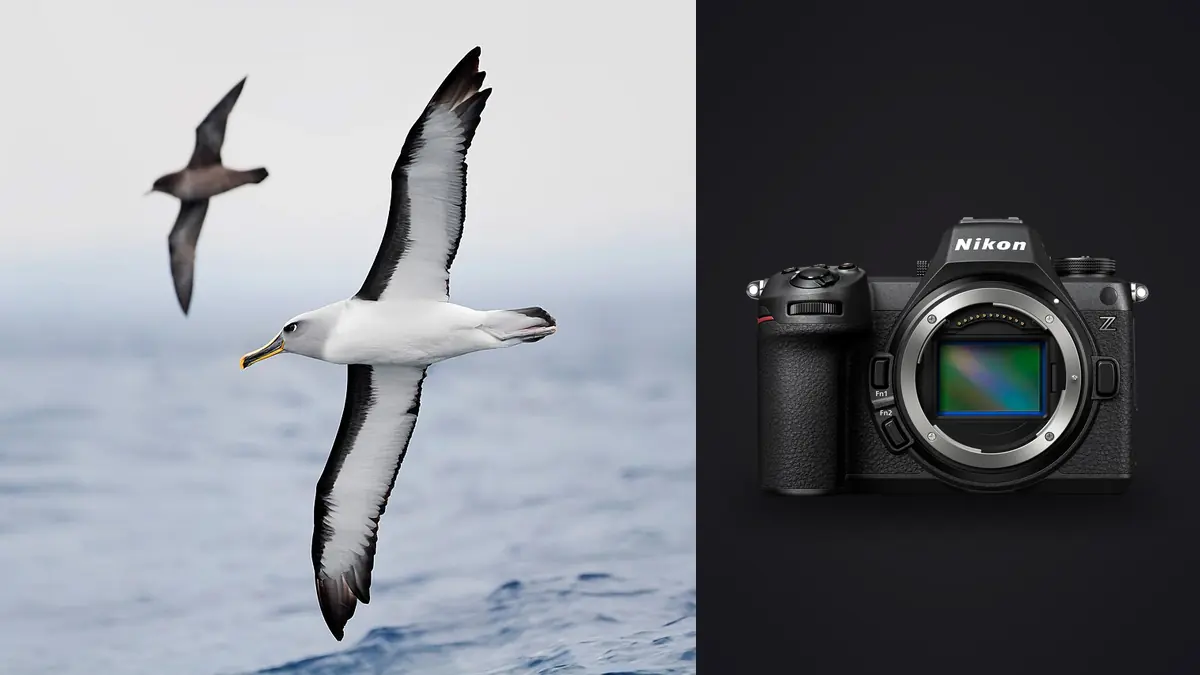
I put a Z6 III through three full seasons of gull colonies, ospreys, and one deeply frustrating week trying to nail swifts against a bright sky, and the thing that struck me wasn't the spec sheet. It's the sensor readout. Nikon dropped a partially stacked CMOS chip into a body that costs roughly a third of the Z9, and for birds in flight that one decision matters more than the megapixel count printed on the box. This isn't a spec dump. It's what actually happens when a peregrine folds its wings twenty meters from your lens and you have about a second and a half to get it right.
Why the sensor readout matters more than resolution
The Z6 II read its sensor slowly enough that fast panning against a bright background could bend straight lines into a lean, the classic rolling shutter skew you get with electronic shutter and quick relative motion. Wingtips on a diving falcon are exactly the kind of edge that shows it. The Z6 III's partially stacked sensor reads out several times faster, and in practice that means I stopped thinking about shutter type as a compromise. I leave it on electronic shutter permanently for BIF work now, silent, no mechanical lag, and I'm not chasing skewed feathers in post the way I used to.
It's not a fully stacked sensor like the Z9's, so it isn't immune to distortion at the extremes, a hummingbird's wingbeat is still faster than the readout can freeze without artifacts, but for anything from swallows up to eagles, the readout speed stopped being something I had to work around.
Autofocus against real backgrounds, not test charts
Bird detection on a clean sky is not a meaningful test. Any modern mirrorless body with subject recognition will lock onto a hawk against pale blue and hold it. The test is a tern coming in low over chop, or a warbler moving through backlit reeds with a dozen branches crossing the frame at different depths. That's where the Z6 III's behavior gets interesting, and occasionally where it gets annoying.
On open water and open sky, the eye-detect portion of bird mode is genuinely reliable down to surprisingly small subjects in the frame, smaller than I expected given how much trouble older Nikon bodies had with tiny, fast-moving targets. Where it struggles is clutter. Send a bird through a screen of branches and the AF will occasionally jump to a twig with more contrast than the bird's shaded flank, then take a beat to recover once the subject clears. I've had better luck in that situation switching out of full bird-detect and into a narrower dynamic-area mode with subject detection left on as a backup layer rather than the primary driver. It's less automatic, but it gives me a fighting chance to keep the AF point parked on the bird's body when the algorithm would otherwise get confused by the background.
Low light is the other honest weak point. Gulls working a pier at dusk, or owls at last light, push the AF into hunting more than I'd like. It still locks, but it's noticeably slower to commit than in daylight, and I've missed a few sequences because the system was still confirming while the bird banked out of frame.
Where it genuinely surprised me
Erratic fliers were the thing I expected to be the weak point and weren't. Swallows and swifts changing direction three times a second are brutal for any tracking system, and I went in assuming I'd be leaning on manual focus for a lot of it. Instead the combination of fast readout and the newer subject-detection model kept up well enough that my keeper rate on swifts roughly doubled compared to what I got out of a Z6 II on the same stretch of river the previous summer. Not scientific, just a photographer noticing the difference in a folder of RAW files.
Frame rate, buffer, and how it changes the way you shoot
Up near 20 frames per second in full-resolution 14-bit RAW with a deep buffer changes your shooting discipline in a way that's easy to underestimate until you've lived with it. On older bodies with shallow buffers, you learn to be stingy, short bursts, careful timing, don't hold the shutter down through the whole approach. The Z6 III's buffer is deep enough that I stopped rationing shots the way I used to, which is good for keeper rate and bad for how many frames end up on the card by the end of a session.
Here's how it stacks up against the bodies I get asked about most for birding, based on how they've actually behaved for me in the field rather than manufacturer marketing copy:
| Body | Sensor readout | Max RAW burst | AF coverage | Typical buffer before slowdown | Body weight |
|---|---|---|---|---|---|
| Nikon Z6 III | Partially stacked | ~20 fps (14-bit RAW) | ~90% of frame | Several hundred frames on fast CFexpress | ~760g |
| Nikon Z8 | Fully stacked | ~20 fps RAW, faster JPEG-only modes | ~90% of frame | Effectively unlimited on CFexpress in normal use | ~910g |
| Nikon Z9 | Fully stacked | ~20 fps RAW, faster JPEG-only modes | ~90% of frame | Effectively unlimited on CFexpress | ~1340g (integrated grip) |
| Nikon Z6 II (predecessor) | Conventional CMOS | ~14 fps RAW, shorter bursts | ~90% AF area, older algorithm | Buffer clears noticeably slower, more rolling shutter at speed | ~705g |
The practical takeaway from that table isn't "buy the Z9 if you can afford it," though that's true for pure throughput. It's that the Z6 III closes most of the gap to the fully stacked flagships for a fraction of the price and weight, and the place it actually falls behind is sustained high-speed bursts over many seconds, the kind of shooting you do photographing a raptor hunt from first strike to the catch. For the more common case, a bird lifting off, banking, landing, three or four seconds of real action, I never felt short-changed.
Lenses that actually keep up
A fast body paired with a slow lens is still a slow system. The Nikkor Z 100-400mm f/4.5-5.6 VR S has been my most-used lens on the Z6 III for anything from ducks to gulls to perched raptors, mostly because the zoom range lets me react when a bird gets closer than expected, which happens constantly with opportunistic species. For serious raptor and small-bird work at distance, the Z 400mm f/4.5 VR S balances beautifully on this body, light enough to handhold for an hour of walking a shoreline, which matters more than people admit when you're chasing something on foot rather than working from a hide.
The budget option that gets underrated is the Z 180-600mm f/5.6-6.3 VR. It's not as fast to focus as the S-line primes and it's noticeably softer wide open at 600mm, but paired with the Z6 III's AF system it's a genuinely usable combination for anyone not ready to spend prime-lens money, and I've gotten publishable frames out of it more than once. If you're running a teleconverter, know that the Z6 III's AF speed drops off more with a 2x than a 1.4x, enough that I only reach for the 2x in good light with a slow-moving or perched subject, not for anything erratic in flight.
The settings I actually dial in
Every photographer has opinions here, but this is what's been sitting in my custom bank for two seasons now and hasn't needed much revision:
- AF-C with 3D-tracking as my default starting point, switching to a narrower dynamic-area zone the moment a background gets busy
- Bird subject detection on, but treated as a safety net rather than something I lean on blindly in clutter
- Back-button AF, separated from the shutter release, because I want to be able to stop tracking instantly if the system grabs the wrong branch
- Manual exposure with Auto ISO, shutter locked between 1/2000 and 1/3200 depending on species, aperture wide open unless the light is generous
- Pre-release capture buffering on for unpredictable takeoffs, it's saved more launch shots than I expected going in
- Electronic shutter as the permanent default for anything in flight, mechanical only for slow perched work where I want the tactile shutter feel
The part nobody mentions: what happens after the shutter
A three-second burst at high frame rate is somewhere between forty and sixty frames. A good morning at a rookery can leave you with four or five thousand images by lunch, most of them near-duplicates of the same wingbeat with the eye a fraction softer or sharper from one frame to the next. That's the actual bottleneck in birds-in-flight photography, and it isn't the camera. It's finding the six frames worth keeping out of five thousand without your eyes glazing over on a laptop that evening.
This is the part of the workflow I stopped doing by hand. I run bursts like this through imagic, which scores focus and sharpness locally on the machine, so it can tell me which frame in a ten-shot burst actually has the eye sharp instead of the shoulder or the leading wing feather, without uploading a single RAW file anywhere. It also clusters near-duplicate bursts automatically, so instead of scrolling through fifty nearly identical frames of one flight pass, I'm looking at the two or three it flagged as the sharpest of that group. If you haven't seen how that kind of automated first pass actually works, this breakdown of AI photo culling covers the mechanics better than I can in a paragraph here.
The offline part isn't a nice-to-have for this kind of shooting. I'm regularly culling on a laptop at a cabin with no signal, or on a card reader plugged in at a rest stop between locations, and a tool that needs a cloud connection to score focus is a tool I can't use in the field. Once I've got a shortlist, I lean on imagic's apply_my_style preset for a first-pass edit, trained on my own previous bird edits rather than a generic filter, which keeps a consistent look across a season's worth of shoots without me manually matching white balance and contrast on every single selects folder. For anyone still triaging bursts like this by eye, these workflow tips are worth a read regardless of which camera produced the files.
Where I've been wrong before
I went into this camera assuming the smaller buffer relative to the Z9 would bother me more than it has. In practice, most bird-in-flight opportunities are short, a bird lifts off, you get four seconds of usable action, it's gone. The situations where buffer depth actually decides your keeper count, extended raptor hunts, long chase sequences over open water, are rarer than the marketing around high-speed bodies would suggest. I'd rather have the Z6 III's weight on a long day of hiking to a heron colony than the Z9's throughput I use maybe one day in twenty.
The mistake I did make, and see other people make constantly, is assuming bird subject detection will just handle everything. It's very good. It's not magic, and against genuinely cluttered backgrounds it needs a human hand narrowing the AF area, not blind faith in the algorithm.
Frequently Asked Questions
Does the Z6 III's autofocus actually keep up with small, fast fliers like swallows and swifts?
Better than I expected going in. The combination of the faster sensor readout and the newer subject-detection algorithm handled erratic direction changes noticeably better than the previous-generation Z6 II on the same locations. It's not flawless against dense cover, but on open ground it's genuinely competitive with far more expensive bodies for this specific use case.
What memory card setup makes sense for burst shooting birds in flight on this body?
A fast CFexpress Type B card in the primary slot is what unlocks the full buffer depth and clearing speed. I run SD UHS-II in the second slot as backup and for smaller JPEG output rather than trying to record RAW to both simultaneously, which slows the whole pipeline down when the buffer is already under pressure during a long burst.
Is the Z6 III overkill or underkill compared to the Z8 for serious birding?
It's a genuine middle ground rather than a compromise. You give up sustained buffer depth on very long high-speed bursts and a bit of build ruggedness compared to the Z8, but you get a noticeably lighter body and a real price difference. For most birders who aren't shooting raptor hunts start to finish every outing, the gap closes more than the spec sheets suggest.
Do I need a super-telephoto prime, or will a zoom cover birds in flight adequately?
A zoom in the 100-400mm range covers a surprising amount of real-world birding, especially for species that approach closer than expected, gulls, terns, ospreys near a hide. Primes at 400mm or 600mm earn their keep once you're working distant or skittish subjects consistently, but I'd tell most people starting out to learn the body and its AF behavior on a zoom before spending prime-lens money.