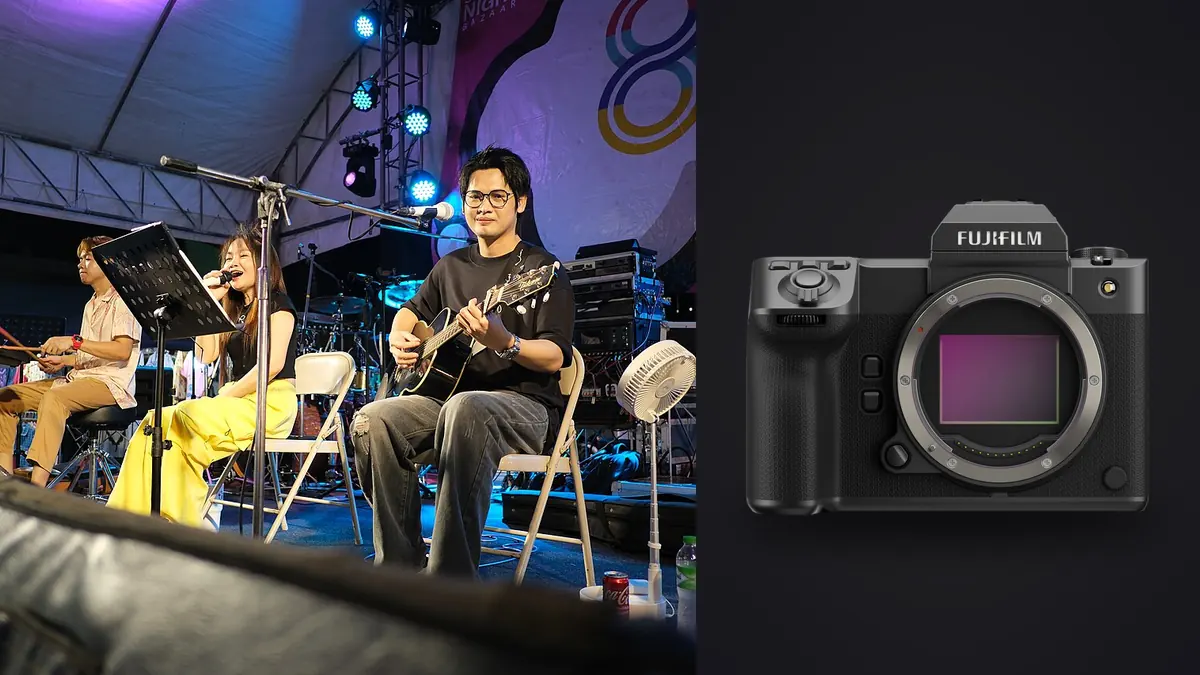
Medium format used to mean landscapes, studio portraits, and product tables lit within an inch of their life. It did not mean the photo pit at a sold-out arena show, three songs, no flash, house lighting doing whatever the lighting designer feels like that night. The Fujifilm GFX 100 II changed that calculus for a specific, narrow group of shooters: people who already own GF glass, who deliver huge prints or magazine covers alongside web galleries, and who are willing to trade some autofocus certainty for a sensor that can pull detail out of a blown spotlight that a full-frame file simply cannot recover. This is not a camera to tell a photographer buying their first gig body to chase. It is a camera worth understanding if you already shoot medium format for other work and keep wondering whether it can pull double duty on show nights.
Why bring a medium format body into a three-song pit at all
The pit is a hostile environment for any camera. You get three songs, sometimes less, shooting from the barrier with a wall of photographers on either side, house lighting that swings from near darkness to blinding strobes inside a single chorus. Full-frame bodies dominate this space for good reason: fast native telephotos, deep buffers, autofocus systems tuned over a decade of sports and wildlife use cases that happen to transfer well to a singer moving under a spotlight.
The GFX 100 II earns a place in that conversation for one reason above all others: its 102-megapixel sensor holds an enormous amount of recoverable dynamic range. Concert lighting is brutal on exposure. A vocalist lit from one side by a hard spot while the drummer behind them sits in near black is a scene no metering mode handles cleanly. On a smaller sensor you either clip the highlights on the singer's face or crush the shadows on the rest of the stage. The GFX sensor gives you more room to pull that spotlight back in post without the file falling apart, and more room to lift shadow detail from the rest of the frame without banding. That single trade, more usable stops in an unforgiving lighting scenario, is the entire argument for bringing it.
Autofocus in the dark: what actually happens under moving stage light
Fujifilm's subject detection AF, carried over and refined from the X-H2S generation, covers animals, birds, and vehicles well. Human subject tracking, meaning face and eye detection on a person, is present and improved from the original GFX 100S, but it was never built with the same priority as Sony's or Canon's flagship sports bodies. In a controlled interview setup or on a bright stage it locks on fine. Under fast-changing concert light, moving spots, strobes, backlighting that silhouettes the performer, it hunts more than a modern full-frame flagship. That is not a knock on Fujifilm's engineering so much as an honest description of where medium format autofocus sits today relative to systems built primarily to chase athletes and birds in flight.
Subject detection helps, but it was built for a different job
Eye detection on a singer standing relatively still under a spot works close to as well as anything on the market. Where it struggles is exactly the moment you most need it: a guitarist lunging toward the barrier during a strobe hit, or a singer spinning away from the light with their back briefly to the crowd. The system recovers, but the recovery takes a beat longer than photographers coming from a Sony A9 III or Nikon Z9 are used to, and that beat can be the difference between a sharp frame and a soft one during the exact peak of the performance.
Burst rate and buffer, the two numbers that matter more than megapixels
The GFX 100 II shoots up to 8 fps, which is genuinely fast for a medium format sensor and was not possible on the GFX 100S. But 8 fps on a 102-megapixel file is a very different proposition than 8 fps (or 20, or 30) on a 24-megapixel full-frame sensor. Each frame is enormous, and the buffer fills faster in real terms even though the frame count sounds respectable on paper. In practice, a few seconds of continuous shooting during a big chorus moment will start to slow the camera down before the moment is over, and you feel that lag exactly when you cannot afford it. Full-frame and APS-C sports bodies simply outrun it here. If your pit access depends on capturing a fast-moving frontman across an entire three-song set at full burst, this is not the tool for that job.
The dynamic range payoff, in real numbers
Here is the trade laid out plainly, comparing the GFX 100 II against two cameras that regularly show up in the same pits.
| Spec | Fujifilm GFX 100 II | Sony A9 III | Nikon Z9 |
|---|---|---|---|
| Sensor | 102MP medium format BSI | 24.6MP full-frame stacked | 45.7MP full-frame stacked |
| Max burst (mechanical/e-shutter) | 8 fps | 120 fps | 20 fps (raw) |
| Native ISO ceiling | 12800 | 25600 | 25600 |
| Compressed RAW file size | ~100-140MB | ~25-35MB | ~45-55MB |
| Body weight (body only) | ~971g | ~703g | ~1340g |
| Fastest native telephoto available | GF 110mm f/2 (equiv. ~87mm f/1.6) | FE 70-200mm f/2.8 GM II | Z 70-200mm f/2.8 S |
Those numbers tell the real story. The A9 III and Z9 both out-burst the GFX by an order of magnitude and both have genuine fast telephoto zooms built for exactly this kind of work. What the GFX brings back is the ability to recover a blown highlight on a performer's face two or three stops further than either of those sensors can manage, and to do it while producing a file large enough to crop into for a poster or magazine spread without visible softness. If your delivery is a web gallery and a handful of social crops, that resolution advantage barely matters. If your delivery includes large-format print or you routinely need to reframe a mediocre composition after the fact because pit access was tight, it matters quite a lot.
Lens reality check: the GF lineup was not built for a barrier
This is where the GFX 100 II runs into its hardest limit for live music work. The fastest lenses in Fujifilm's GF catalog are the GF 80mm f/1.7 and the GF 110mm f/2, both excellent optically, both roughly equivalent to a 63mm f/1.3 and an 87mm f/1.6 in full-frame terms once you account for the crop factor. There is no native GF equivalent to a 70-200mm f/2.8. If you shoot from a general admission pit where you are often twenty or thirty feet back from the stage with no room to move closer, an 87mm-equivalent prime leaves you either cropping hard in post (which the resolution can absorb, to be fair) or missing the reach entirely for anything but a headliner-close barrier position. Photographers who make this system work for gigs typically pair it with the GF 55mm f/1.7 for wider stage shots and the 110mm for tighter portraits, then lean on the sensor's resolution to crop rather than trying to zoom optically.
Camera settings that keep it usable in the pit
A few adjustments make a real difference when you commit to bringing this body into a live show:
- Shoot compressed RAW, not lossless or uncompressed. The file size difference is significant and compressed RAW loses almost nothing visible for concert work, where you are grading for mood rather than chasing absolute pixel-level fidelity.
- Push the shutter speed floor higher than you would on a faster-burst body, generally 1/500 or above for anything with hand movement, since you will get fewer total frames per moment and want each one sharp.
- Set the AF area to a single, tight zone rather than wide tracking during unpredictable strobe sections. Wide-area subject tracking under strobes tends to hunt between the performer and the light itself.
- Pre-focus on a mark (a monitor wedge, a mic stand position) during soundcheck when you can, and treat autofocus as a refinement on top of that rather than the sole plan.
- Format a fast CFexpress Type B card and carry spares. A full 102-megapixel buffer clearing after a burst will eat into your three-song window if you are writing to a slower card.
After the encore: what 100-megapixel files do to your workflow
The part nobody mentions when they talk about medium format for live work is what happens once you are back at the laptop with 400 to 600 frames from a three-song set, each one over 100MB. Culling that volume by eye, at full resolution, on a deadline that might be two hours if it is a same-night review, is genuinely punishing. This is the part of the GFX workflow that actually breaks people, not the autofocus.
Running these sets through imagic before touching anything else helps here. It scores focus and sharpness locally on the machine, which matters more with a 102-megapixel file than with a lighter format, because a frame can look sharp at a glance on a laptop screen and still be a half-stop soft where it counts, on the eyes. It also clusters the burst sequences and near-duplicates automatically, so instead of scrolling through eleven nearly identical frames of a guitarist mid-strum you get the cluster with the sharpest one flagged. Because it processes everything on the machine rather than uploading to a cloud service, it also does not choke on file sizes that would make a browser-based tool crawl, and it keeps unreleased tour photos off someone else's server before a publicist has cleared them, which matters more than people admit when shooting for a band's label.
Once the pass is culled down to the twenty or thirty keepers, a consistent color grading approach handles the mixed lighting better than color-balancing each frame individually, since a stage lit by three different fixture types rarely gives you a clean white balance to start from. imagic's apply_my_style preset, trained on a set of previously graded show photos rather than a generic filter, gets that first pass close enough that the manual work is mostly fine-tuning rather than starting from a flat file. For anyone shooting enough gigs that culling eats a real chunk of the evening, it is worth reading up on how AI photo culling actually works before assuming it will handle 100-megapixel files the same way it handles a 24-megapixel set, because the sharpness math genuinely does need to account for the extra resolution.
Who this setup is actually for
Not every working music photographer needs to read further than this: if your bread and butter is fast-moving frontmen, festival photo pits with a strict three-song, no-flash policy, and delivery that lives entirely online, a full-frame body with a 70-200mm f/2.8 will serve you better in every practical sense. The GFX 100 II is for a narrower case: photographers who already shoot medium format for editorial or fine art work, who get late-set or single-song access rather than fighting for space in a scrum, and who need files that hold up as a gallery print or a magazine gatefold as well as a web gallery. If that describes your actual client list, the trade of burst speed for dynamic range and resolution starts to make real sense. If it does not, the GFX is a fascinating camera to rent for one special show, not a rational primary body for a touring photographer's bag.
Frequently asked questions
Can the GFX 100 II keep up with fast-moving performers under strobe lighting?
Not as reliably as a stacked-sensor full-frame body. Its autofocus recovers from erratic movement more slowly than a Sony A9 III or Nikon Z9, and its 8 fps burst leaves real gaps compared to bodies shooting well past 20 fps. Static or moderately paced performers are fine; a frontman sprinting the length of the stage under strobes is where it shows its limits.
Is a 102-megapixel file actually necessary for concert photography?
For most delivery formats, no. Web galleries and social crops do not need anywhere near that resolution. The resolution earns its keep specifically for large-format print, magazine covers, or aggressive after-the-fact cropping when pit position limited your reach, which is a real but narrow use case for most working music photographers.
What lens should I actually bring into the pit with this camera?
The GF 80mm f/1.7 and GF 110mm f/2 are the two realistic choices for available-light concert work. Neither replaces a 70-200mm f/2.8's reach, so plan on cropping into the file rather than zooming optically, and expect to be closer to the stage than full-frame shooters around you to compensate.
How much storage should I plan for a typical show?
Budget generously. A three-song set at even a moderate shooting rate can produce 400 or more compressed RAW frames at 100MB-plus each, meaning a single gig can consume 40-60GB before you have even started culling. Fast CFexpress cards and a solid backup routine are not optional at this file size.