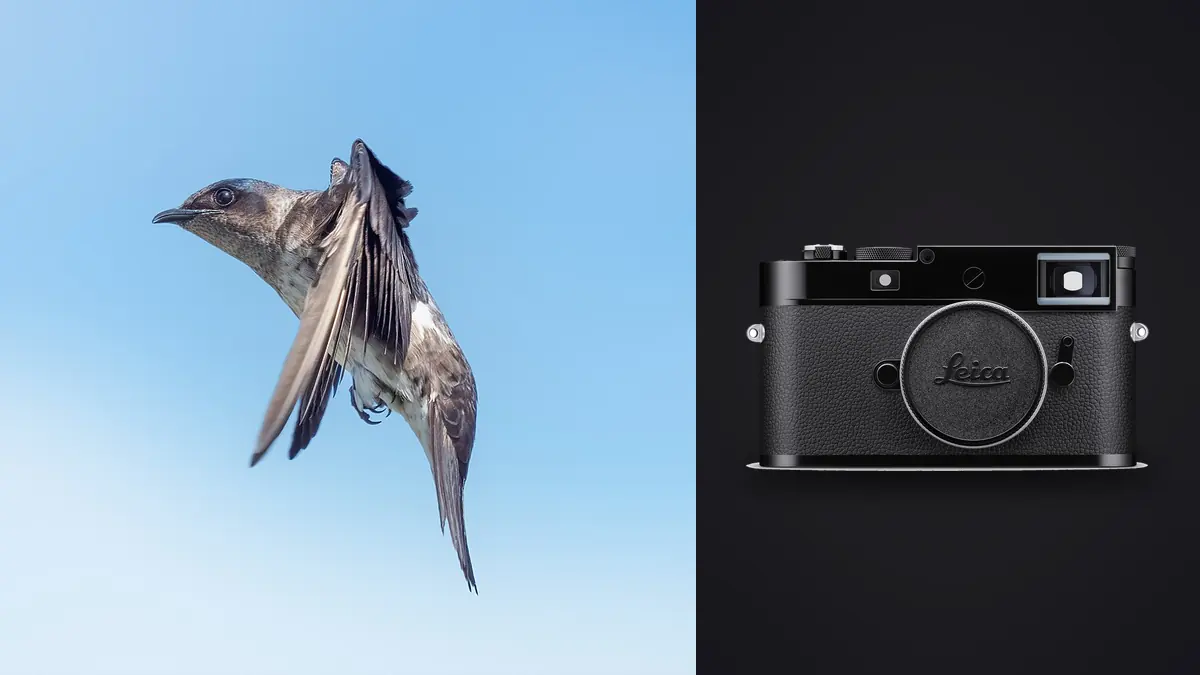
A rangefinder for birds in flight sounds like a joke until you actually try it. No autofocus, a mechanical patch you focus by eye, and frame lines that stop at 135mm while every serious bird lens on earth starts around 400mm. I spent four mornings at a local heronry and two afternoons on a gull-heavy pier with an M11 strapped to me instead of my usual mirrorless rig, mostly out of stubbornness, partly because I wanted to know whether the reputation the M-system has for being "the wrong tool for wildlife" actually holds up in practice. Short version: it mostly does, but not entirely, and the reasons why are more interesting than a flat no.
The rangefinder problem, stated plainly
The M11's rangefinder has an effective base length of roughly 50.6mm once you factor in the 0.73x viewfinder magnification. That geometry is what makes focusing a 35mm or 50mm lens by eye so reliable, you're triangulating a coincident image over a usable baseline. Stretch that same mechanism out to 135mm, which is the longest focal length Leica currently builds in native M-mount (the APO-Telyt-M 135mm f/3.4), and the margin for error at any real distance starts to bite. A bird sitting still at 20 meters is forgiving. A bird banking hard at 20 meters, closing distance every quarter second, is not. Your thumb is turning a focus tab based on a coincidence you're judging by eye, with zero assistance, while the subject is actively working against you.
None of this is a defect in the camera. The M11 is doing exactly what a rangefinder has always done, and doing it extremely well for the distances and speeds it was designed around: street work, environmental portraits, landscapes where the subject holds still long enough for you to trust your eye. Birds in flight were never part of that design brief, and pretending otherwise wastes a lot of good light.
Frame lines run out before your glass does
The M11's viewfinder shows three paired frame lines: 35/135mm, 28/90mm, and 50/75mm. That 135mm ceiling matters more than it looks like on paper. Once you mount anything longer, you lose the coupled rangefinder patch entirely and you're focusing blind through an optical finder that can't even frame the shot. In practice that means anyone serious about reach on an M11 ends up buying a Visoflex.
Working through the Visoflex 2
The Visoflex 2 is a clip-on electronic finder with a 3.68-million-dot OLED panel, and it's genuinely the only way to use long glass on this body with any confidence. It gives you focus peaking and a magnified live view patch, which restores some of what the rangefinder loses at long focal lengths. The catch is refresh rate and eye relief. Panning a gull against a bright sky through an EVF that isn't built for tracking action feels noticeably laggier than the same pan through a modern mirrorless finder tuned for exactly that job. I lost more frames to losing the bird in the frame entirely than I did to soft focus, which tells you where the real bottleneck sits.
What actually mounts, and what it's good for
Once you accept you're working through the Visoflex for anything past 135mm, the R-mount lenses Leica built for its old reflex system become relevant, adapted through the R-Adapter M. These are old, heavy, manual-everything lenses with stop-down metering, but the optics on the APO-Telyt-R glass in particular are still excellent by any modern standard. Here's how the realistic options stack up for this specific use case, based on the combinations I actually carried into the field:
| Lens (mount) | Reach on the M11 | Focusing method | Approx. weight (lens + adapter) | Best use for birds |
|---|---|---|---|---|
| APO-Telyt-M 135mm f/3.4 | 135mm, rangefinder-coupled | Native rangefinder patch | 730g | Perched birds at 15-25m, environmental frames with habitat in view |
| APO-Telyt-R 280mm f/4 + R-Adapter M | 280mm | Manual focus via Visoflex 2, no rangefinder coupling | ~2,400g | Static raptor watches from a hide, patient perched subjects |
| Vario-Apo-Elmarit-R 105-280mm f/4.2 + R-Adapter M | 105-280mm zoom | Manual focus via Visoflex 2 | ~1,950g | Flexible framing on perched or slow-moving birds; marginal for flight |
| Adapted 400mm f/5.6 (third-party manual mount) | 400mm | Manual focus via Visoflex 2, stop-down metering | ~1,400g | Pre-focused flight lines only; low keeper rate, worth it for the right shot |
Notice what's missing from that table: anything under 1,400 grams that reaches past 280mm, and anything at all with autofocus. Every serious wildlife rig from the mirrorless world solves both problems at once. The M-system solves neither, which is exactly why this whole exercise only makes sense if you already own the glass, or you're doing it for reasons that have nothing to do with efficiency.
Where the M11 actually earned its keep
Perched birds, not birds in flight, is where this camera stopped feeling like a compromise. At the heronry, with the 135mm APO-Telyt-M and the rangefinder doing what it's built for, I got sharper hit rates than I expected on herons standing still in the reeds, preening, adjusting a stick in the nest, the kind of static-but-alive moment that doesn't need tracking autofocus. The 60-megapixel sensor helped here too. Leica's triple-resolution mode lets you shoot at 60, 36, or 18 megapixels, and shooting full resolution meant I could crop a static heron shot in post and still land something that looked like it was framed with a much longer lens than 135mm.
The other genuine advantage is the shutter. The M11 has a fully mechanical option alongside its electronic shutter, and even in mechanical mode it's quiet compared to a DSLR mirror slap or the shutter clatter of a big mirrorless body under a high-speed burst. At close range on skittish waders that spook at a loud click, that quietness bought me shots I don't think I'd have gotten with a louder rig. It's a narrow advantage, but it's real, and it's the kind of thing you only notice once you've flushed a bird off a branch with your own camera noise one too many times.
A zone-focus routine that sometimes catches flight
Flight shots weren't hopeless, they were just a numbers game with worse odds than usual. The technique that worked best was old-school zone focusing on a predictable flight line: gulls following the same arc off a pier, herons flying a repeated path back to a nest. I'd pre-focus the 135mm on a fixed point along that path, stop down to f/8 for extra depth of field, and fire a short burst as the bird crossed the zone rather than trying to track it continuously through the frame. The M11 shoots at roughly 4.5 frames per second, which is slow next to a modern mirrorless burst mode, and the buffer fills fast when you're writing 60-megapixel DNGs, so I treated every burst as a single, deliberate attempt rather than a spray-and-pray.
Keeper rate on true birds-in-flight frames using this method sat somewhere around one usable shot for every fifteen to twenty attempts, and "usable" is doing some work in that sentence, meaning in-focus and reasonably framed, not necessarily a great shot. That's a rough night compared to what a dedicated wildlife body delivers, but it's not zero, and on the mornings it worked, the files were genuinely lovely: the M11's color response and the APO-corrected rendering on that 135mm produced a look I didn't quite get out of my usual gear.
Sorting the wreckage afterward
Here's the part nobody talks about with this kind of shooting: the aftermath. A morning of zone-focused bursts on a manual rangefinder produces a huge pile of near-misses, frames where the bird is a half-step ahead or behind the plane of focus, plus a lot of near-duplicate frames from each burst that all look the same at a glance. Going through that by eye, frame by frame, at full resolution, is a genuinely miserable way to spend an evening.
This is where I leaned on imagic to get through the pile. It runs entirely offline, which matters when you're hauling a card full of 60-megapixel DNGs back from a weekend trip and don't want to wait on an upload before you can start sorting. Its local sharpness scoring flags which frames in a burst actually landed focus, which on manually focused BIF attempts is the difference that matters most, and its burst clustering groups the near-identical frames from each pass so I'm comparing the five best candidates from a sequence instead of scrolling through forty near-copies one at a time. Once I'd picked keepers, I ran them through a preset I'd built in imagic with apply_my_style, trained on how I'd already been editing my heron and gull shots, so the color and contrast treatment stayed consistent across a set that had wildly inconsistent light between mornings. It's not a replacement for getting the focus right in camera, nothing is, but it cut what used to be a two-hour cull down to something closer to twenty minutes. If you want the mechanics behind that kind of sorting, we've written more about how AI photo culling works separately.
Is a modern mirrorless just better for this? Yes, mostly
I want to be straightforward about this rather than talk the M11 up past what it deserves. A current mirrorless wildlife body with eye-detection autofocus, a 500mm-plus lens, and a 20-plus frame-per-second burst will out-shoot this setup on birds in flight every single time, by a wide margin, with far less effort and far less skill required from the person holding it. If the goal is maximizing your hit rate on flight shots, buy that system instead. There's no argument here that changes that math.
What the M11 offers instead is a different kind of session. It's lighter to carry on a long hike into a hide than most 400mm-plus wildlife combos, it's quieter, and it forces a slower, more deliberate way of watching a bird before you commit to a frame, which changed how I photographed perched subjects even after I gave up chasing flight shots with it. If you already own M-mount or R-mount glass and you're curious what it can do outside its comfort zone, it's a worthwhile week of shooting. If you're buying a system from scratch specifically to photograph birds in flight, this isn't that system, and no amount of technique closes that gap entirely.
Frequently Asked Questions
Can the Leica M11 autofocus at all?
No. The M11 is fully manual focus, whether you're using the coupled rangefinder for native M-mount glass up to 135mm or the Visoflex 2 electronic finder with focus peaking for anything adapted and longer. There's no autofocus module in the body and no lens in the M-mount lineup that offers it. Any claim otherwise is confusing it with a different Leica line.
What's the longest lens you can realistically use for birds in flight on an M11?
Native M-mount tops out at the 135mm APO-Telyt-M, which loses rangefinder coupling anyway once you're framing through the Visoflex for precision. Adapted R-mount glass gets you to 280mm with the APO-Telyt-R, and third-party adapters can push further, but every step past 135mm trades away the rangefinder's speed advantage for reach you have to focus manually through an EVF. Past 280mm the weight and slow manual workflow make flight shots a low-percentage game.
Is the M11's silent or quiet shutter actually useful for birding?
Yes, more than I expected. Even in its mechanical mode the shutter is noticeably quieter than a DSLR or most mirrorless bodies running a mechanical shutter at speed, and that made a real difference on close, skittish waders and perched songbirds that would flush at louder gear. It's not a factor for birds already in flight, where the noise doesn't matter anymore, but it changes how close you can get to a resting bird before it moves.
Should someone starting out in wildlife photography buy an M11 for this?
No, and I'd say that even as someone who enjoyed the challenge. Manual rangefinder focusing on moving subjects is a skill that takes real time to build, the lens options for reach are heavy, expensive, and slow to work with, and the burst rate and buffer depth are well behind what dedicated wildlife bodies offer for a fraction of the learning curve. It's a rewarding secondary tool if you already shoot Leica for other reasons and want to point it at birds occasionally, not a starting point for someone building a birding kit from zero. If your bottleneck ends up being sorting through hundreds of frames afterward rather than the shooting itself, that part is easy to fix regardless of camera, imagic will run the same offline cull on a card of manually focused rangefinder attempts as it will on a modern autofocus body's output, and our notes on building a faster photo workflow cover the culling side in more depth.