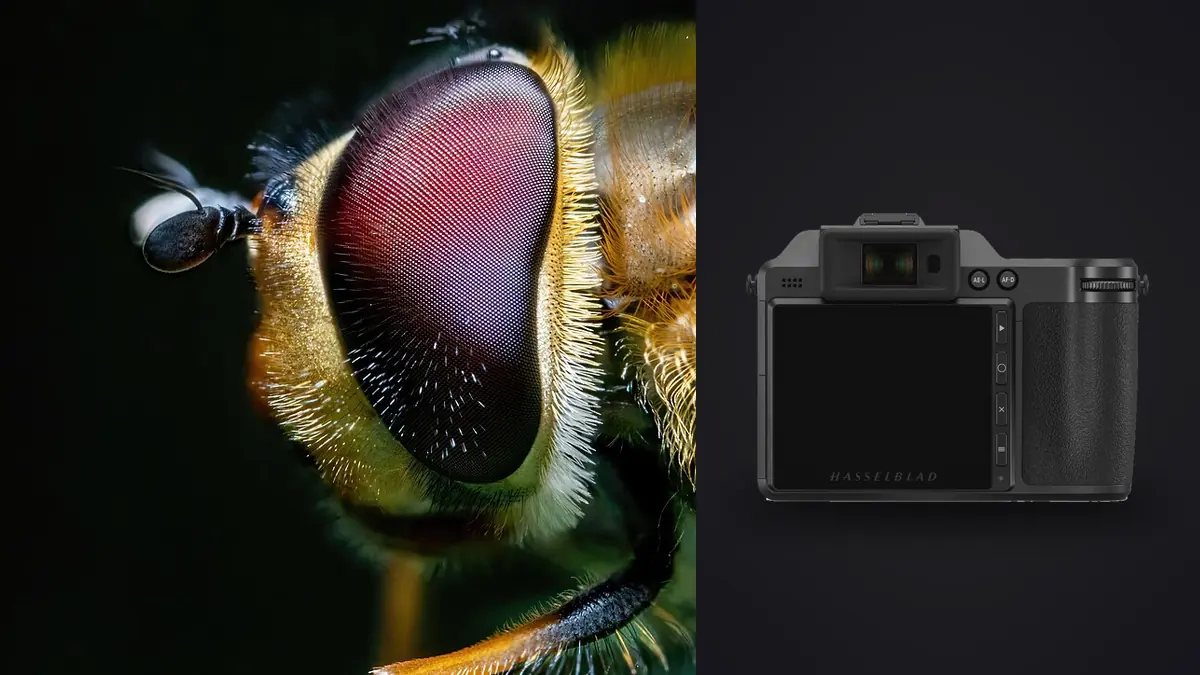
A Hasselblad X2D 100C is not a camera anyone would design from scratch for photographing jumping spiders and hoverflies. It has no dedicated 1:1 macro lens, its autofocus was built with landscapes and studio product work in mind, and at just under 900 grams for the body alone, before you thread on anything, it is not the rig most people grab for a two hour crawl through wet grass at dawn. And yet a small, stubborn group of insect photographers use exactly this system, because the thing that makes it a strange choice on paper (a 100 megapixel medium format sensor with genuinely clean files at base ISO 64) is also the thing that makes cropped-in insect detail hold up at print sizes a lot of other bodies would struggle with. This is a look at what that trade costs you in practice, not another spec sheet.
The magnification problem that the spec sheet hides
Here is the number that matters more than resolution, sensor size, or dynamic range for insect work: Hasselblad's own XCD 120mm macro lens tops out around 1:2 magnification. Half life-size. Most dedicated macro shooters coming from full-frame or APS-C systems are used to native 1:1 lenses, where the subject on a beetle's compound eye is rendered at true life-size on the sensor. On the X2D, you either accept a smaller-than-you-want subject in frame, or you crop.
Cropping sounds fine until you do the math on what it actually costs. At 1:2, a subject fills half the linear dimension it would at 1:1. To simulate a true 1:1 frame by cropping in post, you are throwing away roughly three quarters of the sensor area, which turns your 100 megapixel file into something closer to 25 megapixels of usable insect detail. That is still a perfectly good file for web use and most print sizes, but it quietly erases most of the resolution advantage that made the camera tempting in the first place. I have shot damselfly eyes on this system and ended up with files that, after the crop, print no larger than what I used to get off a 24 megapixel APS-C body shooting native 1:1.
Depth of field at this scale is unforgiving no matter the sensor
Medium format's larger surface area buys you cleaner shadows and smoother tonal transitions, but it does nothing to fix the physics of macro depth of field. At half life-size magnification and f/8, you are working with a sliver of acceptably sharp focus that might be a millimeter deep on a jumping spider's face, sometimes less. Stop down to f/11 or f/13 to claw back some depth and you start losing contrast to diffraction, which shows up faster on a 100 megapixel sensor than it would on a lower-resolution body, simply because the pixels are small enough to resolve the softening.
The X2D also has no built-in focus bracketing sequence, which a lot of mirrorless bodies half its price ship with as standard. Sony, Fujifilm, and OM System bodies will fire an automated bracket and step focus for you. On the Hasselblad, every stack is manual: rail forward a fraction of a millimeter, fire, rail again. For a mantis face I will often shoot 30 to 50 frames by hand before I am confident I have covered the depth I need, and that only works on subjects that hold still, dew-slowed insects at first light, captive-reared specimens, anything asleep. Anything actively moving through a flower head is off the table for stacking on this body.
Lens options are thinner than they look
Outside the 120mm macro, the XCD lineup does not give you much to work with for close-focus insect work. There is no native extension tube system from Hasselblad, and third-party helicoid tubes built for the XCD mount typically break the electronic contacts that control aperture and leaf shutter timing, so you lose the ability to stop down from the camera body and end up shooting wide open or locked at whatever aperture the lens defaults to without power. A few shooters get around this with manual helicoid adapters and lenses that have a physical aperture ring, but that rules out almost every current XCD lens, since Hasselblad moved to electronically controlled apertures across the line.
Reversing a lens, the classic budget trick for extreme magnification on other systems, is also a non-starter here. There is no cheap reversal ring ecosystem for XCD glass, and even if there were, you would be reversing a lens with no manual aperture control and losing exposure control entirely. Practically, this means the X2D's insect macro ceiling is fixed by that one 120mm lens and its 1:2 ratio. You are not stacking accessories to get past it the way you can on an EF, E, or X mount body.
Autofocus hunts, so most of this work ends up manual anyway
The X2D's autofocus is contrast-detection, tuned for locking onto a stationary subject with reasonable contrast, a face, a building edge, a product on a table. Point it at a compound eye against a similarly-lit leaf background and it hunts, often finding nothing until you manually rough in the distance first. In the field I stopped relying on autofocus for anything past about 1:4 magnification and just use focus peaking on the rear screen combined with a focus rail, moving the whole camera rather than racking the focus ring. The tiltable 3.6 inch touchscreen actually earns its keep here since you can check peaking at odd, low angles without lying flat in the mud.
How the file size problem actually shows up in the field
Each 100 megapixel raw off this sensor lands somewhere around 100 to 150MB depending on scene detail. Multiply that by a 40-frame manual stack and you are looking at 4 to 6GB for one final composite, before you have even started blending in software. The original X2D 100C shipped with a 1TB internal SSD and no memory card slot at all, which was controversial at launch and matters a lot more for macro shooters than it does for someone doing portraits. On a stacking session you can burn through storage fast, and there is no swapping a card mid-shoot if you fill up out in a field with no laptop nearby. You offload over USB-C or you stop shooting.
That storage crunch is exactly where a local, offline culling pass earns its keep before you touch a single frame in an editor. I run stacking sessions like this through imagic specifically because its duplicate and burst clustering groups near-identical rail sequences automatically, so I am not scrolling through 40 nearly-indistinguishable frames of a fly's thorax by eye trying to spot the one where the antenna tip is actually sharp. Because the culling and sharpness scoring run entirely on the machine rather than uploading anything, a folder of 6GB medium format files does not sit waiting on a slow connection before you can start working, which matters when you are trying to review a shoot the same evening while the light and the memory of what you were focusing on are both still fresh.
What actually works well on this system
None of this means the camera is a bad choice, it means it is a specific one. Where the X2D genuinely earns its keep is in static, controlled setups: a pinned specimen under diffused strobe, a captive insect in a small enclosure with a plain background, anything where you can take your time and are not racing a moving subject. In that context the sensor's dynamic range holds detail in both a beetle's dark elytra and a bright out-of-focus background without clipping either, and the color rendering on iridescent wings (dragonflies, certain beetles, morpho-adjacent moths) has a subtlety that I have not gotten out of smaller sensors at the same settings. The files also hold up to aggressive cropping better than the raw megapixel count alone suggests, because there is comparatively little noise to amplify when you punch in.
The 5-axis in-body stabilization, rated by Hasselblad at up to 7 stops, is also more useful for macro than people expect, not for handholding true macro ratios (you will still want a rail or a tripod there) but for the framing and focus-check phase, where a stabilized live view makes it much easier to judge whether you have actually nailed the eye before committing to a stack.
How the numbers stack up against a purpose-built macro kit
| System | Native macro ratio | Sensor size | Effective resolution at 1:1-equivalent framing | Approx. body + macro lens cost |
|---|---|---|---|---|
| Hasselblad X2D 100C + XCD 120mm Macro | 1:2 (crop needed for 1:1 framing) | 43.8 x 32.9mm | ~25MP after crop | ~$12,500-13,000 |
| Full-frame mirrorless + native 100mm f/2.8 1:1 macro | 1:1 native | 36 x 24mm | ~60MP, no crop | ~$4,500-5,500 |
| APS-C mirrorless + native 1:1 macro (e.g. 80mm f/2.8) | 1:1 native | 23.5 x 15.6mm | ~40MP, no crop | ~$3,000-3,500 |
Pricing above reflects approximate street pricing at time of writing and moves around; check current listings before budgeting. The uncomfortable takeaway from that table is the one most people do not expect: for pure insect-at-life-size detail, a full-frame body with a proper 1:1 macro lens will out-resolve the medium format setup, because it is not throwing away three quarters of its sensor to get there. The Hasselblad's advantage shows up in tonal quality and cropping headroom on subjects shot below 1:2, not in raw close-up reach.
A workflow that keeps this system usable
If you are going to run insect macro on the X2D anyway, because you already own the system for other work and do not want to carry a second body, a few habits make it less painful. Shoot tethered or offload every session rather than letting the internal SSD fill up over a week of outings, since there is no way to hot-swap storage mid-shoot. Commit to a rail-based manual stacking routine rather than fighting the autofocus on anything smaller than a dragonfly. And build a culling pass into the workflow immediately after the card, or in this case the SSD, comes off the camera, because a week of stacking sessions can leave you with thousands of frames that are 90 percent near-duplicates of each other.
That last part is where I lean on automated culling rather than eyeballing every frame, and it is also where the "apply_my_style" preset feature in imagic pays off across a long macro season: once I have graded a batch of insect shots to a look I like (specific shadow lift, specific green and amber balance for foliage backgrounds), the AI preset carries that same treatment across new sessions instead of me rebuilding it from scratch every time the light changes. If you are weighing whether a one-time license fits a workflow this file-heavy, the pricing breakdown is worth a look before you commit a season's worth of shoots to any particular tool.
Frequently Asked Questions
Is the Hasselblad X2D 100C worth buying specifically for insect macro?
Not on its own merits. If insect macro is the primary goal, a full-frame or APS-C body with a native 1:1 macro lens will get you more usable magnification and resolution for roughly a third of the cost. The X2D only makes sense here if you already shoot other subjects on the system and want to extend it into macro occasionally.
What is the closest thing to a true macro lens for the XCD mount?
The XCD 120mm macro, which tops out around 1:2 (half life-size). There is no native 1:1 XCD lens and no official Hasselblad extension tube system to get closer than that.
Can I use third-party extension tubes to get past 1:2 magnification?
You can, but most tubes built for the mount break the electronic aperture and shutter contacts, meaning you lose in-camera aperture control. It is workable for controlled studio setups where you can preset the aperture beforehand, but it is not a practical option for fast-changing field conditions.
Does the lack of a memory card slot actually matter for macro shoots?
Yes, more than for most other genres. Manual focus stacks generate large amounts of data fast, and the internal SSD cannot be swapped mid-session the way a card can. Plan on offloading over USB-C between sessions rather than assuming you can shoot through a full day on a single fill.