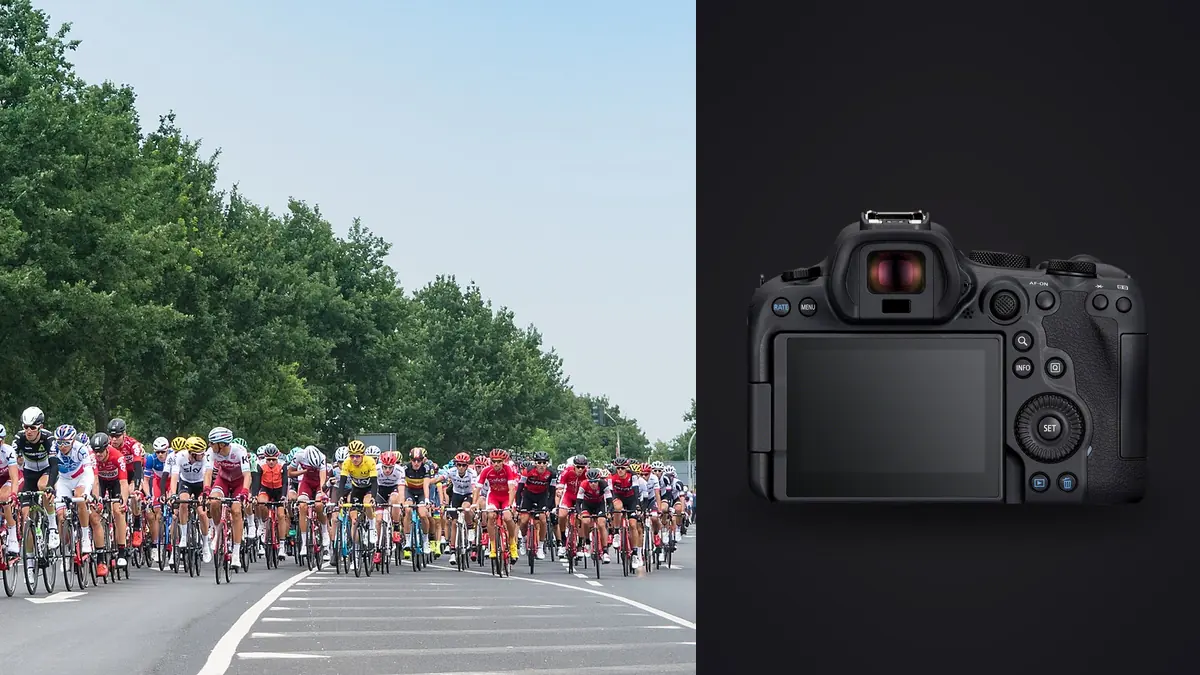
I picked up the R6 Mark II specifically because my old body couldn't keep up with relay exchanges. Two seasons of shooting a regional track program later, I have a pretty settled opinion on it: this is a genuinely strong camera for track and field, but it has one real weakness that nobody selling it to you will bring up first, and a couple of settings quirks that took me longer to sort out than they should have. This isn't a spec sheet regurgitation. It's what actually happens when you point this body at a 4x100 exchange, a pole vault runway, or a shot put ring under stadium lights.
Why It Copes With a Meet's Chaos in the First Place
Track and field is a strange sport to shoot because it's not one sport, it's eight or nine happening at once across a stadium. Sprinters are coming at you head-on, the long jump pit is behind you, and somewhere a javelin is in the air. The R6 Mark II's Dual Pixel CMOS AF II system handles this better than I expected coming from an older Canon body. The deep-learning subject detection (People mode, specifically) locks onto a runner's torso and head even when three other athletes are crossing the frame during a pack start in the 800m. It doesn't get confused by lane lines or the anti-slip texture on the track surface the way older contrast-detect systems used to.
In-body stabilization matters more here than you'd think, and not for the reason people assume. I'm rarely shooting at shutter speeds slow enough to need it for handholding. What it actually helps with is keeping the finder steady during long panning sequences with the 100-500mm at full extension, which makes it easier to hold AF on a runner's face through a full 100m sprint rather than losing them off the side of the frame halfway down the track.
Where the AF system still occasionally embarrasses itself: field events with a lot of background clutter. Shot put and discus rings at smaller meets often sit close to a fence line, a scoreboard, or a cluster of other athletes warming up. I've had the camera grab a spectator's bright jacket instead of the thrower more than once. It's not a dealbreaker, but it's a reason I still keep a single center AF point mapped to a back button as a fallback rather than trusting subject detection blindly in every situation.
Frame Rates and the Buffer Problem Nobody Warns You About
On paper, 40fps electronic shutter sounds like it solves every timing problem a sprint finish or a pole vault bar clearance could throw at you. In practice, there are three things that limit how useful that number actually is at a real meet, and all three matter more for track than for something like tennis or basketball.
Rolling shutter shows up exactly where you'll notice it
The R6 Mark II doesn't have a stacked sensor, so the electronic shutter reads the frame line by line rather than all at once. For most track and field work this is a non-issue. But pan fast across a sprinter at full extension with the electronic shutter and you'll occasionally get a slight lean or skew to the runner's body, especially their trailing leg, in individual frames. It's subtle enough that most viewers never notice, but if you're delivering large prints for a team banner or a school display, it's worth catching before it goes to the printer. I've started defaulting to the mechanical shutter for anything I know is getting printed large, and saving the 40fps electronic mode for web galleries and quick turnaround social content where nobody's pixel-peeping.
The buffer runs out faster than the frame rate suggests
Canon's own numbers put RAW buffer depth at 40fps somewhere in the range of 75 to 140 frames depending on card speed and whether you're shooting RAW alone or RAW+JPEG, and in practice with a fast UHS-II card I land closer to the lower end of that once I've been shooting RAW for a full 100m race. That's under two seconds of continuous 40fps shooting before the camera slows down to clear the buffer. For a 100m final that's fine. For an extended sequence like a full triple jump approach and landing, or a pole vault attempt from the plant through the bar clearance, I've hit the wall mid-sequence and missed the frame right after the bar because the buffer was still writing.
There's no CFexpress slot, and that changes your card strategy
This one catches people off guard. The R6 Mark II uses dual UHS-II SD slots, not CFexpress. That's not a flaw exactly, SD cards are cheaper and more available at a meet if you forget one, but it does mean your buffer clearing speed has a hard ceiling that a CFexpress-equipped body like the R3 doesn't share. If you're planning to lean on 40fps bursts through an entire meet, buy the fastest UHS-II cards you can find and don't assume the camera will keep pace with your finger.
| Shooting mode | Rate | Rolling shutter risk | Realistic buffer | Where I use it |
|---|---|---|---|---|
| Mechanical shutter | 12fps | None | Deep, rarely an issue | Sprint finishes and anything headed for a large print |
| Electronic (silent) shutter | 40fps | Noticeable on fast pans | ~2 seconds of RAW before it stalls | Baton exchanges, bar clearances, web/social delivery |
| RAW burst with pre-shooting | 30fps | Moderate | Captures up to 0.5s before full press | Unpredictable moments: false starts, a jumper's exact takeoff |
| Electronic first-curtain | 12fps | Low | Deep | Field events shot from a tripod, less time pressure |
Lens Pairings That Actually Earn Their Keep
I get asked constantly what lens to buy first for track and field, and the honest answer depends on where you're allowed to stand. Most meets keep photographers off the infield except for credentialed press, which changes the math completely.
If you're shooting from the stands or a fence line at a normal high school or club meet, the RF 100-500mm f/4.5-7.1 is the lens that gets used the most across a full meet. It covers the far side of the track for the 200m and 400m, reaches into the field event area for throws, and still lets you frame tight on a finish line from a reasonable distance. The variable aperture is the honest tradeoff: by 500mm you're at f/7.1, which is workable in daylight but gets rough once a meet runs into evening under stadium lights.
If you get infield or trackside access, the RF 70-200mm f/2.8 becomes the more useful lens for relay exchanges, hurdles, and the finish line itself, where you're often closer than you'd expect and want the wider aperture for a shallower background and better low-light performance under floodlights. I keep the 70-200mm on the body for anything happening in the first 100 meters of straightaway and switch to the 100-500mm for the far turn and field events.
A 1.4x teleconverter on the 100-500mm gets you to 700mm at the top end, which sounds great for distant field events, but autofocus does noticeably slow down and hunt more in anything but bright daylight. I only reach for that combo for javelin and hammer throw, where the action is far from any vantage point and I have time to let the AF settle before the athlete releases.
Autofocus Settings I Actually Dial In Before First Call
Default AF case settings are tuned for general use, and I've found a few adjustments make a real difference specifically for track's mix of predictable and chaotic motion.
For sprints and hurdles, I bump tracking sensitivity toward "locked on" rather than the default responsive setting. Runners in adjacent lanes crossing near your subject during a pack finish will otherwise pull focus away at the worst possible moment. For field events, I flip the other direction and use a more responsive case, because a long jumper's approach speed and body position change fast right before takeoff and I want the camera reacting to that change rather than holding stubbornly on an earlier point.
Subject detection set to People with eye detection on works for the vast majority of track and field. I only turn it off for the pole vault runway, where the pole itself and the athlete's inverted position through the clearance sometimes confuses eye detection enough that a single well-placed AF point tracks the bar clearance more reliably than the automated system does.
Back-button focus is non-negotiable for me at a meet. Separating focus activation from the shutter button means I can pre-focus on a spot on the track (the first hurdle, the takeoff board) and just wait for the athlete to arrive rather than re-acquiring focus on every frame of a burst.
Getting Through the Take Without Losing the Rest of Your Weekend
Here's the part almost nobody talks about when they review this camera: what happens after the meet. A single 40fps burst through one 200m race can produce 200 to 300 frames by itself. Multiply that across heats, finals, and field events at a full-day meet and you're looking at several thousand images to get through before you can deliver anything to a team, a parent, or a school newspaper.
This is where I actually changed my workflow, not my camera settings. I run everything through imagic before I touch an editor, because its local sharpness and focus scoring flags the frames where the R6 Mark II's AF genuinely missed, which happens more often in a 40fps burst than the marketing suggests, especially on those cluttered field-event backgrounds I mentioned earlier. It also clusters the burst sequences automatically, so a 45-frame baton exchange collapses down to the handful of frames actually worth reviewing instead of me scrolling through near-duplicates one at a time. For anyone shooting youth track meets, the fact that this all runs locally rather than uploading a card full of images of other people's kids to some cloud service is not a small detail, it's one of the reasons I trust the workflow at all.
The other piece that's saved me real time is the apply_my_style preset, trained on my own past edits rather than some generic sports preset. Track meets run under wildly inconsistent light, bright midday sun for the morning heats, harsh mixed shadow under a stadium roof by evening finals, and having a starting point that already reflects how I personally handle that instead of building color grading from scratch every single meet cuts a meaningful chunk out of a Sunday night editing session. If you haven't sat down and worked through how a culling pass should actually flow before you get to color, it's worth reading through how AI photo culling actually works and adjusting your own process, because the gains compound across a full season, not just one meet.
A Meet That Changed How I Shoot This Camera
Late last spring I was covering a conference championship where the 4x400 relay came down to the final exchange, and I had the 100-500mm mounted because I'd been shooting the pole vault ten minutes earlier. I didn't have time to swap lenses, so I was stuck shooting the anchor leg exchange from further back than I'd have liked, at 40fps electronic. The buffer choked about a second and a half into the sequence, right as the baton actually changed hands, because I'd already burned through most of it holding the shutter down waiting for the runners to arrive. I got the moment before and the moment after. Not the moment itself.
That's on me, not the camera, but it's exactly the kind of mistake this body will let you make if you treat 40fps as a safety net instead of a tool you have to manage. Since then I hold the shutter in shorter, more deliberate bursts timed to the actual exchange zone rather than spraying the whole approach, and I haven't missed that shot again.
Frequently Asked Questions
Is the R6 Mark II fast enough to freeze a clean 100m sprint finish?
Yes, comfortably. Even the 12fps mechanical shutter gives you a frame roughly every 80 milliseconds, which is plenty of resolution around a finish line where the whole race is over in about ten seconds. The 40fps electronic mode is more useful for catching the exact moment of a lean or a photo-finish tie than the mechanical shutter is, since you're getting more candidate frames across that split second.
Does the rolling shutter issue actually matter for track and field, or is that only a motorsport problem?
It matters less than for motorsport, where subjects move much faster across the frame, but it's not nothing. Fast pans on sprinters at 40fps electronic can show slight skew on a trailing limb. For web galleries and social posts it's rarely visible. For large prints or anything where a coach or parent is going to study the image closely, I'd shoot mechanical or first-curtain electronic instead.
What's the one lens to buy first if I'm only shooting track meets from the stands?
The RF 100-500mm f/4.5-7.1. It covers the far side of the track, reaches into most field events, and still lets you get reasonably tight on the near straightaway. The 70-200mm f/2.8 is the better second lens once you get infield or trackside access, but it's not the one I'd buy if I could only own one.
Do I need CFexpress cards for this camera, and does it hurt buffer performance not having that option?
No, the R6 Mark II only takes SD cards (dual UHS-II slots), so CFexpress isn't a purchase decision you need to make. It does mean your buffer clears more slowly than a CFexpress body like the R3 or R1, which is the practical reason to shoot deliberate, shorter bursts rather than holding the shutter down through an entire race and hoping the buffer keeps up.