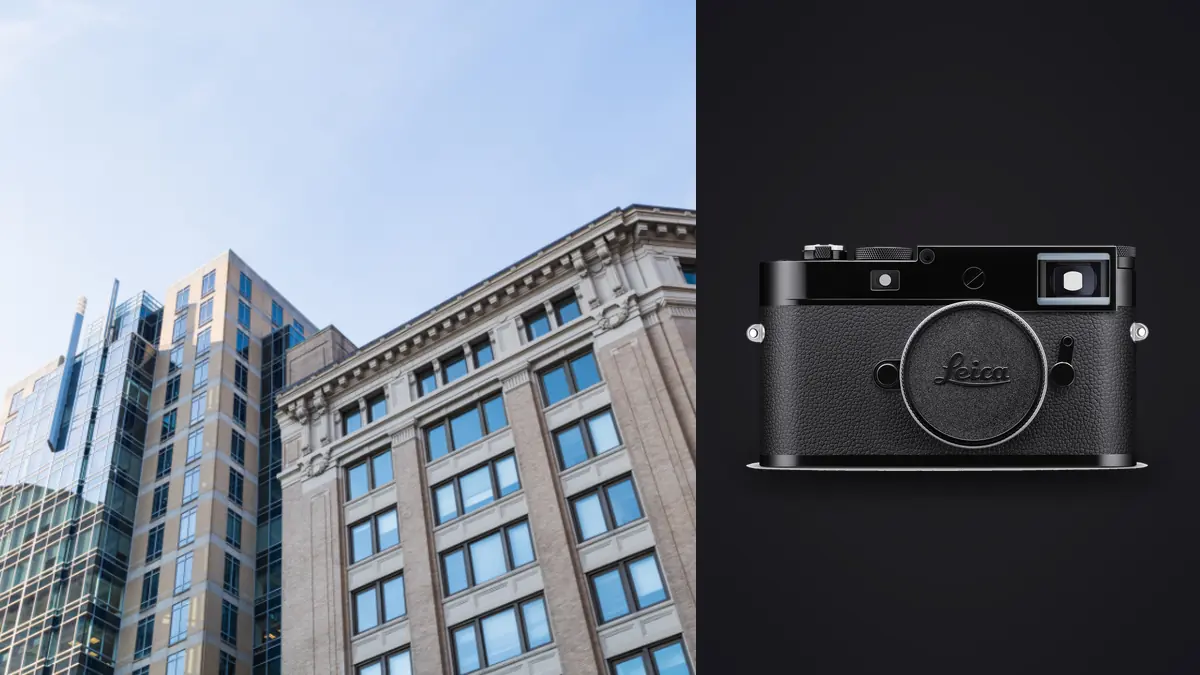
The first thing anyone who shoots buildings for a living will tell you is that a rangefinder is a strange tool for the job. No tilt-shift mount, no autofocus, no in-body stabilization, and a viewfinder that shows you an approximation of the frame rather than the frame itself. And yet I've now shot three boutique hotel projects and a run of high-end residential listings with an M11 as the primary body, and I keep coming back to it for reasons that have nothing to do with tradition or Leica mystique. It comes down to file quality per gram of gear, and how little the camera gets in the way once you've accepted its limits.
Why bring a rangefinder to a job that's usually shot with view cameras or shift lenses
Architectural and interior work has traditionally leaned on tilt-shift optics or actual view camera movements because verticals matter more than almost anything else in the frame. A slightly converging doorway reads as amateur work to a client even if the light and composition are otherwise excellent. Leica doesn't make a shift lens for the M mount, full stop. So if you're expecting this article to tell you the M11 replaces a Canon TS-E setup or a Cambo Actus, it doesn't, and I'd be lying if I said otherwise.
What it does instead is trade optical correction for resolution and file quality, and let you fix perspective in post with enough pixel headroom that the crop doesn't cost you anything visible in the final delivery. A 60-megapixel sensor with genuinely excellent Leica glass in front of it gives you room to pull a frame back into square without the file falling apart at print size or even large web display. For a lot of interior work, especially real estate and boutique hospitality where turnaround matters more than technical perfection, that trade is a good one.
The kind of jobs where this actually makes sense
I wouldn't take an M11 onto a commercial architecture shoot for a developer's marketing package where the client expects pixel-perfect verticals straight out of camera and has budgeted for a view camera operator. That's still shift-lens or digital back territory. Where the M11 earns its keep is smaller interior jobs: boutique hotels, short-term rental listings, restaurant interiors, design studio portfolios, the kind of work where you're moving through eight or ten rooms in an afternoon and speed matters as much as technical purity.
The triple-resolution sensor matters more here than the megapixel number suggests
The M11's sensor shoots DNG at three selectable resolutions rather than one fixed output, and this is the feature that actually changes how I approach interiors, not the raw megapixel count everyone talks about. You choose the mode before the shoot depending on how much crop room you expect to need for correcting verticals or reframing tight doorways.
| DNG mode | Resolution | Approx. file size | Crop headroom for correction | When I actually use it |
|---|---|---|---|---|
| L-DNG (full) | 60 MP (9528 x 6328) | 75-85 MB uncompressed | Generous, can lose 20-25% of frame and still deliver large | Hero shots, lobby and living room wides where verticals need heavy correction |
| M-DNG | 36 MP (7416 x 4928) | 45-55 MB | Moderate, fine for minor lean correction | Bracket sets and detail shots where I don't expect much reframing |
| S-DNG | 18 MP (5152 x 3427) | 22-28 MB | Minimal, use only when verticals are already close | Walkthrough documentation shots, agent reference frames, buffer-heavy days |
On a typical interior day I'm shooting L-DNG for anything going into the final gallery and dropping to M-DNG for supporting detail shots (light fixtures, tile work, hardware) where I know I won't need to fight perspective. That alone probably saves me a third of my card space over a day without changing the look of the delivered images at all, since nobody's cropping a cabinet pull shot 20% into square.
Lenses: what earns a spot in the bag and what doesn't
Interior work lives and dies on your wide end, and this is where M-mount glass genuinely surprises people who assume rangefinder lenses are built for street photography and portraits. Leica's wide primes were designed with very flat field performance and minimal barrel distortion as a priority, because rangefinder users have never had in-camera distortion correction to lean on the way SLR and mirrorless shooters do.
| Lens | Max aperture | Close focus | Distortion character | Interior use case |
|---|---|---|---|---|
| Super-Elmar-M 21mm ASPH | f/3.4 | 0.7 m | Very flat, minor barrel only at the extreme edge | Small bathrooms, tight kitchens, anything under 12 sq. meters |
| Elmarit-M 28mm ASPH | f/2.8 | 0.7 m | Essentially neutral, no visible correction needed | Default living/dining room wide, my most-used lens on interior days |
| Summicron-M 35mm ASPH | f/2 | 0.7 m (0.3 m w/ macro adapter) | Neutral, slight pincushion at close range | Bedrooms, detail vignettes, low-light dusk shots where the extra stop helps |
| Tri-Elmar-M 16-18-21 | f/4 | 0.5 m | Handled well per click-stop but not truly zoomable | Scouting a space before committing to a fixed wide, not a primary tool |
The 28mm is the lens I'd keep if I could only bring one. It's wide enough for most North American and European room sizes without the exaggerated foreground-background separation that a 21mm introduces, and Leica's correction on this particular optic is close enough to distortion-free that I rarely touch a lens profile in post. The 21mm comes out for genuinely cramped spaces, mostly bathrooms and galley kitchens, and it needs more careful leveling because anything wider than 28mm starts to show its geometry the moment the camera isn't dead level.
Focusing a rangefinder in rooms that don't move
This is the part that sounds worse on paper than it is in practice. Interiors are static subjects. You're not tracking a running child or a bird in flight, you're focusing on a doorframe or a piece of furniture that will sit still for as long as you need it to. The coupled rangefinder patch is honestly faster than fumbling with autofocus point selection on a mirrorless body once you're used to it, because you're placing focus exactly where you want it rather than trusting a subject-detection algorithm to guess what matters in a room full of straight lines and reflective surfaces.
Where it gets genuinely harder is very low light, evening shoots in restaurants or hotel bars where the ambient is down to candlelight and accent lamps. The rangefinder patch gets harder to read precisely below a certain light level, and that's when I switch to the Visoflex 2 electronic viewfinder with focus peaking turned on. It adds a small amount of setup time and a slightly less elegant shooting experience, but it removes any guesswork, and for anything that matters I'll always take the slower, certain method over a beautiful but soft frame.
What close focus limits actually cost you
Most M lenses top out around 0.7 meters of minimum focus distance without an adapter, which is longer than you'd want for shooting small product-style detail work: a faucet, a light switch plate, a stack of folded towels. If detail shots like that are a regular part of your deliverable, budget for the macro adapter on the 35mm Summicron or plan to bring a second body with a lens that focuses closer. Picture a boutique hotel job where the client wants amenity close-ups and half of them have to be reshot on a backup camera because the M11 setup simply can't get close enough.
Fixing verticals without shift glass
Since there's no optical correction happening at capture, every frame with visible verticals gets straightened in Lightroom or Capture One using the guided upright tools, and this is exactly where shooting L-DNG pays off. A 60-megapixel file gives you enough real estate that pulling the top or bottom of a frame in to correct a lean rarely drops you below the resolution you need for a full-page magazine spread or a large web hero image, let alone a listing photo.
My actual process on site: shoot slightly wider than the intended final crop on purpose, keep the camera as close to level as I can manage with a small bubble level on the hot shoe, and accept that I'll lose 10-15% of the frame edges to correction later. It's not as clean as a tilt-shift lens getting it right in camera, but it's fast, and fast matters when you're contracted for a half-day shoot across an entire property.
Where the actual bottleneck shows up afterward
Here's the part nobody mentions when they're talking about camera gear: a single interior room, bracketed for a mixed-lighting scene with window daylight and warm tungsten lamps, easily produces five to nine exposures per angle. Multiply that across a dozen rooms in a property and you're looking at well over a hundred nearly-identical 75MB files by the end of the day, and picking the sharpest, best-exposed frame out of each bracket by eye on a laptop screen is where the real time goes, not the shooting itself.
This is the point in the workflow where I actually rely on imagic. It runs its sharpness and focus scoring locally on the machine, so it flags the genuinely sharpest frame in each bracket set without me eyeballing every exposure at 100% zoom, and because everything processes offline with no cloud upload, unreleased interior shots of an unlisted property or a hotel that hasn't announced its renovation never have to pass through anyone's servers before the owner has approved release. For NDA-bound commercial interiors that matters more than people expect. The duplicate and burst clustering also groups those five-to-nine-frame brackets automatically, so instead of scrolling through a flat folder of a hundred and forty near-identical files I'm reviewing maybe fifteen clustered groups. If you want more on how that scoring actually works under the hood, I wrote about it separately in how AI photo culling works.
The other piece that's been useful across a run of similar interior jobs is imagic's apply_my_style preset, trained on my own past edits rather than a generic preset pack. Interior work tends to need a consistent white balance and contrast approach across a whole property so the gallery doesn't look like ten different photographers shot it, and having a preset that's actually learned from my own prior color decisions on similar mixed-lighting rooms gets me to a consistent starting point faster than building looks room by room from scratch.
What I'd actually tell someone before they buy one for this
If you're already shooting interiors professionally with a shift-lens SLR or mirrorless kit and it's working, I wouldn't tell you to switch. The M11 doesn't do anything a well-corrected tilt-shift system can't do better in camera. What it's good for is a specific niche: photographers who want extremely high file quality in a compact kit, who are comfortable correcting perspective in post rather than at capture, and who value the discretion of a small, quiet camera when shooting occupied spaces like working restaurants or lived-in homes where a bulky rig draws attention. The body alone runs close to $9,000 and a couple of good wide primes will add another $6,000-$8,000 on top of that, so this isn't a budget path into architectural work by any measure. It's a tool for people who already have a reason to want Leica glass and are willing to build their perspective-correction workflow around post-production rather than expecting the lens to do it.
For anyone weighing whether the file review and culling side of a shoot like this is worth optimizing, it's worth a look at general workflow speed too, not just gear. I covered some of that ground in 10 tips for a faster photo workflow, most of which applies just as well to a bracket-heavy interior shoot as it does to any other genre.
Frequently Asked Questions
Can you correct converging verticals without a tilt-shift lens on the M11?
Yes, but only in post-production. There's no in-camera or optical correction on the M mount, so you shoot with intentional extra frame margin and straighten verticals afterward in Lightroom's or Capture One's upright tools. Shooting in the full 60MP L-DNG mode gives you enough resolution headroom that the crop from correction rarely costs you visible quality in the final delivery.
Is the M11 fast enough to shoot a full property in a half-day session?
For a typical residential or boutique hotel property, yes, once you've built a routine around it. The limiting factor isn't shutter speed or buffer, it's the manual focus and manual perspective planning per room, which adds a beat of setup time compared to an autofocus body. Most photographers doing this regularly find their per-room pace evens out after a few jobs.
Which M-mount lens should I buy first if I'm shooting mostly interiors?
The Elmarit-M 28mm ASPH is the most versatile starting point for typical room sizes, with distortion low enough that most frames need no correction at all beyond leveling. Add the 21mm Super-Elmar only once you're regularly running into rooms too tight for the 28mm to cover.
Does the lack of autofocus actually slow down a static interior shoot?
Less than you'd expect, because interiors don't move. The coupled rangefinder patch is fast and precise for stationary subjects in reasonable light. It only becomes genuinely slower in very dim evening interiors, where switching to the optional Visoflex EVF with focus peaking is the more reliable option even though it adds a step.