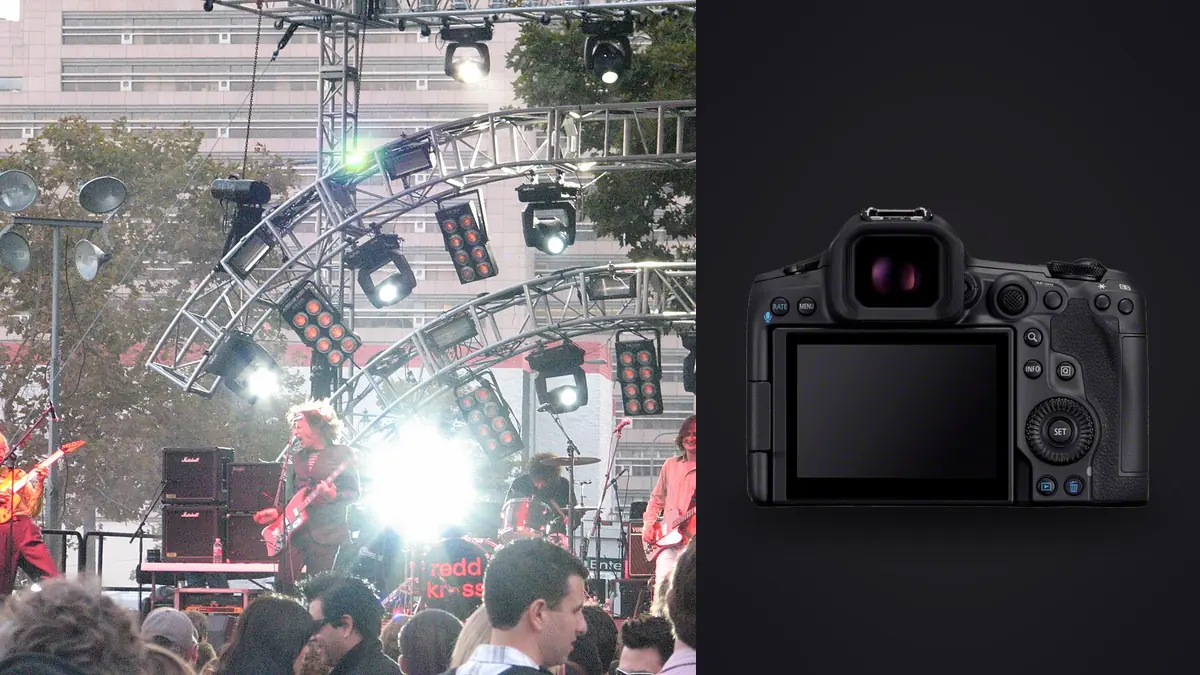
I picked up the R5 Mark II three songs before doors opened at a 900-capacity room, which is not how you're supposed to learn a new body, but touring photographers rarely get the luxury of a shakedown week. By the end of that first three-song pit session I had a decent sense of what Canon changed and, more usefully, what it didn't. This isn't a spec dump. It's what actually mattered once the house lights dropped and a singer started throwing himself at the barricade.
The stacked sensor changes the pit experience more than the numbers suggest
The original R5 was a very good camera that happened to have a rolling shutter problem nobody in a concert pit could ignore. Skew a swinging guitar neck or a drummer's stick at the wrong shutter speed with the electronic shutter engaged and you'd get a slight lean in the frame, subtle enough that most people rarely noticed but obvious enough that it bugged the hell out of me. The Mark II's stacked, backside-illuminated sensor reads out fast enough that I stopped thinking about it. I ran electronic shutter for an entire festival weekend, three stages, in full sun and under LED walls at night, and never once had to switch back to mechanical to protect a shot.
That matters more in a pit than it sounds like it should. Photo pits are loud, cramped, and full of security who will tap you on the shoulder the moment your shutter clacks during a quiet acoustic intro. Silent electronic shooting at up to 30fps means I can burst through a jump or a mic-stand toss without the drummer hearing me over his own snare, and without an usher three rows back giving me a look during the ballad.
Eye Control AF is genuinely useful when a singer won't stop moving
I was skeptical of Eye Control AF when Canon brought it back from the R3. On paper it sounds like a gimmick for wildlife shooters tracking birds through foliage. In a pit, with a monitor wedge six feet from my knees and a singer who covers the entire stage width in a single verse, it turned out to be the single feature that changed how I shoot. Calibrate it properly (do this in a quiet moment before doors, not while house lights are still up and your pupils are behaving differently than they will under stage lighting) and you can glance at a guitarist's face, let the camera lock focus there, then flick your eye to the drummer mid-fill without touching a joystick. It's not perfect. It drifts if your eye relief changes, which happens constantly if you're wearing a lanyard or shifting a second body slung across your chest. But even at 70% reliability it beats hunting for a focus point with your thumb while trying not to elbow the shooter next to you.
Subject detection with people priority does the heavy lifting the rest of the time. Face and eye tracking holds through hair whips and quick spins better than the original R5 ever did, though I'll say plainly it still occasionally locks onto a security guard's face at the edge of frame instead of the vocalist, so I don't treat it as fully hands-off.
What the ISO ceiling actually buys you in a real club
Every camera brand claims usable high ISO these days, so I care less about the marketing number and more about where I personally stop trusting a file for printing. On the R5 Mark II I'm comfortable printing and sharing files shot at ISO 6400 without much thought, I'll push to 12800 for anything that's going to run small, and I keep 25600 in my back pocket for the genuinely underlit dive bars where the alternative is a blurred, useless frame. Above that the files are recoverable for web use but I'm doing real noise reduction work, not just a light touch.
The 45-megapixel resolution is a mixed blessing here. It gives me room to crop a wide shot into a tight one after the fact, which can save a night where you can't get closer to the stage than the barricade allows. But more megapixels packed into a full-frame sensor also means each individual photosite is smaller than on a camera like the R6 Mark II, and it shows at the extreme end of the ISO range. If your work is almost entirely tiny dark clubs at ISO 12800 and up, the resolution trade might not favor the R5 II over a lower-megapixel body, and I'd rather be honest about that than pretend resolution is free.
| Venue type | Typical light situation | ISO I actually set | Shutter mode | AF setup I use |
|---|---|---|---|---|
| Small club or bar stage | Single wash, often warm and dim, 50-150 lux | 6400-12800 | Electronic, silent | Eye Control + people priority, wide zone |
| Mid-size theater (seated) | Controlled rig, follow spot present | 3200-6400 | Electronic or mechanical | Single subject tracking, spot AF for follow-spot moments |
| Arena show | Bright moving heads, big contrast swings | 1600-4000 | Electronic, high fps for bursts | People priority, action-priority off unless it's a very physical set |
| Outdoor festival, daylight set | Full sun, hard shadows under brim of hats | 100-400 | Mechanical (avoids any banding risk near LED screens) | Continuous AF, wide zone, high-speed burst for jumps |
| Outdoor festival, night set | LED walls, strobes, pyro | 1000-3200 | Electronic, watch for strobe banding at fast shutter | Eye Control if calibrated, otherwise single point locked to vocalist |
| Orchestra pit or seated classical | Bright, even, but zero tolerance for shutter noise | 800-1600 | Fully silent electronic, mandatory | Single point, manual recompose, minimal movement anyway |
A note on LED wall banding
One thing that caught me out early: shooting electronic shutter at a fast rate under an LED video wall can introduce banding that has nothing to do with the camera's flicker-reduction setting working properly, it's a refresh-rate mismatch between the wall and your effective readout speed. The R5 Mark II's anti-flicker mode helps with traditional stage lighting flicker, but for LED walls specifically I've had better luck dropping shutter speed slightly (1/500 instead of 1/1000 where the action allows) or, when the wall is the dominant light source and the banding won't quit, switching to mechanical shutter for that section of the set even though it means giving up some silence.
Buffer depth and why it stopped mattering
With the original R5, RAW buffer depth was the thing I complained about most to other pit photographers. Fire off a burst through a big chorus moment and you'd feel the camera choke, the fps rate visibly dropping as the buffer filled. The Mark II, paired with a fast CFexpress card in the primary slot, doesn't do that in any three-song pit scenario I've thrown at it. I've held the shutter through an entire drum fill and chorus hit, well over a hundred RAW frames, without feeling a stutter. That's the kind of improvement that doesn't show up on a spec sheet comparison chart but changes how confidently you shoot. I stopped babying the shutter button and started trusting that the shot I wanted would actually be there when I got home.
The dual card slots (CFexpress Type B plus UHS-II SD) matter more in this genre than most. A one-night festival headline set doesn't happen again if a card fails. I run RAW to both cards during anything I'd call irreplaceable, and JPEG backup to the SD slot only for lower-stakes support-act coverage where speed of file access matters more than redundancy.
Lenses that actually earn their place in a three-song pit
Pit access is almost always the first three songs, no flash, shoot from the barricade or a narrow pit lane, and you rarely get to move much once you've claimed a spot. That constraint shapes lens choice more than any camera feature does.
- RF 28-70mm f/2: heavy, but the extra stop over an f/2.8 zoom is real in a dim club, and I use it as my one-lens solution when I know I'll be stuck in a fixed pit position all night.
- RF 70-200mm f/2.8: my most-used lens for anything mid-size or bigger, since stage depth means the singer might be 15 feet from the barricade one moment and 40 feet away by the end of the song.
- RF 50mm f/1.2 or RF 85mm f/1.2: for venues where you can get genuinely close, tight portraits with that lens rendering are the frames that tend to get licensed for posters and press.
- RF 24mm f/1.4: underrated for wide crowd-and-stage context shots from the side of the pit, especially with festival lighting rigs in frame.
In-body stabilization rated to 8.5 stops sounds academic until you're shooting a slower ambient-light frame at 1/30s to catch a lighting sweep without motion blur wrecking the whole image. It genuinely extends what's usable at the bottom end of your shutter range, though it obviously does nothing about a moving subject, only camera shake.
The part nobody puts in the spec sheet: what happens after the show
A three-band bill with pit access on all three acts can leave you with 2,500 to 4,000 RAW files by 11pm, and you're usually filing something for a publication or the venue within 24 hours. This is where I stopped trying to eyeball every frame in a Lightroom grid at 1am. I run the night's card through imagic first, mostly for two things: its local sharpness and focus scoring flags which of those hundred-plus frame bursts actually landed critical focus on the eyes rather than the moving mic or a stray hand, and its duplicate and burst clustering collapses those bursts down to the handful worth reviewing instead of me scrubbing through all of them manually. Because it runs entirely offline on my laptop, I'm not uploading a headline act's unreleased setlist photos to anyone's server before the tour photographer or the band's team has cleared them, which matters more in this genre than most people outside it realize.
Once the culling pass is done, I lean on the apply_my_style preset, trained on my own past concert edits rather than a generic look, to get a fast first pass across the surviving frames before I do the handful of hero shots manually. It won't replace judgment on the two or three images that actually run somewhere, but it removes the repetitive grading work on the other ninety files, which is the part of a concert night that used to eat my Sunday morning.
Frequently Asked Questions
Is the R5 Mark II's silent shutter actually silent enough for a seated acoustic or classical show?
Yes, in my experience it's genuinely silent to anyone more than a couple of feet away, which covers essentially every seated venue situation. The one caveat is that the camera itself isn't the only noise source in a quiet room, your own movement, a strap buckle, or a second body knocking against a monitor wedge will carry further than the shutter does. Silent shutter solves the mechanical clack, it doesn't make you invisible.
Do I need the RF 28-70mm f/2, or is an f/2.8 zoom enough for club lighting?
For most mid-size and larger venues, f/2.8 is enough given how capable the sensor is at ISO 6400 and above. The f/2 zoom earns its weight specifically in the smallest, dimmest rooms where you're already pushing ISO past 12800 and that extra stop buys you a meaningfully cleaner file or a faster shutter speed to freeze motion. I wouldn't buy it purely for concert work unless dive bars and basement venues are a regular part of your calendar.
Does Eye Control AF still work with glasses, a lens hood in the way, or monitors right in your face?
It works with glasses for most people, though calibration takes more patience and can drift more over a night. A lens hood doesn't interfere since the sensor is reading your eye, not your subject. Bright monitor wedges or strobing stage lights pointed near your face are the real disruptor, they can throw off the eye-tracking sensor's read temporarily, so I treat Eye Control as a strong assist rather than something to bet an entire set on.
CFexpress versus SD for a three-band night, does the difference actually matter?
It matters for buffer clearing speed during long bursts and for backup redundancy, less so for raw file safety on any single card, both formats are reliable when they're not cheap ones. I keep CFexpress as primary for its write speed during long RAW bursts and use the SD slot for simultaneous backup on anything I can't reshoot. If your camera is only writing to SD, you'll notice the buffer take longer to clear after a big burst, which is the moment you're most likely to miss the next shot.