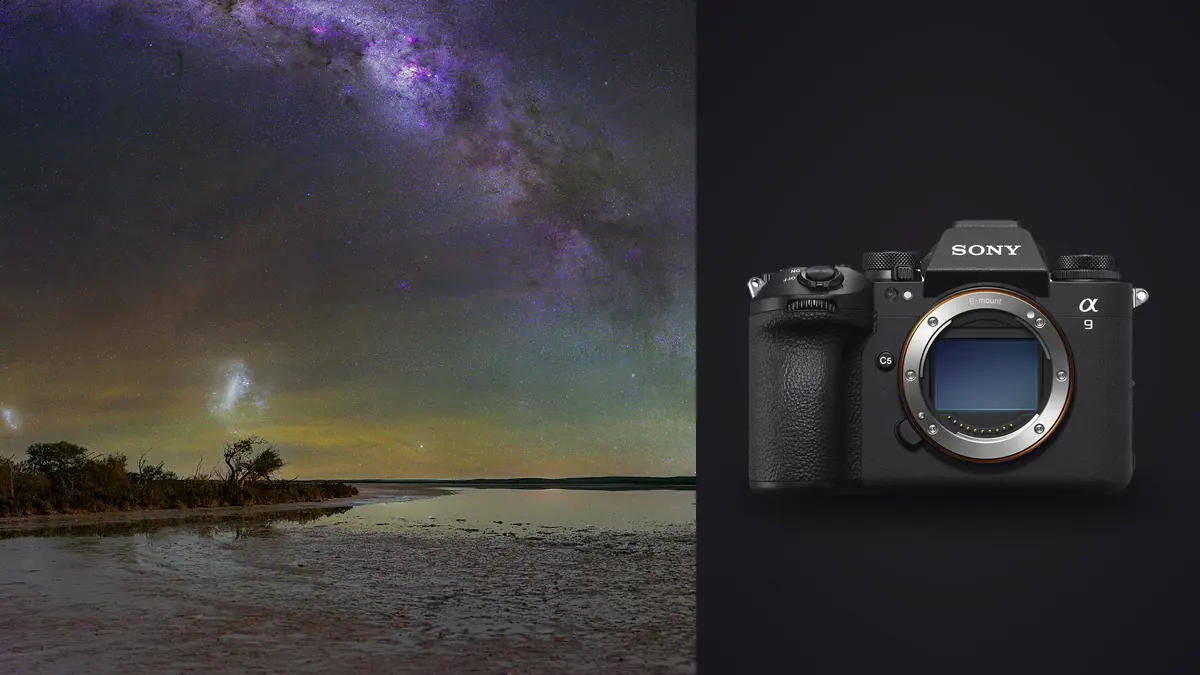
The Sony A9 III was built for sports shooters chasing puck drops and photo finishes, not for someone standing in a gravel pullout at midnight waiting for the Milky Way core to clear a ridgeline. That mismatch is exactly why it's worth talking about. It has quirks a dedicated astro camera wouldn't have, starting with a base ISO of 250 instead of the usual 100. It runs a global shutter sensor that nobody at Sony was thinking about tracked 90-second exposures when they designed it. And yet, after three seasons of hauling one up dirt roads in the desert and along ridgelines in the Sierra foothills, I've come around on it for star work, with some real caveats attached.
A Sports Sensor Doing Night Work
Global shutter gets marketed for its ability to kill rolling-shutter skew on fast subjects, which is irrelevant to a stationary tripod pointed at Polaris. What matters more for astro is the noise behavior underneath it. Stacked global shutter designs need extra per-pixel circuitry to read every photosite at once instead of scanning row by row, and in my experience that circuitry costs you a bit at the noise floor compared to a conventional backside-illuminated sensor of the same generation. It's not dramatic, and stacking dozens of subs buries a lot of it anyway, but at 100% crop on a single sub shot at ISO 6400, the A9 III is noisier than an A7R V file at the same ISO. That's worth knowing before you build your whole workflow around this body specifically for astro.
The base ISO of 250 is the other quirk that catches people off guard. Most full-frame bodies bottom out at 100, which gives you more clean headroom to push exposure in post before noise becomes the limiting factor. The A9 III can't go there natively (125 extended, but extended ISO on any Sony body tends to just be a tone curve trick, not real gain reduction). Practically, this means your "clean" shots at night are already starting from a slightly hotter baseline than you'd get on a camera built for landscape and astro work.
Where the body actually helps: the blackout-free electronic viewfinder makes star-hopping and manual focus confirmation genuinely easier than on a camera that blacks out between frames, and the buffer is deep enough that you can fire a burst of test exposures to nail focus and framing without waiting on write times. Neither of those show up in a spec sheet comparison, but both save real minutes in the field when your fingers are numb and you're trying to get a tracker polar-aligned before the good light window closes.
Settings That Actually Matter at 2 A.M.
Shoot uncompressed or lossless compressed raw, not the standard compressed option. Standard compression on Sony bodies is lossy in the shadows, which is precisely where your star stack data lives. Set long exposure noise reduction off entirely if you're stacking (the dark frame subtraction happens later, in software, across your whole set) but leave it on if you're shooting single untracked frames you plan to use straight out of camera. White balance doesn't matter for raw capture, but I set it to a fixed 3800K anyway so my LCD preview at 2 A.M. actually resembles what the sky looks like, rather than the neon-orange mess auto white balance produces under a sodium-lit horizon.
Aperture wide open is standard advice, but on most fast primes I'll pull back a third to two-thirds of a stop from wide open to tighten up coma in the corners. A 24mm f/1.4 shot at f/1.4 will smear stars into little seagulls near the frame edge; shot at f/2, that mostly cleans up. For untracked single frames, the exposure ceiling before trailing becomes visible is a straightforward function of focal length. Here's what I actually use in the field, checked against 100% crops rather than pulled off a calculator:
| Focal Length | Aperture Used | Untracked Ceiling (single sub) | Subs Needed for ~20 Min Integration |
|---|---|---|---|
| 14mm | f/1.8 | 10 sec | ~120 subs |
| 20mm | f/1.8 | 8 sec | ~150 subs |
| 24mm | f/1.4 | 6 sec | ~200 subs |
| 35mm | f/1.4 | 4 sec | ~300 subs |
| 50mm | f/1.2 | 3 sec | ~400 subs |
That right-hand column is why nobody stacks 50mm shots untracked for fun. It's technically possible, but you'll be sitting at your tripod for the better part of an hour babysitting a intervalometer for a stack you could get in twelve minutes with a tracker doing 90-second subs instead.
Tracked Rigs vs a Bare Tripod
The A9 III plus a fast 24mm or 35mm prime sits comfortably under the payload limit of small trackers like a Star Adventurer GTi or a SkyGuider Pro, both of which I've run it on without issue. Where the camera actually distinguishes itself on a tracker is the total absence of shutter shock, because there's no mechanical shutter to slap open and closed. On long exposures that's a minor benefit at best since vibration settles well before a 90-second exposure begins, but during the polar alignment routine, when you're firing repeated short test exposures to check drift, it adds up. No mirror slap, no shutter curtain movement, just clean reads.
Global shutter also sidesteps a problem I didn't expect to care about: banding from distant flickering light sources. Shooting anywhere near a highway, an LED billboard, or even a neighbor's motion-sensor porch light means some of your frames on a rolling-shutter body come back with faint horizontal banding where the sensor's row-by-row readout caught the light mid-flicker. On the A9 III, every pixel reads at the same instant, so that artifact simply doesn't happen. It's a small thing until you've thrown away fifteen subs from a set because a truck's headlights strobed across a rolling-shutter frame at just the wrong readout moment.
If you don't own a tracker yet and are trying to decide whether it's worth the investment for this body specifically: it is. The A9 III's noise floor being a touch higher than a dedicated astro sensor means you benefit more than most from longer, cleaner tracked subs instead of stacking a pile of short, noisier untracked ones.
From Four Hundred Subs to One Frame
A typical night for me now produces somewhere between 150 and 400 light frames, plus 30 to 40 dark frames shot with the lens cap on at the same ISO and shutter speed, plus a handful of flats if I bothered to bring a light panel. That's a lot of nearly-identical raw files to sort through, and the sorting problem is different from normal culling. You're not looking for the sharpest frame out of a burst the way you would with wildlife or sports; you're looking for which frames drifted out of focus as the temperature dropped and the lens breathed, because a cooling front moving through at 2 A.M. can shift focus on some lenses enough to soften a whole run of subs without you noticing on a small camera LCD.
This is one of the few places I actually reach for imagic in an astro workflow. I run its local sharpness scoring across the full sub set before it goes anywhere near stacking software, specifically to flag the run of frames where focus crept during a temperature swing. It processes everything on the laptop with no upload step, which matters more than usual out here since most of my astro spots have zero signal. Catching a soft run of forty subs before you feed them into DeepSkyStacker saves you from a mushy final stack that you don't diagnose until you're back home looking at it on a real monitor.
For the actual stacking, here's how the common options stack up for this specific workflow, working from Sony ARW files:
| Software | Platform | Cost | Foreground + Sky Blend | ARW Handling |
|---|---|---|---|---|
| DeepSkyStacker | Windows only | Free | No, sky-only | Native, no conversion |
| Sequator | Windows only | Free | Yes, built-in sky mask | Native |
| Starry Landscape Stacker | Mac only | ~$28 | Yes, manual masking | Needs TIFF/DNG conversion first |
| PixInsight | Windows, Mac, Linux | ~$230 one-time | No, calibration and stacking only | Native via RAW module |
For a straightforward Milky Way panorama with a blended foreground I reach for Sequator first because it's free and fast. For a deep-sky target like a nebula where I actually want proper calibration with darks, flats, and bias frames handled correctly, PixInsight is worth the steep learning curve. DeepSkyStacker sits in between and is a reasonable free option if you're only stacking sky and don't need a foreground blend at all.
Where the Editing Gets Personal
Most astro-landscape shots aren't a single exposure. You've got your tracked sky stack, and separately you've got an untracked foreground frame, usually shot during blue hour before the tracker even goes on the mount so the ground isn't smeared from the tracking motor slowly rotating the whole rig. Blending those two takes some manual masking, but the color grade across the foreground panels is where I've started leaning on imagic's apply_my_style preset. I trained it against a folder of my own finished astro-landscape edits from the past year, and running new foreground frames through it before the manual blend gets me to roughly the right starting point (shadow lift, that slightly cool cast I like on rock and sand) in seconds instead of rebuilding the same curve adjustments from scratch every single outing.
It's not a substitute for finishing the sky stack by hand, which still needs a real star-color correction pass and usually some selective noise reduction on the core of the Milky Way. But for the parts of the image that are ordinary landscape editing wearing a night photography costume, having a preset that's actually trained on your own prior work beats starting cold every time.
A Night on a Ridge Outside Joshua Tree
Last October I hauled the A9 III, a 20mm f/1.8, and a SkyGuider Pro up a fire road east of the park boundary, mostly to see whether the higher noise floor I'd measured on my desk actually mattered outside in real dark-sky conditions. Polar alignment took about eleven minutes with the app-guided routine, helped along by the blackout-free finder letting me check star position between exposures without losing my place. I ran 90-second tracked subs at ISO 800, forty of them, plus darks shot once I'd broken down the rig at the truck with the tailgate up as a wind block. Back at the truck with no signal at all, I ran the set through imagic on the laptop to check for the focus-drift problem before driving two hours home not knowing if the night was usable. Four subs near the end of the run had gone soft as the temperature dropped from the low 50s into the high 30s, exactly the pattern I'd expect from a lens that isn't parfocal across a big thermal swing. Pulling those four out before stacking took maybe ninety seconds and meant the final DeepSkyStacker run wasn't dragged down averaging in soft frames. The stack itself held up fine against the noise floor concerns; forty subs at ISO 800 buries individual-frame noise well enough that the base-250 quirk barely registered in the finished image. It only really bites you if you're judging single subs at high ISO in isolation, which nobody does with a finished stack anyway.
Frequently Asked Questions
Does the global shutter actually help with star trails, or is that marketing?
It doesn't affect trailing itself, since trailing is a function of exposure time and focal length, not readout method. What it does help with is banding from flickering artificial light sources near your composition, and it eliminates shutter-induced vibration during the rapid test exposures you fire while polar aligning. Neither is why you'd buy this camera for astro specifically, but both are real, measurable conveniences once you're using one.
What ISO should I actually stop at on the A9 III for Milky Way shots?
For tracked subs I rarely go past ISO 1600, since longer tracked exposures let you keep ISO down while still gathering plenty of signal. For untracked single frames where you're limited to a few seconds by the trailing ceiling, I'll push to ISO 6400 and accept the noise, because a noisy sharp frame beats a clean blurry one every time. Anything past 6400 on this body starts showing enough pattern noise in the shadows that I'd rather add more subs at a lower ISO instead.
Do I need a star tracker if I already own an A9 III?
For Milky Way wide-field work, yes, if you're serious about clean stacks. The camera's noise floor being a notch above a dedicated astro sensor makes it more dependent on longer, tracked exposures rather than piling up dozens of short, noisy untracked frames to compensate. A basic tracker under $400 will do more for your final image quality than any camera upgrade at this point.
How many sub-frames do I actually need for a clean Milky Way stack?
For a wide-field tracked shot at a reasonably dark site, 30 to 50 subs at 60 to 90 seconds each gets you a genuinely clean result on this sensor. For a fainter deep-sky target through a telephoto lens, expect to need well past 100 subs plus a matched set of darks and flats. More subs always helps, but the return curve flattens hard past a couple hundred unless you're chasing a specific faint target.