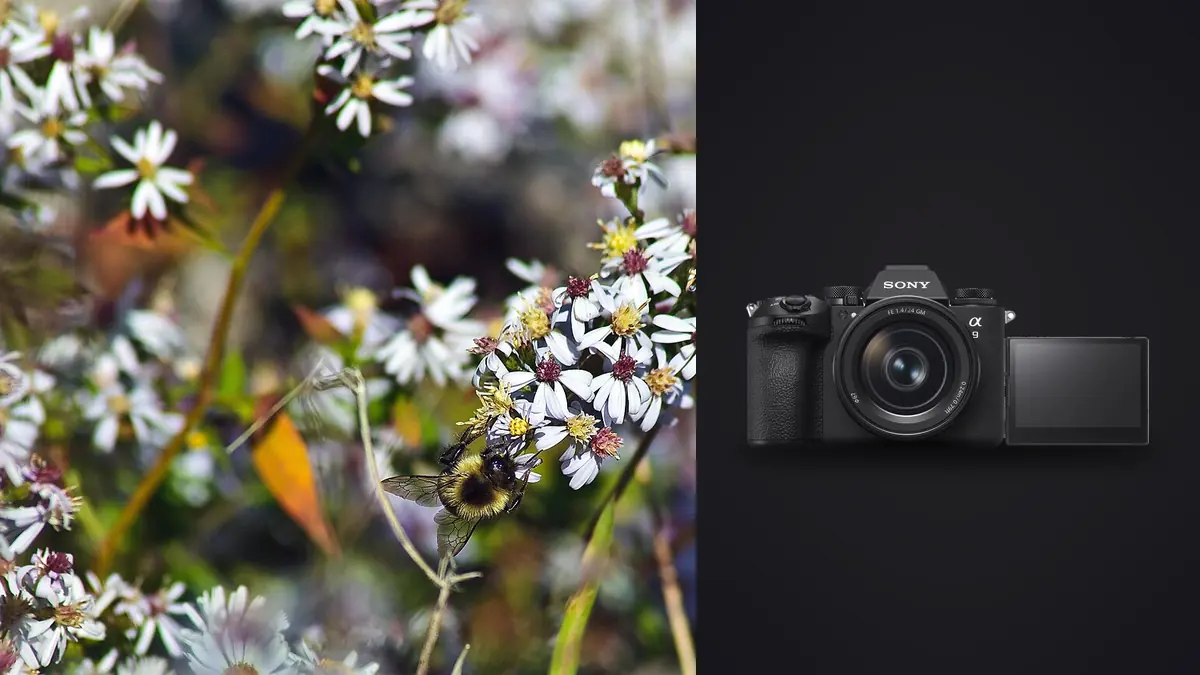
Late June, a gravel path behind a wetland reserve, and a common darter dragonfly perched on a dead reed just long enough for four seconds of shooting. That is the kind of subject the Sony A9 III was built to chase, though not because Sony designed it with insects in mind. A camera engineered to track a puck across a hockey rink turns out to handle a twitchy compound eye almost as well. I have spent most of a season pairing the A9 III with a couple of different macro lenses, mostly the FE 90mm G OSS and, more recently, the Sigma 105mm Art, and the results are a genuinely interesting mismatch: a body built for football sidelines and velodromes, doing close-focus work that most people still shoot on a higher-resolution body for the extra detail.
A sports camera that happens to solve a macro flash problem
The headline spec on the A9 III is the global shutter, the first full-frame stacked sensor to read every pixel at once instead of scanning line by line. For sports and birds in flight, that kills rolling shutter skew on golf swings and propellers. For insect macro, the more useful side effect is almost never mentioned in the marketing: because there is no mechanical curtain and no rolling readout to protect, the camera can sync flash at any shutter speed, all the way up to 1/80,000 of a second.
That matters more than it sounds. Outdoor insect macro at f/16 or f/22, the apertures you need to get a beetle's whole thorax in focus, usually means one of two compromises on a normal camera: drag the shutter and let ambient light blow out the background, or stack ND filters to get your ambient exposure down to the 1/200 or 1/250 flash sync ceiling most bodies are stuck with. With the A9 III I can set 1/2000 or faster, let the sun do almost nothing to the exposure, and use a small flash or twin macro strobes to do all the actual lighting. Backgrounds go dark and clean without a single filter in the bag. It is the one feature on this camera that insect shooters should actually care about more than the frame rate.
Insect eye AF: firmware promises versus a bee's actual eye
Sony added an Insect category to the subject recognition AI on the A9 III through a firmware update, sitting alongside Human, Animal, and Bird. In the field it is a mixed bag. On dragonflies, damselflies, and butterflies, subjects with a clearly defined compound eye that contrasts against the wing or foliage behind it, the recognition locks on fast and holds through small movements of the perch. On beetles and certain moths, where the eye blends into a dark thorax with almost no contrast, it hunts, sometimes settling on the leading antenna instead of the eye, which at 1:1 magnification with a paper-thin plane of focus is enough to ruin the shot.
My actual workflow ends up being a mix. For anything perched and cooperative, I switch off subject recognition entirely and use a single small AF point with back-button focus, then rock the camera a few millimeters forward and back to walk the focus plane onto the eye by hand, the old macro technique that predates autofocus recognition by decades. For anything moving, hoverflies especially, which hang in place and then dart sideways without warning, Insect recognition combined with the A9 III's blackout-free viewfinder at up to 120fps is genuinely useful, because you can see the subject continuously through a burst instead of losing it in a strobing viewfinder between frames. At high magnification your field of view might be four centimeters wide. Losing the subject for even a quarter second in a blackout is often the difference between a full frame and an empty one.
The ISO 250 floor does not bite as hard as I expected
One real trade-off with a global shutter sensor is dynamic range at the bottom of the ISO range, and Sony set the A9 III's native base at ISO 250 instead of the ISO 100 you get on the A7R V or the older A9 II. On paper that is 1.3 stops less headroom before you start clipping highlights in bright conditions, and for a landscape or portrait shooter that is a real annoyance.
For insect macro specifically it matters less than the spec sheet suggests. Most of my insect frames are shot at f/11 to f/16 to squeeze enough depth of field onto a subject that might be three millimeters thick through the point of focus, and once you are stopped down that far in daylight, ISO 250 versus ISO 100 is rarely the difference between a clipped highlight and a clean one. Where the base ISO does show up is at dawn, chasing dew-covered insects in the shaded understory before direct light arrives, natural-light handheld work where I am already sitting at ISO 1600 to 3200. Push shadow recovery on those frames and the extra noise floor from starting 1.3 stops higher is noticeable next to files from a 61-megapixel body. If most of your insect work happens under flash, which kills the base ISO question outright, this is a non-issue. If you shoot available light at dawn or in deep shade, it is worth testing before you commit.
Matching the body to a macro lens
The A9 III does not have a native macro lens of its own, so magnification and working distance come entirely from glass, and working distance is the number that actually decides whether an ant tolerates you or bolts. Here is how the lenses I have used or borrowed compare on paper, with rough working distance figures at maximum magnification (measured from the front of the lens to the subject, not from the sensor):
| Lens | Max magnification | Working distance at max mag | Weight | Approx. street price | Best fit |
|---|---|---|---|---|---|
| Sony FE 90mm F2.8 Macro G OSS | 1:1 | ~13cm (5.1in) | 602g | $1,000 | All-round default, OSS helps handheld |
| Sony FE 50mm F2.8 Macro | 1:1 | ~4cm (1.6in) | 236g | $500 | Static subjects only, too close for most insects |
| Sigma 105mm F2.8 DG DN Macro Art | 1:1 | ~12.6cm (5in) | 715g | $770 | Slightly heavier, comparable working distance |
| Tamron 90mm F2.8 Di III Macro VXD | 1:1 | ~9cm (3.5in) | 630g | $700 | Fast VXD motor pairs well with the A9 III's AF |
| Laowa 100mm F2.8 2X Macro APO | 2:1 | ~6cm at 2x, ~15cm at 1x | 638g | $800 | Manual focus only, for ants and other tiny subjects |
The 90mm G OSS stays my default because its linear AF motor keeps up with the A9 III's tracking without the hunting you sometimes get pairing older screw-drive macro glass with a fast body, and because a full centimeter or two more working distance than the 50mm is often the gap between a bee that tolerates the lens and one that leaves. The Laowa is a different tool entirely: manual focus only, so the A9 III's AI tracking is wasted, but the high-refresh EVF and focus peaking still make nailing a 2:1 shot of an ant's head genuinely easier than doing the same thing on a slower-refresh finder.
A morning at the reserve: what actually slows you down
Combo weight is reasonable. A9 III body at roughly 702g plus the 90mm at 602g comes to about 1.3kg, light enough to hand-hold for a three-hour walk along a boardwalk without a monopod, which matters because insect macro is a stalking sport, you are crouching and shuffling constantly and do not want a rig that fights you. Battery life is the same NP-FZ100 across most of the current Sony lineup, but 120fps bursts on a fast subject chew through a charge faster than the CIPA rating suggests, so I carry two spares rather than one.
The bigger bottleneck is not the camera at all, it is what a 120fps body does to your card and your evening. A two-second burst on a dragonfly launching off a reed is 240 frames, and the overwhelming majority of them are throwaway: wings mid-blur, the subject half out of frame, focus drifted off the eye by a millimeter. Scrubbing that by hand after a full morning in the field is genuinely miserable. This is where I lean on imagic's local sharpness scoring to rank a burst by actual focus accuracy rather than by eye, and its duplicate and burst clustering to group near-identical frames instead of making me click through all 240 one at a time. It runs entirely on the laptop, no upload, which matters at a wetland reserve where there is no signal anyway. If you want the mechanics behind that kind of scoring, how AI photo culling actually works is a reasonable rabbit hole.
Editing the keepers
Once the burst is culled down from 240 frames to the four or five that are actually sharp on the eye, the edit itself is usually quick and repetitive: pull shadows on the flash-lit subject, cool the background slightly, add a touch of clarity on the compound eye facets without oversharpening the whole frame. I built a look for this over a season of insect shoots and now apply it with imagic's apply_my_style preset, trained on my own past edits rather than a generic macro preset pack, so new batches land close to the finished look before I touch a slider. It will not replace judgment on a genuinely tricky frame, backlit wings or a subject half in shadow still need a manual pass, but for the bulk of a shoot it cuts the editing time down to something that does not eat the whole evening. For the field side of that same problem, worth a look: tips for a faster photo workflow covers more of the culling-to-edit pipeline in general.
Frequently Asked Questions
Do I need the A9 III specifically, or would a cheaper Sony body do the same job for insect macro?
For anything perched and cooperative, a spider on its web, a resting moth, a caterpillar on a leaf, an A7 IV or even an A6700 with the same 90mm lens will get you a nearly identical keeper rate for a fraction of the price. The A9 III earns its cost on fast, erratic subjects: dragonflies hawking over water, hoverflies hanging and darting, bees working a flower bed at speed, and on the flash sync freedom described above. Whichever body you use, culling a big burst down to the sharp frames is the same job either way, and that is where tools like imagic's local scoring save the most time regardless of what camera produced the files.
Does the global shutter actually make insect wings sharper?
Indirectly. The global shutter itself does not freeze a wingbeat, flash duration does that, since most insect wings move far faster than any practical shutter speed can stop on its own. What the global shutter buys you is the ability to use flash at any shutter speed rather than being capped at 1/250, which means you can balance a fast flash-frozen wing against a properly exposed, non-blown background in bright sun. The wing sharpness comes from your flash duration, not the shutter.
Is 24.6 megapixels enough resolution for macro insect crops?
It is on the lower side if you crop hard into something tiny like an aphid or an ant's head after the fact. A 61-megapixel body like the A7R V will out-resolve the A9 III once you start cropping aggressively or printing large. Treat the A9 III's advantage as speed and tracking, not raw detail, and try to fill the frame optically with the right lens or a bit of extension tubing rather than counting on the sensor to bail you out in post.
Do extension tubes work well on the A9 III for going past 1:1?
Yes, autofocus tubes from Kenko or Meike work fine electronically and keep AF communication intact with the 90mm or the Sigma 105mm. Each stop of added magnification costs light, since extension tubes reduce effective aperture, which can slow AF hunting in dim understory conditions even on a fast body like this one. It is manageable in decent light, less pleasant at dawn, and worth carrying a small flash if you plan to stack tubes for anything approaching 2x.