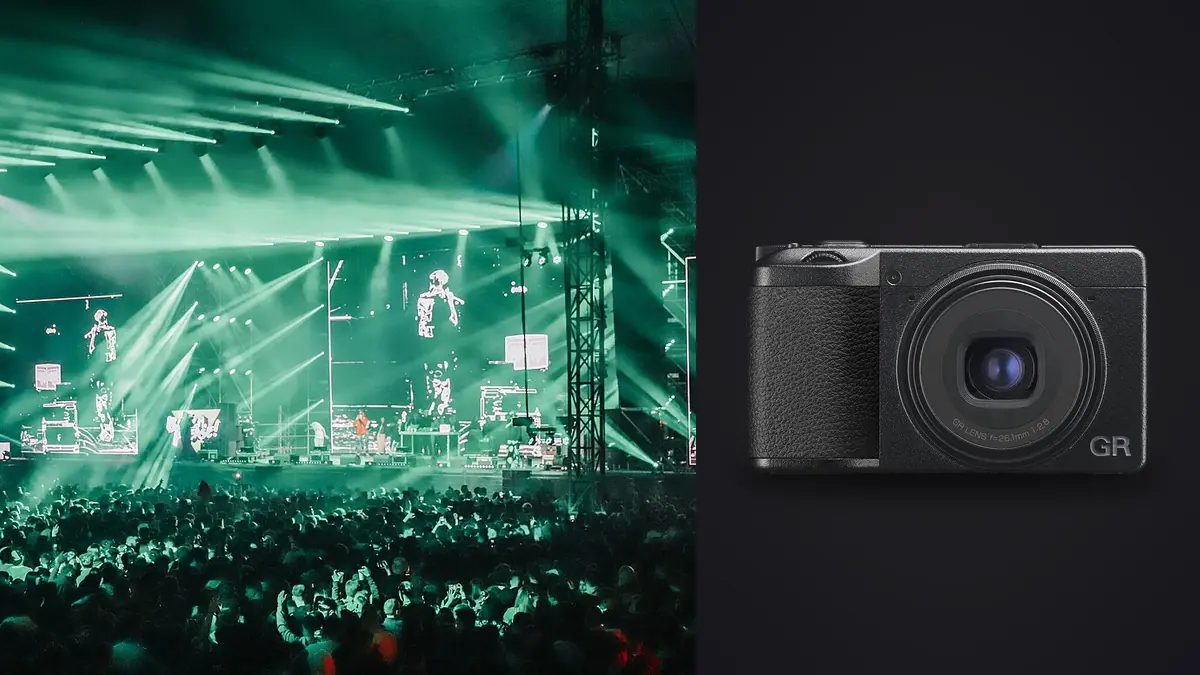
I get asked about the GR IIIx for gig work more than almost any other pairing of camera and genre, mostly because it seems like a contradiction on paper. It's a fixed-lens compact with a 40mm equivalent field of view, no viewfinder unless you bolt one on, and a maximum aperture of f/2.8 that most photo pit veterans would call slow. None of that screams "concert camera." And yet one stuffed in a jacket pocket can earn its place every single time, just not in the role people assume.
This isn't a spec sheet regurgitation. It's what happened when I actually pointed this thing at a stage, what broke, what I had to work around, and where it genuinely beat cameras three times its price for a specific kind of live music image.
Why a fixed 40mm even belongs in this conversation
The instinct for concert photography is always "get closer, get longer." A 70-200mm on a full frame body is the default answer for a reason: three-song pit access, security barriers, and stage lighting that punishes anything slower than f/2.8 all push you toward long, fast glass. The GR IIIx does the opposite of all of that on purpose.
What it's actually good for is the stuff that happens around the performance, not just the performance itself. Load-in chaos backstage, a singer adjusting a monitor wedge before doors open, the crowd surge when the house lights drop, a guitarist's hands on the fretboard from three feet away during an acoustic set where you can actually stand that close. The 40mm equivalent framing is close to how your eyes see a room, which means the images read as "I was there" rather than "I had a long lens pointed at a stage from row twelve." For documentary-style tour coverage, editorial features, or an artist's own archive, that difference matters more than reach.
It also matters that nobody notices you're shooting. The leaf shutter is close to silent, there's no mirror slap, and the body is small enough to work a room without reading as "photographer with a job to do." I've gotten shots of a band arguing about a setlist change five minutes before doors that would never have happened with a DSLR hanging off my shoulder.
Where it actually struggles on stage
I want to be straight about the limits before anyone buys one expecting it to replace a proper pit kit, because it won't.
f/2.8 on a sensor this size, at 40mm equivalent, in a venue lit for atmosphere rather than photography, means you are pushing ISO 6400 and higher constantly. The GR IIIx's APS-C sensor handles that better than a lot of compacts, files stay usable through ISO 3200 with a light hand on noise reduction, but past 6400 you're trading detail for a clean image and there's no getting around it. If a headliner is running moody blue-and-purple lighting with hard backlighting (which is most headliners now), you will lose shadow detail you'd have kept on a fast 50mm and a full frame body.
The lack of a built-in viewfinder is the second real problem. Composing on the rear LCD in a dark room with stage light blowing out the screen is genuinely hard, and I've missed frames because I couldn't tell if focus had actually locked until I chimped the shot afterward. The optional external viewfinder helps but it's an accessory you have to remember to bring and it adds bulk that undercuts the whole point of carrying this camera.
And the fixed 40mm means you cannot get a usable frame of a headliner from anywhere but the first couple of rows. If your access is a photo pass with no pit privileges, standing at front-of-house, this camera gives you crowd shots and atmosphere, not a usable hero image of the performer's face. Know that going in.
The exposure approach that actually works
Aperture priority doesn't hold up under stage lighting because the meter gets fooled by big swings between spotlit and dark stage sections song to song. What I settled on after a few wasted sets is full manual with auto ISO capped around 12800, shutter locked wherever the song's tempo calls for (1/250 for anything with movement, willing to drop to 1/125 for a ballad where the singer is mostly still), and aperture wide open at f/2.8 basically all the time. You're not choosing depth of field here, you're chasing light. Let the ISO float and accept the noise; a sharp, noisy frame edits into something usable, a soft, clean one doesn't.
Focus behavior when the lighting is actively hostile
Autofocus on the GR IIIx is contrast-detect, and contrast-detect AF genuinely struggles against moving colored gels, strobes, and haze, which describes most modern concert lighting. In AF-C, I've watched it hunt for a full second while a singer moved through a beam of light, and a second is an eternity in live music photography.
The fix that actually worked for me was leaning on Snap Focus more than I expected to. Set it to roughly 2.5 to 3 meters for anything shot from the barrier or the first couple of rows, and the lens just locks there instantly, no hunting, no missed frames while the AF system decides what it's looking at. It's a manual-focus workaround dressed up as a feature, but it's dressed up well, and for a camera this size it's the difference between a keeper rate you can live with and one you can't.
Face detection AF is fine for the still moments (soundcheck, backstage portraits, a quiet acoustic number) but I turn it off entirely once the lighting gets aggressive. It costs more hunting time than it saves in accuracy.
Battery, cards, and getting through an actual set
The battery is the honest weak point of this whole system for gig work. Ricoh rates it around 200 shots per charge in real conditions with the screen on constantly (which it has to be, no viewfinder), and shooting a three-act night with a support slot, a co-headliner, and a headliner easily burns through 400 to 600 frames once you count burst sequences. I carry three spare batteries now and still cut it close on longer nights. If you're used to a mirrorless body that does 400+ shots per charge, budget for this being noticeably worse.
Card choice matters less than people think since the buffer clears fast in DNG, but I'd still avoid anything under a UHS-I 90MB/s card if you're shooting rapid three-frame bursts during a chorus, which I do constantly to catch the peak of a jump or a head toss.
How it actually stacks up against other concert-ready setups
This is based on gear I've personally used across the same tour dates, not spec sheet comparisons.
| Setup | Effective focal length | Widest usable aperture | Weight (body + lens) | Usable ISO ceiling | How noticeable in a crowd |
|---|---|---|---|---|---|
| Ricoh GR IIIx | 40mm (fixed) | f/2.8 | ~262g | ~6400 | Barely, reads as a phone from a distance |
| Fujifilm X100VI | 35mm (fixed, digital tele crop to ~50mm) | f/2 | ~521g | ~10000 | Low, but the OVF/EVF hybrid draws a second glance |
| Sony a7C II + 24-70mm f/2.8 | 24-70mm (zoom) | f/2.8 | ~1,220g | ~16000 | Clearly a working photographer's rig |
| Crop-sensor DSLR + 70-200mm f/2.8 | ~112-320mm equivalent | f/2.8 | ~2,100g+ | ~12800 | Unmissable, security often flags it at the door |
The GR IIIx wins on discreetness and pocketability by a wide margin and loses on reach and low-light ceiling. It's not a replacement for a pit lens, it's a second body for the frames a long lens can't get, and once I started treating it that way instead of trying to make it my only camera for a show, it stopped feeling like a compromise.
Getting through the files afterward
A three-band night with this camera in my bag alongside a proper pit body routinely leaves me with 1,000+ frames by 1am, and a decent chunk of the GR IIIx's share is soft because Snap Focus was set for the wrong distance on a given song, or a burst sequence caught someone mid-blink across six nearly identical frames. Culling that by eye at the end of a tour date is how you end up sending an edit two weeks late. What actually changed my workflow was running the night's card through imagic before I even open Lightroom. Its local sharpness and focus scoring flags the Snap Focus misses immediately, which matters a lot with this camera specifically since contrast-detect hunting produces frames that look fine at thumbnail size and fall apart the moment you zoom into a musician's face. The burst and duplicate clustering handles the three-frame sequences from a chorus, grouping them so I'm choosing the sharpest jump shot from a cluster instead of scrolling past five near-identical frames one at a time. And because it runs entirely offline, I can do this culling pass backstage or in a hotel room on venue wifi that barely loads email, no upload step, no waiting on a signal that isn't there.
Once the keepers are picked, I run them through an apply_my_style preset I trained on my own tour edits from earlier in the year, which gets the whole night's selects to a consistent look before I do any fine adjustment. That single step used to be the slowest part of a tour edit, matching color across venues with wildly different house lighting rigs, and now it's mostly done before I've finished my second coffee. If you're new to building that kind of workflow around culling generally, the breakdown in how AI photo culling actually works covers the mechanics better than I can in a paragraph here, and these workflow tips are worth a look if tour turnaround time is your bottleneck too.
Who this camera actually makes sense for
If you're the sole photographer on a tour and need one camera to cover everything from stage to green room to merch table, the GR IIIx alone is going to leave gaps, mainly on any performer shot from more than a few feet away. But as a second body for a working photo pit shooter, or as the only camera for someone documenting a smaller venue circuit where you can genuinely stand close to the stage, it does something a bigger kit can't: it disappears. Bands relax around it. Venue staff don't hassle you about it at the door the way they will a body with a long lens attached. And the files, once you get the exposure and focus workarounds dialed in, hold up fine for editorial use, prints, and album art.
Frequently Asked Questions
Is the Ricoh GR IIIx fast enough for a dark club show?
It's workable but not comfortable. f/2.8 combined with a smaller sensor means you'll be running ISO 3200 to 6400 routinely in a dim venue, which is fine for web use and most editorial placements but starts showing its limits in a full-bleed print. For a well-lit theater or festival main stage, it handles better than you'd expect.
Can you actually shoot from the photo pit with a 40mm equivalent lens?
Only if you're right at the barrier. Past the first row or two, the performer becomes too small in frame to be usable as a standalone image. Most photographers I know who carry this camera in the pit use it for wide environmental shots (the stage, the lighting rig, the crowd from the barrier looking back) rather than performer close-ups, and pair it with a longer lens on a second body for the tight shots.
Do you need the external viewfinder for live music work?
I'd say yes if you're shooting regularly. Composing on the rear screen in low light is doable but slower and less accurate, and you'll miss more decisive moments waiting to confirm framing. The external finder adds bulk and cost, but it earns its keep the first time you nail a shot you'd have fumbled on the LCD.
How many songs or sets can you realistically shoot on one battery?
In practice, I get through roughly one full opening set (four to six songs plus some ambient shooting) before I'm swapping batteries, especially with the screen running the whole time since there's no viewfinder to fall back on. For a full night with multiple acts, plan on at least two spares, three if you're also shooting backstage or crowd coverage between sets.