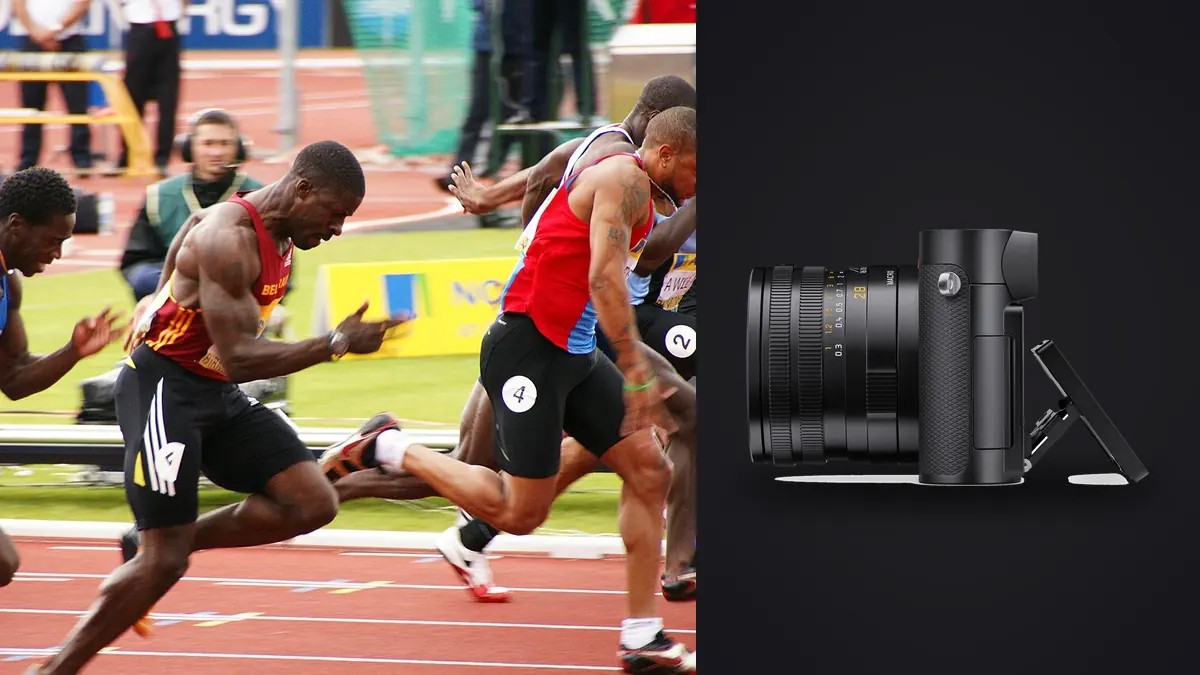
The Obvious Objection First
A Leica Q3 is a fixed 28mm f/1.7 lens bolted to a rangefinder-style body. Leica sells it as a street and travel camera, and every review treats it that way. So it's fair to ask why anyone would drag one to a track meet or a cycling criterium instead of a body with a 70-200mm zoom on it. The honest answer is usually practical rather than aspirational: you already own the Q3 for personal work, you don't want to carry two systems to your kid's regional meet, or you're covering an event where a giant white lens draws unwanted attention (school athletics departments and some amateur race organizers are twitchy about anything that looks like a press credential). None of that makes the Q3 a sports camera. It does mean the pairing comes up often enough to be worth working through honestly, including the parts where it falls short.
What "Track and Field" Actually Means for a 28mm Prime
There's no zoom ring on this camera. What the Q3 gives you instead is a set of in-camera crop guides at 35mm, 50mm, 75mm and 90mm equivalents, built on top of a 60-megapixel sensor with enough resolution to spare. The important detail most first-time buyers miss: those crop lines only bake into the JPEG. Shoot DNG and the full 28mm frame is preserved, crop marks and all, so the "zoom" you dial in on the body is really a framing guide for how far you can crop later without the file falling apart. That reframes the whole exercise. You're not choosing a focal length in the field, you're choosing how much resolution you're willing to spend to get there.
The math is straightforward once you know the sensor is 60MP at 28mm. Cropping to a 35mm equivalent keeps roughly 38 megapixels. Cropping to 50mm drops you to around 19 megapixels. At 75mm you're down to about 8 megapixels, and at 90mm you're scraping under 6. That last number matters more than it sounds: 6 megapixels is fine for a web gallery or a 5x7 print, but it will not hold up on a two-page magazine spread or a large banner print, and it leaves almost no room to crop further if your framing was off by a stride or two.
| Crop setting | Approx. resolution retained | Realistic track use |
|---|---|---|
| 28mm (native, no crop) | ~60 MP | Sprint start scene, whole field for a relay handoff, infield warm-up context |
| 35mm crop | ~38 MP | Handoff zone from the infield rail, throwers' circle from a few meters back |
| 50mm crop | ~19 MP | Head-and-shoulders on a shot putter or high jumper shot from the stands |
| 75mm crop | ~8 MP | Runner in the back straight; usable for web images, tight for print |
| 90mm crop | ~6 MP | Emergency reach when you genuinely can't move closer; print size is limited |
What this table is really telling you is a positioning problem, not a lens problem. If you need a clean 20-megapixel file of a competitor's face, you need to be shooting from something closer to a 50mm-equivalent distance, which at a real track means standing near the finish straight or working from inside the fence at a throws event, not from the top row of the grandstand.
Autofocus and Burst Behavior Where It Counts
The Q3 replaced the Q2's contrast-only autofocus with a hybrid phase and contrast system, and it's a real improvement for continuous tracking, not a marketing footnote. On a 28mm lens, depth of field is naturally forgiving at typical shooting distances, which hides a lot of AF imprecision. It stops hiding it the moment you get close. Trackside for a 100m final, standing a few meters off the lane at the finish, wide open at f/1.7 puts you in shallow-depth-of-field territory where the system actually has to track a moving face, not just land somewhere in a wide focus zone. In that scenario it keeps up reasonably well with a single runner crossing the frame, but it's not the subject-tracking of a dedicated sports body, and it will occasionally lock onto a shoulder or a bib number instead of an eye when two athletes overlap in frame, which happens constantly at a hurdles race or a pack sprint finish.
Burst rate is where the tradeoffs get concrete. The electronic shutter will push to 15fps, but a 60-megapixel sensor generates enormous files at that rate, and in practice the RAW buffer empties fast, well under two seconds of full-speed shooting before the camera throttles down while it writes to card. For a 100m dash that's actually enough, the race itself is over in ten to eleven seconds and you don't need to hold the trigger the whole time. For something like a mile or a relay carnival with repeated bursts across twenty minutes, you'll be releasing the shutter in short, deliberate bursts around the moments that matter (the handoff, the kick at the bell lap, the lean at the tape) rather than holding it down continuously the way you might with a camera built for this.
| Shutter mode | Practical burst rate | Shutter speed ceiling | Rolling shutter risk | Best for |
|---|---|---|---|---|
| Mechanical | ~5 fps | 1/2000s | None | Shot put, discus, javelin wind-up; slower, deliberate sequences |
| Electronic | up to 15 fps | Well past 1/2000s, silent operation | Visible skew on fast lateral motion (legs, spokes, swinging arms) | Sprint finishes, foot-strike freezes, anywhere shutter noise would be intrusive |
The rolling shutter point is worth taking seriously rather than treating as a spec-sheet footnote. Shoot a sprinter's legs at 15fps electronic and you can get a slight skew or wobble in fast-moving limbs, the same effect you'd see photographing a spinning bike wheel or a swinging bat. For a static or slow subject it's invisible. For a runner's legs mid-stride, especially in a tight crop, it's sometimes visible enough to bin the frame. Switching to the mechanical shutter removes it entirely at the cost of frame rate and a slightly noisier shutter, which is a real tradeoff and not a settings menu you can ignore.
Where This Camera Actually Wins
Track and field from a stand is the hardest sell for the Q3. Criterium cycling is a much better match, because the format puts you legally and safely close to the action on tight corners, and a 28mm lens at close range produces exactly the kind of environmental, in-the-pack image that a long lens compresses away. Skate parks and BMX tracks work for the same reason: proximity is normal, not a problem to solve, and the fast f/1.7 aperture earns its keep in low, awkward park lighting. Pit lane at a local motorsport event is another strong fit, wide-open documentary frames of a crew mid-stop, where a 400mm lens would be too tight to tell the story. What all three have in common is that you can physically stand close enough for the native 28mm field of view, or a mild 35mm crop, to do the work, rather than relying on the thin end of the crop range to fake reach you don't have.
Handling the Volume a Meet Actually Produces
Fifteen frames a second for even a short burst adds up fast once you multiply it across a real event. A three-second burst around a finish line is 45 frames from one heat. A regional meet with eight heats in the 100m alone, plus prelims and finals, plus every other event you shoot the same way, turns into thousands of DNG files by the end of the day, a large percentage of them nearly identical frames a stride apart. Scrolling that manually on a laptop between events is its own event. This is the part of shooting the Q3 for sports that has nothing to do with the lens and everything to do with what you do after you get home, and it's where a tool like imagic earns its place in the workflow: it clusters those burst sequences automatically so you're reviewing "this stride versus that stride" as a small group instead of paging through hundreds of frames one at a time, and because it runs entirely on-device, you can start sorting a card in a hotel room or a car in the parking lot with no upload wait, which matters more than it sounds at a venue with bad wifi. There's a longer breakdown of how the clustering and scoring actually works at how AI photo culling works if you want the mechanics.
Focus precision inside those bursts matters more than usual, too. Because a close-range f/1.7 frame has genuinely shallow depth of field, one frame in a burst can have the eye tack sharp while the frame right next to it has drifted onto a shoulder or an earring, and that difference is nearly impossible to judge on the Q3's rear screen at a glance, especially outdoors in bright sun. Running the take through local sharpness scoring rather than trusting the on-camera preview is the difference between picking the frame that looks fine at thumbnail size and picking the one that's actually critically sharp on the athlete's face.
Building One Consistent Look for a Whole Season
Track surfaces are not neutral. A blue all-weather track throws a completely different color cast than a red Mondo surface, and a night meet under sodium-vapor floodlights pushes everything warm and green in a way daylight meets never do. If you're shooting the same club or the same athlete across a season, that inconsistency shows up as soon as you put two meets side by side in a portfolio or a season recap. Once you've landed on a grade you're happy with for one set, whether that's how you handle the orange track cast or how you pull green out of stadium lighting, carrying that same decision forward by hand across the next six meets is tedious and easy to get slightly wrong each time. This is a case where training a preset on your own actual edits, rather than starting from a generic filter, holds up: imagic's apply_my_style feature learns from edits you've already made and applies that same handling to a new batch, still processed locally rather than round-tripped through a cloud service, which is one less dependency at a venue where you're already fighting for signal. If color consistency across a body of work is a newer problem for you, the walkthrough at the complete guide to photo color grading is a reasonable place to start before you lean on any automated preset.
Field Kit and Settings Notes
A few things that matter in practice beyond the spec sheet. The Q3 has optical stabilization in the lens but no in-body sensor-shift stabilization, which is fine at the shutter speeds you'll actually use for freezing motion (1/1000s and up) but worth knowing if you're shooting slower sequences like a javelin approach where you might want to drag the shutter slightly. Battery life takes a real hit running the EVF continuously through a multi-hour meet at high burst rates; carry at least one spare and treat the USB-C port as a between-events top-up rather than your only charging plan. The tilting touchscreen, new on the Q3 versus the fixed screen on the Q2, is genuinely useful for low sideline angles at a hurdles race or a long jump pit, where getting the body down near ground level without lying in the infield changes the shot completely. And because you're working with a fixed lens, your zoom decisions during the meet are really positioning decisions: scouting where the light is good, where you can legally stand close to the action, and where the background behind a 28mm frame won't be cluttered with tents and coolers, matters more here than it would with a zoom that can crop out a messy background from further away.
Frequently Asked Questions
Can a fixed 28mm lens actually cover a track meet on its own?
For some events, yes, particularly ones where you can get physically close: relay handoffs from the infield, throws events from just outside the safety fence, warm-up and start-line moments. For anything shot from a fixed grandstand seat at a normal track's distance, a 28mm lens even with digital crop is working at a real disadvantage against a 300mm or 400mm lens on a dedicated body. Go in expecting to shoot the moments you can walk up to, not the moments you'd normally reach for with glass.
Do the in-camera crop modes actually change the image quality, or just the framing?
If you're shooting JPEG, the crop bakes in and you get a smaller file at capture. If you're shooting DNG, the full 60-megapixel, 28mm frame is preserved regardless of which crop guide you had selected, and the crop only shows up as framing lines in the viewfinder and a suggested crop in the metadata. Practically, this means you can shoot native and decide your effective focal length later at the computer, which is the more flexible way to work this camera.
Is the autofocus fast enough to track a sprinter at the finish line?
It'll keep up with a single runner crossing the frame reasonably well thanks to the Q3's phase-detection AF, which is a genuine step up from the Q2. It's not built for the kind of dense-pack tracking a dedicated sports camera handles, so expect some missed frames when athletes overlap, and lean on burst shooting around the moment rather than trusting a single well-timed press.
What's the biggest limitation nobody mentions when recommending a Q3 for sports?
Buffer depth at full burst rate. Fifteen frames a second sounds fast until you realize the RAW buffer on a 60-megapixel file clears in under two seconds of continuous shooting before the camera slows down to write to card. Plan your bursts around specific moments rather than holding the shutter down and hoping, and budget real time afterward to sort through the volume a day of short bursts still produces.