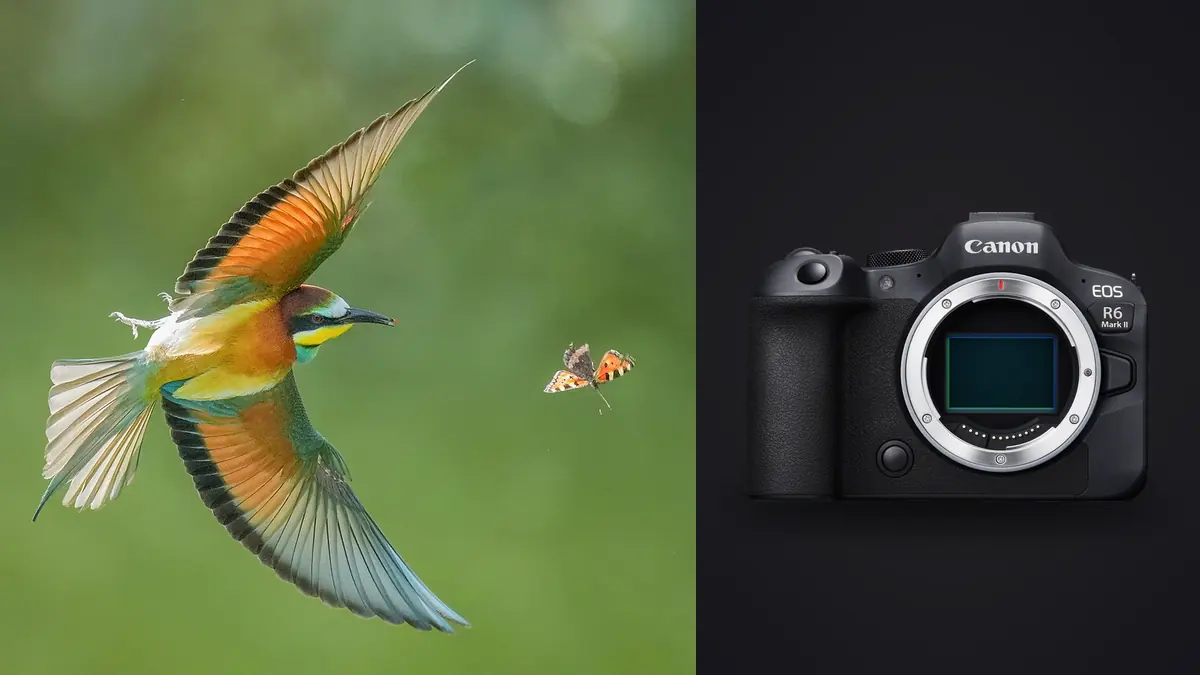
I switched to the R6 Mark II from an R6 (the original) mostly because of a single frustrating afternoon with ospreys at a reservoir near Rutland Water. The old body kept locking onto the bright sky behind the bird instead of the bird itself, and I came home with forty sharp frames of empty blue. The Mark II does not fix everything about shooting fast fliers, but it fixes that specific problem, and it changes enough else about the workflow that it deserves its own notes rather than a generic "how to shoot birds in flight" rundown.
What the spec sheet actually buys you
The R6 Mark II carries a 24.2MP full-frame sensor, which is on the low side for cropping into distant birds, but it is not the number that matters most for flight work. What matters is the pairing of Dual Pixel CMOS AF II with a Digic X processor fast enough to run subject detection at high frame rates without falling behind. Canon rates continuous shooting at 12fps with the mechanical shutter and up to 40fps with the electronic shutter, and in practice both numbers hold up, provided you have fed the buffer a fast enough card.
The caveat nobody puts on the box: this is not a stacked sensor. The R3 and R1 read out fast enough that rolling shutter distortion is nearly a non-issue even on quick wingbeats. The R6 Mark II reads noticeably slower, so at 40fps electronic you will occasionally get a warped wingtip or a slightly skewed tail on birds moving fast across the frame, like a swift banking hard or a peregrine in a stoop. It is not constant, and most of the time you would not notice unless you pixel-peep, but it is real and worth knowing before you commit to electronic-only shooting for everything.
Autofocus that tracks the bird, not the branch behind it
Out of the box, the R6 Mark II's subject detection includes an "Animals" category that covers birds specifically, and it is genuinely good at picking out an eye once the bird's head is roughly a reasonable size in frame. The part that trips people up is AF case selection. I run a custom case built off Case 2 (continue tracking subjects, ignoring possible obstacles) with Tracking Sensitivity nudged to +1 and Acceleration/Deceleration tracking set to 0. Case 4 (for subjects that accelerate or decelerate quickly) sounds tempting for birds launching off a perch, but I found it made the AF too twitchy when a bird briefly crossed in front of a branch, causing it to jump to the branch and stay there for a frame or two.
Zone selection matters as much as case selection. For a bird against open sky I use Whole Area AF and let subject detection do the finding. Against a cluttered background (reeds, a treeline, another bird nearby) I drop to Flexible Zone (Small) and place it manually, because Whole Area will happily lock onto the sharpest-contrast thing in the frame even if that thing is a leaf. Back-button focus is close to mandatory here: with a single AF-on button held down through the whole pass, you can lift your thumb the instant the bird crosses behind a branch instead of letting the camera hunt and refocus on the branch itself.
One more setting worth checking before you leave the house: Servo AF's "1st image priority" versus "Release priority." I keep it on Release priority for BIF, accepting the occasional soft first frame of a burst in exchange for never missing the decisive wingspread because the camera was still confirming focus.
Burst mode, buffer depth, and the rolling shutter trade
The three shooting modes worth knowing for flight work behave differently enough that a quick side-by-side is more useful than a paragraph of caveats:
| Mode | Max rate | Approx. RAW buffer | Rolling shutter risk | Best for |
|---|---|---|---|---|
| Mechanical shutter | 12 fps | ~140 frames | None | Herons, gulls, slower raptors, anything with a predictable flight line |
| Electronic (silent) shutter | 40 fps | ~75-90 frames | Moderate on fast lateral motion | Fast passerines, terns diving, unpredictable launches |
| RAW burst mode (pre-shooting, 0.5s) | 30 fps | 2-3 second buffer window | Same as electronic | Catching the exact wingbeat or the moment of takeoff you'd otherwise miss by a frame |
Pre-shooting mode in particular changed how I approach a perched bird I suspect is about to launch. Half-press to arm it, and the camera keeps rolling a half-second buffer before your actual button press, so the frame where the tail feathers first spread gets captured even if your reaction time is a beat slow. The trade is a smaller effective buffer and files that arrive bundled in Canon's CR3 RAW burst format, which some older RAW converters do not open cleanly, so check your software chain before relying on it for a paying job.
On buffer depth: the numbers above assume a genuinely fast CFexpress card. Drop to a merely-fast SD card (even UHS-II) and you will feel the mechanical shutter's buffer roughly halve, and the electronic shutter's buffer clear out to a crawl mid-burst. I learned this the annoying way on a kestrel hover shoot, watching the frame counter stall at 4fps because I'd left a UHS-I card in the second slot.
Glass that actually earns its keep
The R6 Mark II's 24.2MP sensor rewards a long lens more than a high-megapixel body would, because you don't have the cropping headroom of a 45MP R5 to bail you out of an undersized subject. For most of a season I carried the RF 100-500mm f/4.5-7.1L, which handholds all day and autofocuses fast enough for erratic fliers, but tops out short for small birds at real distance. Adding the RF 1.4x extender gets you to 700mm at a still-usable f/10, and the R6 Mark II's AF continues to work fine at that aperture in good light, though it noticeably slows down under tree cover or at dusk.
For serious reach on a budget, the RF 800mm f/11 and RF 600mm f/11 primes are worth a look if you mostly shoot in bright conditions and can live with a fixed aperture; they are light enough to handhold for a morning at a hide, which a 600mm f/4 simply is not. If money allows, the RF 200-800mm f/6.3-9 covers nearly everything a birder needs in one lens, at the cost of being noticeably heavier and slower to focus at the long end than the 100-500mm. None of these choices is wrong, they just trade weight, reach, and light-gathering against each other in ways that depend on whether you're hiking to a spot or shooting from a car window.
Exposure settings that survive a bird crossing from shade into sun
I shoot manual exposure with Auto ISO for flight work, because a bird's flight path routinely crosses from backlit sky to a dark treeline and back within a single burst, and neither aperture priority nor shutter priority reacts to that fast enough without exposure compensation gymnastics. Shutter speed floor depends on the bird: 1/3200s or faster for small, fast wingbeats like terns or swallows, 1/1600 to 1/2000 for mid-size raptors, and you can drop to 1/1000 for large, slow-flapping birds like herons or pelicans without losing wing-tip sharpness. Metering mode matters too: evaluative metering tends to underexpose a dark bird against bright sky, so I dial in +2/3 to +1 stop of exposure compensation as a standing habit whenever the background is open sky, and back it off again once the bird moves in front of foliage.
In-body stabilization is rated up to 8 stops with certain RF lenses, but that number is close to meaningless for BIF since you're shooting at speeds fast enough that camera shake was never the limiting factor. Where IBIS actually helps is steadying the viewfinder image while you're panning and tracking, which makes it easier to keep a small bird centered in frame long enough for AF to grab it.
Getting through the frames afterward
A single good hour of BIF shooting at 40fps produces numbers that would have seemed absurd five years ago: two or three thousand frames is not unusual, and most of them are near-duplicates from the same burst, the wing at a slightly different angle, the eye open or closed. Reviewing that manually in a normal RAW browser is the actual bottleneck of this hobby, not the camera. I run everything through imagic afterward specifically because its burst clustering groups those near-identical frames together automatically, so instead of scrolling past forty variations of the same wingbeat I'm looking at maybe six representative frames per burst and picking the one with the crispest eye. Since the culling and sharpness scoring run locally on the machine, I can do this in the car in the parking lot with no signal, which matters more than it sounds like it should when you're trying to decide whether to head back out for another hour of light or call it a day.
The other thing that's saved me time is the apply_my_style preset feature, trained on my own past edits rather than a generic wildlife preset pack. Flight shots against open sky tend to need a fairly consistent treatment (a touch of shadow recovery on the underside of the bird, restrained saturation on the sky) and having that applied automatically across a batch means I'm not repeating the same three sliders on six hundred keepers. If you're weighing culling tools generally rather than just this one, the comparison at photo culling software comparison is a reasonable starting point, and the mechanics of how automated scoring actually decides what's sharp are covered in more depth at how AI photo culling works.
Frequently Asked Questions
Is the R6 Mark II fast enough for small, erratic birds like swallows or swifts?
Yes, with caveats. The 40fps electronic burst and animal-eye detection handle swallows reasonably well once the bird is a decent size in frame, but the smaller and more erratic the subject, the more you'll rely on Flexible Zone AF placement rather than trusting Whole Area detection to find the right target on its own.
Does the electronic shutter's rolling shutter distortion actually matter for wildlife work?
For most birds moving through the frame at typical speeds, no, you won't see it. It shows up on fast lateral motion close to the camera, like a tern banking sharply nearby, where a wingtip can appear slightly skewed. If you shoot mostly distant, slower-moving subjects, mechanical shutter avoids the issue entirely at the cost of frame rate.
What card should I actually buy for 40fps electronic bursts?
A genuinely fast CFexpress Type B card in the primary slot. UHS-II SD cards will bottleneck the buffer noticeably during long bursts, and UHS-I cards will drop you to a fraction of the rated frame rate almost immediately, which is an easy mistake to make since the second card slot on the R6 Mark II only takes SD.
Is the RF 100-500mm enough reach, or do I need something longer?
For birds at moderate distance (ducks on a pond, raptors overhead, gulls near a coastline) 500mm on a 24.2MP body is workable. For small songbirds at real distance or distant raptors, you'll want the 1.4x extender at minimum, and serious feeder or perch photography benefits from 600-800mm of native reach.