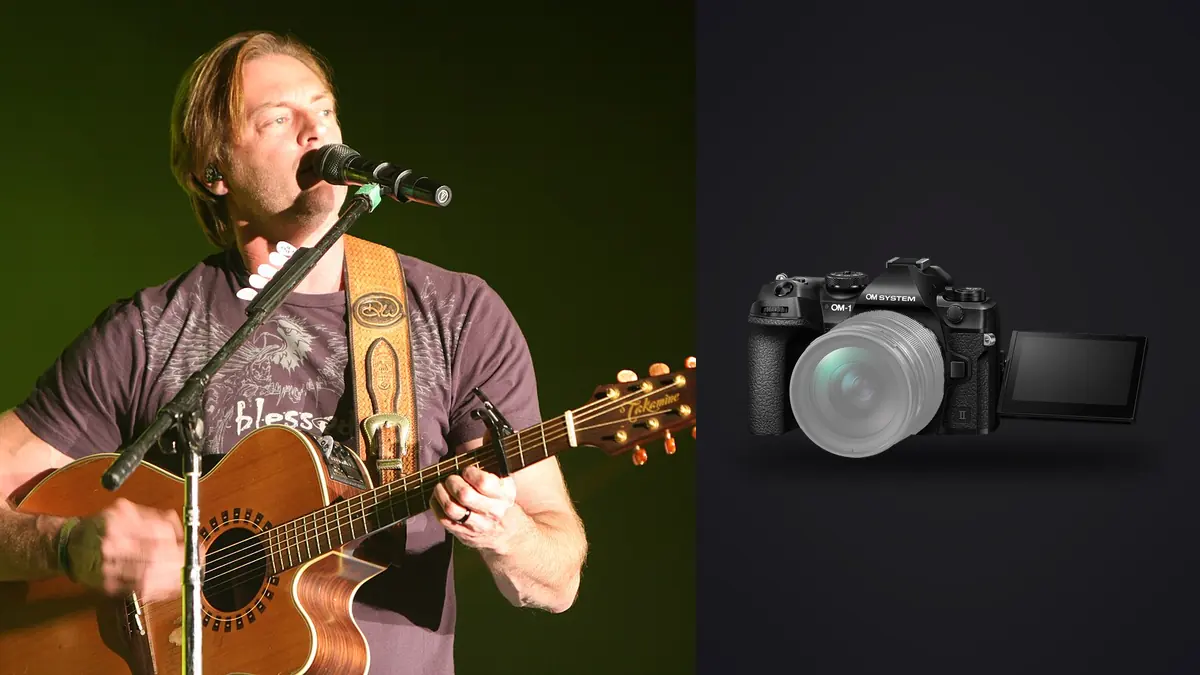
Three songs, no flash, and a lighting rig that swings from a single blue wash to a blinding white strobe hit in the space of one chorus. That's the brief for most photo pit work, and it's a brutal test for any camera. I've been running an OM System OM-1 Mark II as my main body for club shows, a couple of theatre residencies, and one very loud outdoor festival slot this summer, and I want to walk through what actually holds up when the lights start moving and the security guard is tapping his watch.
The Crop Sensor Is a Feature Here, Not a Compromise
Micro Four Thirds gets talked down constantly by people who've never had to sprint between three barricade positions with a full-frame kit on a strap. The 2x crop factor on the OM-1 Mark II means a 40-150mm f2.8 lens frames like a 300mm equivalent, and that lens weighs around 760 grams. A full-frame 70-200mm f2.8 that gets you similar reach with a teleconverter is pushing 1.5kg or more, and you're holding it above your head for the drummer's solo. After a three-hour night with two support acts and a headliner, that weight difference is not trivial. My shoulder notices.
The trade-off is real too, and I won't pretend otherwise. At matched framing and aperture, the smaller sensor gathers less total light than a full-frame sensor, and that shows up as extra noise at high ISO, roughly a stop to a stop and a half worse in practice once you're past ISO 6400. For arena shows with heavy stage lighting this rarely matters. For a small club where the only light source is one warm wash from stage left, it matters a lot, and I plan my aperture and shutter choices around that limitation rather than pretending it isn't there.
What ISO You Can Actually Push
I shoot the OM-1 Mark II at ISO 3200 as my default starting point for indoor shows and I don't hesitate to go to 6400 when a song needs a faster shutter to freeze a jump or a headbang. Past 6400 the files are usable but you're leaning hard on noise reduction in post, and fine detail in hair and fabric starts to smear if you push it too far. I treat 12800 as an emergency setting for a single unmissable moment, not something I plan a set around.
The camera's in-body stabilization is rated up to 8.5 stops with certain PRO lenses, and it genuinely helps for handheld shots between strobe hits when the subject is relatively still, but it does nothing for a musician thrashing around on stage. Stabilization saves you from your own hand shake, not from a moving subject, so don't expect it to let you drop shutter speed below what the performance actually needs.
Silent Shooting and the Three-Song Rule
Almost every pit assignment I've taken in the last two years has come with a house rule: mechanical shutter only for the first three songs, then out, or silent electronic shutter for the entire set if it's a seated theatre show. The OM-1 Mark II's electronic shutter is genuinely silent and tops out at absurd burst speeds, but there's a catch worth knowing before your first theatre gig: rolling shutter readout can cause banding on LED video walls and some moving-head fixtures, showing up as dark stripes across the frame that weren't visible to your eye. The camera has a flicker scan function that samples the light source and adjusts timing to reduce this, and I turn it on by default any time there's an LED screen behind the band. It doesn't fix everything, but it cuts the failure rate on banded frames dramatically compared to shooting electronic shutter blind.
Pro Capture for the Jump Shot
The feature I didn't expect to lean on this hard is Pro Capture. Half-press the shutter and the camera buffers frames before you fully press it, so when a vocalist finally does the jump you've been waiting ninety minutes for, you get the frame at the peak of the leap instead of the one half a second after they've already landed. Human reaction time alone costs you that shot without it. I've started treating Pro Capture as the default mode for any performer known for physical stage presence, and it's saved at least one cover-worthy frame per show since I switched to it.
| Venue type | Typical ISO range | Shutter speed | Shutter mode | AF setup |
|---|---|---|---|---|
| Small club, single wash light | 3200-6400 | 1/200-1/320s | Mechanical, first 3 songs | C-AF, small target |
| Seated theatre, strict house rules | 1600-3200 | 1/160-1/250s | Silent electronic, full set | C-AF, subject detect off |
| Arena, moving heads and strobes | 800-3200 | 1/500-1/1000s | Electronic, flicker scan on | C-AF plus Pro Capture |
| Outdoor festival, daylight into dusk | 200-1600 | 1/500-1/2000s | Mechanical, no restriction | C-AF, wide area |
Lens Choices That Actually Make Sense for a Pit
I carry two lenses to most shows and leave everything else in the car. The 12-40mm f2.8 PRO II covers wide stage shots and crowd context, and the 40-150mm f2.8 PRO II handles tight face shots from the barricade. Both are weather sealed, which mattered more than I expected the night a festival set got hit by an unscheduled downpour halfway through the third song and nobody in the pit stopped shooting.
For the smaller club dates where I'm not restricted to the barricade and can get close, I'll swap in the 25mm f1.2 PRO. The extra stop and a half over the f2.8 zooms buys real separation in a room lit by one bulb, and the rendering on faces at f1.2 is soft enough at the edges to hide a messy background without losing the subject's eyes. It's a heavier, slower lens to work with when the performer won't stay still, so it's not my first pick for anything with a lot of movement.
Battery and Card Management for a Full Night
The BLX-1 battery is rated for roughly 500-600 shots under CIPA testing, but that number assumes normal shooting, not three hours of near-constant EVF use with high frame rate bursts running for entire songs. On a night with two support acts plus a headliner I go through a battery and a half, sometimes two if I'm leaning on Pro Capture a lot. I keep a charged spare in a jacket pocket and swap it during the changeover between bands rather than mid-set.
Dual UHS-II card slots let me run the second slot as a live backup, which matters more in this line of work than most photography because a memory card corrupting after a one-night-only show means the shots are simply gone. There's no reshoot. I'd rather burn the extra few seconds setting up backup recording before doors than explain to an editor why a headliner's only US date has no usable files.
Getting Through the Files Afterward
A three-act night shot at 50fps in bursts produces a genuinely absurd number of frames, often four or five thousand images by the time the headliner walks off. Going through that manually with a loupe tool at midnight after standing for six hours is not realistic, so I run everything through imagic before I touch an edit. Its local sharpness and focus scoring flags which frame in a fifteen-shot burst actually has the singer's eyes in focus, which matters a lot when strobes are firing mid-burst and half the sequence is technically soft. The burst clustering also groups those sequences together automatically, so instead of scrolling past two hundred near-identical frames of the same jump, I'm reviewing maybe fifteen clusters for the whole set.
The other reason I moved to imagic for this specific workflow is that it processes everything locally on the laptop, nothing gets uploaded anywhere. A lot of tour photography comes with an explicit embargo clause, images can't touch a cloud service or a server until the label or publicist has approved a selection, and a cloud-based culling tool would put me in breach of that agreement before I've even picked a favourite frame. Not having to think about that is worth more to me than any marginal feature difference between tools.
Once I've got a shortlist, I use the apply_my_style preset trained on my own previous concert edits to get a consistent starting grade across a set that might swing from a magenta wash to a stark white spotlight within four songs. It's not a replacement for adjusting individual frames, but it means I'm not rebuilding a look from zero every time the lighting design changes on stage, which happens constantly at a live show. If you want more detail on how the culling side of that process actually works, there's a longer breakdown at how AI photo culling works, and I've got a separate rundown of general speed tips for a heavy shoot day at 10 tips for a faster photo workflow.
Frequently Asked Questions
Is the OM-1 Mark II sensor good enough for a dark club show?
It's usable up to about ISO 6400 with acceptable detail loss, and pushable to 12800 for a single moment you can't afford to miss. It won't match a full-frame body's clean files at the same ISO, but paired with an f1.2 prime in a small room it holds up better than its sensor size on paper would suggest.
Do I need the f1.2 primes, or is the 40-150mm f2.8 PRO II enough?
For most arena and theatre work the 40-150mm f2.8 is enough, the extra stop rarely changes your shutter speed decision when stage lighting is doing most of the work. For small clubs with a single weak light source, the f1.2 primes genuinely change what's possible and I'd call them close to essential for that specific situation.
Does the electronic shutter cause problems with LED screens or moving lights?
Yes, rolling shutter readout can produce banding on LED video walls and some moving-head fixtures. The camera's flicker scan feature reduces this noticeably when switched on, but it's worth test-firing a few frames during soundcheck or line check rather than discovering banding for the first time mid-set.
How many batteries and cards should I bring for a three-act night?
I carry two batteries minimum and treat the second as mandatory rather than a backup, since a full night of high burst rate shooting with constant EVF use will exhaust a single charge before the headliner finishes. Both card slots get used, one as a live backup, since a corrupted card on a one-night-only show can't be reshot.