Choosing a camera for wedding photography in 2026 is only half of the job. The other half, the one that actually determines whether a wedding season runs smoothly, is what happens after the ceremony ends: 3,000 to 6,000 RAW files that need to be backed up twice, culled down to a deliverable gallery, edited consistently, and exported before the couple starts asking for a sneak peek. A camera with strong autofocus and a deep buffer only helps at the point of capture. A wedding season is won or lost afterward, at a desk, with a file-management plan that either holds up or does not. This guide covers both halves: what actually matters when picking a wedding body in 2026, a grounded look at five cameras worth weighing, the burst-rate-to-storage math with the assumptions shown, and a file-management plan that carries a wedding from memory card to delivered gallery without losing a frame or a weekend.
What Actually Matters for a Wedding Camera in 2026
A handful of specifications matter more for a wedding than the marketing copy admits. Two card slots, so a single card failure mid-ceremony does not become a missing wedding, sits above nearly everything else; a single-slot body is a liability at a one-shot event no matter how good its sensor is. Autofocus that holds a face in a dim reception hall or a candlelit ceremony under mixed tungsten and string lights matters more than a headline burst-speed number. Buffer depth matters, but not in the sports sense of sustaining a twenty-frame chase for several seconds; a wedding's fast moments (the ring exchange, the first kiss, the bouquet toss, the cake cutting) usually run two to four seconds, so what gets tested is whether the buffer clears fast enough to be ready for the next unscripted moment ninety seconds later, not whether it can sustain a continuous sprint.
Battery life across an eight to twelve hour day matters regardless of a body's rated figure, since every working photographer carries spares anyway. Weight matters more than most buying guides admit, because a body that is comfortable to carry for ten hours tends to get used more confidently than one that gets set down between formals. Lens ecosystem breadth is the long-term cost a price tag does not show: a system with wide, fast primes and a workable telephoto zoom is worth more across three wedding seasons than a body that wins one spec-sheet comparison on day one. Sensor resolution is the most oversold number on the list. Most delivered wedding images end up on a phone screen or an album print, where a well-exposed, sharp 24 to 32 megapixel file outperforms a higher-resolution frame that is soft or a stop underexposed.
One more criterion belongs on this list even though it has nothing to do with the sensor: whether the RAW format a body writes is actually supported, on day one, by the culling and editing software already in the workflow. A camera that ships a brand-new proprietary RAW variant existing tools cannot open yet turns launch week into an unplanned delay, right when a photographer can least afford one.
Five Bodies Worth Weighing for 2026 Wedding Work
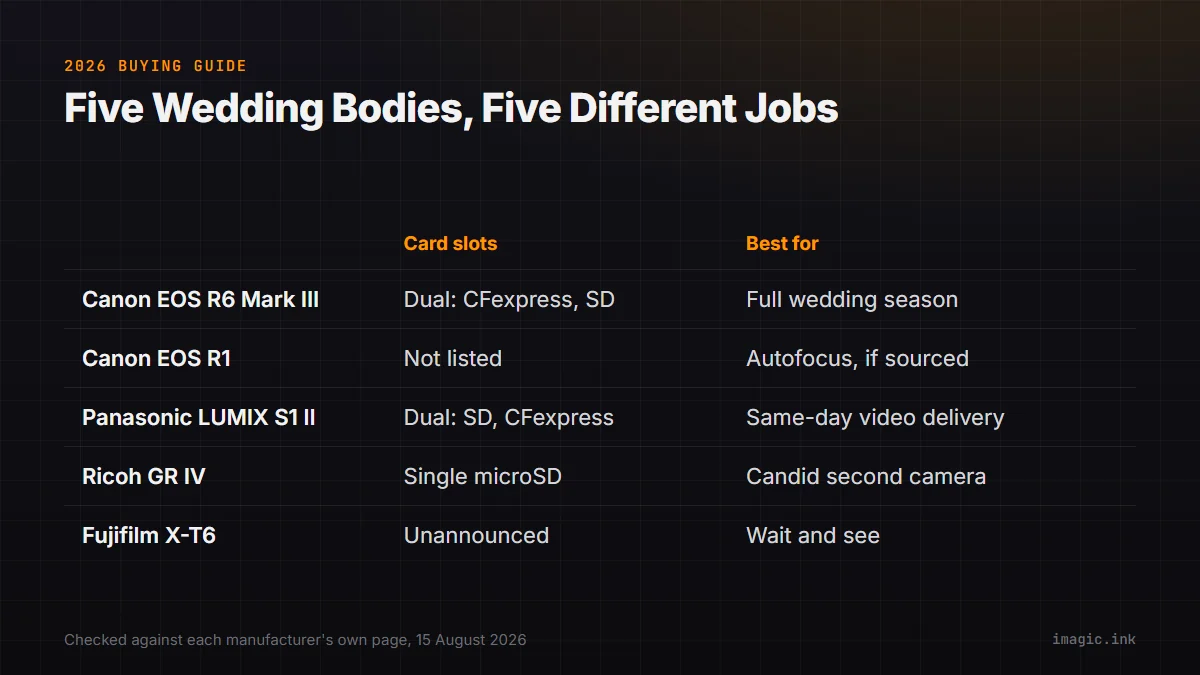
Checked 15 August 2026: the specifications, pricing, and availability notes below are drawn from each manufacturer's own product, press, or support page and are current only as of that date. Stock, regional pricing, and availability change without much notice, so confirm current details directly with the manufacturer before buying.
Canon EOS R6 Mark III, a full-frame body sized for a full wedding season
Canon's EOS R6 Mark III pairs dual card slots (a CFexpress Type B slot alongside an SDXC/SDHC UHS-II slot) with a roughly 32.5 megapixel full-frame sensor, according to Canon's online reference manual. The same manual lists an electronic-shutter continuous-plus mode reaching 40 shots per second in Servo AF, with the mechanical shutter capped at 12 shots per second, plus Dual Pixel CMOS autofocus and an OLED viewfinder at roughly 3.69 million dots. For a wedding day, the practical read is a body that covers processional bursts and a reception dance floor without needing a sports-body buffer, at a sensor resolution that comfortably supports album-sized prints without generating oversized files all day. Not for you if the lens lineup already owned is on a different mount and switching bodies is not worth switching every lens too, or if a lower-priced second-shooter body already covers the same ceremony role without duplicating a flagship-adjacent purchase.
Canon EOS R1, a flagship built for autofocus and low light, if a unit can still be sourced
Canon's EOS R1 sits at the top of the brand's sports and event line, built around a 24.2 megapixel full-frame sensor, a 40 frames per second electronic shutter, 6K RAW video, and a 9.44 million dot OLED viewfinder, per its historical product listing on Canon's US store. As of the 15 August 2026 check, that same US store lists the EOS R1 body as "no longer available," showing a discontinued notice rather than a live purchase option, against a historical listed price of $6,799. That status is specific to the US store; stock and pricing elsewhere vary, so checking the relevant regional Canon site directly is a better plan than treating either the price or the availability as universal. In practice this makes the R1 most relevant to photographers who already own one, or who are shopping the certified-refurbished and used market rather than a new purchase, and its autofocus tracking is most useful to someone shooting sports or wildlife with the same body between weekends. The dedicated Canon EOS R1 sports and RAW culling workflow guide works through the buffer, burst rate, and file-culling math for high-frame-rate work in more detail. Not for you if a new, currently-stocked body matters, since the R6 Mark III above or the LUMIX S1II below is easier to simply order today, and the R1's price and weight are hard to justify for wedding-only work.
Panasonic LUMIX S1II, a hybrid body for photographers who also deliver video
Panasonic's LUMIX S1II pairs a newly developed 24.1 megapixel full-frame partially stacked sensor with a Phase Hybrid autofocus system that adds real-time subject recognition and an Urban Sports tracking mode, according to Panasonic's announcement. The same announcement lists an electronic-shutter SH burst mode reaching up to 70 frames per second with 1.5 seconds of pre-burst buffering, dual card slots (SD alongside CFexpress Type B), and video up to 5.1K at 60p, 4K at 120p, and 5.8K at 60p, with ProRes RAW recording to CFexpress cards. Panasonic also states the sensor delivers 15 stops of dynamic range in V-Log below 30fps, which is a manufacturer claim rather than an independently verified figure. Panasonic's announcement said the S1II and S1IIE would ship from late June through authorized dealers and did not list pricing. The dedicated LUMIX S1II burst and RAW workflow guide covers the buffer and file-handling side of that burst mode in more depth. For a wedding photographer who also delivers a same-day highlight reel or reception content for social media, the video specification list is the deciding factor over the two Canon bodies above. Not for you if same-day video is not part of the delivery, in which case the video-focused engineering, and its price premium over a stills-first body, pays for capability that never gets used.
Ricoh GR IV, a compact second camera for candids, not a primary body
Ricoh's GR IV is a fixed-lens APS-C compact built around a 23.3 by 15.5mm sensor at roughly 25.74 effective megapixels, paired with an 18.3mm lens (a roughly 28mm full-frame equivalent) at f/2.8 to f/16, according to Ricoh's specification page. The same page lists 5-axis in-body stabilization, a body weight of about 262 grams with battery and card installed, and storage split between roughly 53GB of internal memory and a microSD card slot rather than the full-size SD or CFexpress slots used by the bodies above. Ricoh's specification page does not list a weather-sealing rating for the GR IV. None of that makes it a primary wedding body: a single fixed 28mm-equivalent lens and no dual-card redundancy rule it out for ceremony or reception coverage where a shot cannot be retaken. What it suits is the unobtrusive, pocketable second camera some wedding photographers carry for candid guest moments, detail shots of rings and invitations, and engagement or day-after sessions where a smaller camera changes how relaxed subjects are in front of it. The dedicated Ricoh GR IV RAW workflow guide covers its file handling and street and travel use in more depth. Not for you if a single body needs to cover the whole event, since the fixed lens and single storage path make it a poor primary choice for formal portraits, group shots, or a first dance across a dim reception hall.
Fujifilm X-T6, unannounced as of the check date, a wait-and-see for Fuji shooters
As of the 15 August 2026 check date, Fujifilm has not made an official X-T6 announcement, and no confirmed specification, price, or release date exists to weigh against the four bodies above. Photographers already invested in Fujifilm's APS-C system and its color science sometimes hold off a purchase specifically because of an expected successor, and that is a reasonable instinct, but it only works if the wait has a deadline attached to it. Wedding bookings do not pause for a rumored announcement, so treating an unconfirmed camera as this year's wedding body is a bet, not a plan. The dedicated Fujifilm X-T6 rumors and wait-versus-buy guide lays out a framework for deciding how long to wait before booking the current generation instead. Not for you if a body is needed for bookings already on this season's calendar, since an unannounced camera cannot be bought, evaluated, or trusted with a client's wedding day.
The Burst-to-Storage Math Before Your First Wedding
None of the burst-rate specifications above turn into a storage number on their own; that takes an assumption about file size, how long a burst actually runs, and how many of those frames get kept. Working through one example with the assumptions shown makes it possible to substitute a specific body, RAW mode, and shooting style instead of trusting a rounded rule of thumb.
- Burst rate: 40 frames per second, the electronic-shutter maximum Canon's manual lists for the EOS R6 Mark III in Servo AF; this is a manufacturer-specified ceiling, and actual sustained rate depends on buffer depth, card speed, and RAW mode.
- Burst duration: 3 seconds, a typical length for a single fast wedding moment such as a ring exchange or a first kiss, not a sustained multi-second sports sequence.
- Average RAW file size: 35MB, a reasonable planning figure for a roughly 32 megapixel sensor's compressed RAW output; uncompressed or lossless-compressed modes run larger, so check the specific body and RAW setting before relying on this number.
- Keeper rate for that burst: 3 to 5 frames actually delivered, once duplicates and near-identical frames are culled out.
At those assumptions, a single 3-second burst captures 120 RAW frames (40fps times 3 seconds) at roughly 4.2GB of card space, and delivers somewhere between 105MB and 175MB once it is culled down to the frames actually worth keeping. Scale that across a wedding day with roughly ten to fifteen genuinely fast bursts of that kind, plus several thousand more conventionally-paced frames covering formals, details, and candids, and a full wedding day across all categories typically produces somewhere in the 3,000 to 6,000 RAW file range. Depending on file size that lands between roughly 100GB and 250GB of card capacity for the day, before any backup copies are made. A practical planning number is two 128GB to 256GB cards per body, used in a mirrored dual-slot configuration rather than sequential fill, so a card failure never means a gap in coverage rather than just a slower backup.
A File-Management Plan From Ceremony to Delivered Gallery
The camera choice above only protects the moment of capture. Everything from here on protects the files themselves, and it matters just as much as the gear list.
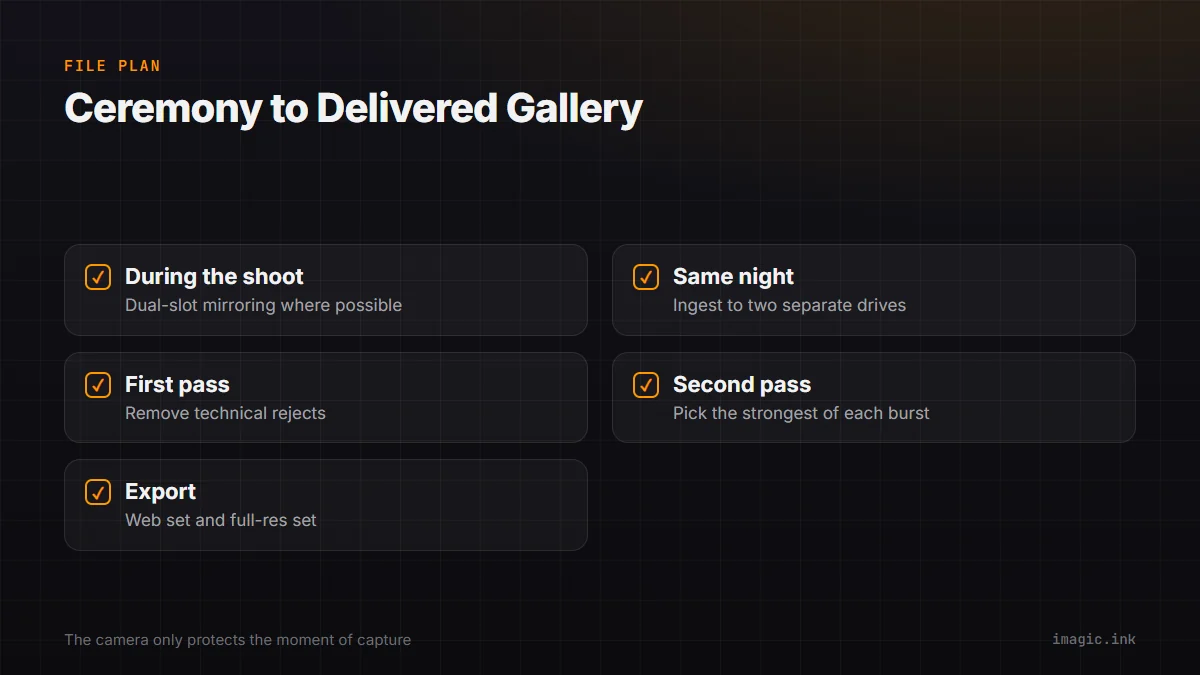
- During the shoot: use dual-slot mirroring where the body supports it, so every frame writes to two cards at once rather than one card being the only copy. Swap cards before they fill rather than after, and physically label a full card as soon as it comes out of the body so an exhausted photographer at 11pm is not guessing which cards are done.
- Same night or next morning: ingest every card to at least two separate physical drives before formatting anything in-camera. A card is not backed up until it exists in two places that are not the same drive; a single external drive that also holds the only backup is a single point of failure with extra steps.
- Folder structure: a consistent naming convention (date, couple's names, and location) makes a shoot findable months later without relying on memory, and keeps automated tools and manual search working the same way across every wedding in a season.
- First culling pass: a fast pass to remove closed-eye frames, motion blur, test shots, and the bulk of near-duplicate burst frames, ideally before detailed editing decisions start, so editing time only goes toward frames that are actually candidates for delivery.
- Second pass, keeper selection: the close calls, comparing near-identical frames from the same burst or the same posed moment and picking the strongest one rather than delivering several similar options to the couple.
- Editing: non-destructive adjustments applied consistently across the gallery, so a color grade or exposure correction can be revisited later without having overwritten the original RAW file.
- Export and delivery: at minimum a web-resolution set for online galleries and social sharing, and a full-resolution set for print, since a single export size rarely serves both use cases well.
Culling and Editing at Wedding Volume Without Losing a Week
The bottleneck in wedding delivery is rarely the camera; it is the days spent reviewing thousands of near-identical frames afterward. Software that runs the first culling pass locally, scoring sharpness, detecting closed eyes, and grouping bursts and near-duplicates together, turns that pass from an hours-long manual review into a shortlist a photographer actually judges. imagic is one example built specifically for that step: it processes photos on the machine they are already stored on rather than uploading them anywhere, applies quality scoring and duplicate and burst grouping automatically, and supports nine RAW formats including Canon's CR2 and CR3, Panasonic's RW2, and Fujifilm's RAF, alongside DNG, so files from the Ricoh GR IV or a Fujifilm body land in the same workflow as a Canon or Panasonic RAW. Analysis runs at roughly 30 to 90 seconds per 1,000 photos on a modern machine, so processing a 4,000 frame wedding day is a matter of a few minutes, not an afternoon; the time that still takes real effort afterward is the human review of the shortlist it produces, not the scoring itself. Culling and editing stay non-destructive throughout, so no command in the pipeline deletes an original file, and a rejected frame stays recoverable if a second look changes the call. A batch-editing pass and one-click styles then apply a consistent look across the delivered set before export to JPEG or TIFF. The free 500-export trial, which does not require a card, is available from imagic's desktop download page.
Not for you if the missing step is on-site tethered shooting during the ceremony itself, mobile capture and review from a phone, cloud collaboration with a remote second shooter's separate photo library, layer-based retouching and generative fill for album production, or built-in printing; none of those are part of what a local culling and editing tool does, and a wedding workflow that needs them should pair a tool like this with something built for that specific stage instead of expecting one application to cover the whole pipeline.
Matching a Body to Your Budget and Shooting Style
The honest buying order is file-management fit first, lens ecosystem and brand investment second, and individual spec-sheet numbers third. A body that shoots a RAW format the existing workflow already reads, with dual-card redundancy, beats a marginally faster burst rate on a system that requires rebuilding a lens kit from scratch. The table below recaps the five bodies covered above against that lens, using only the facts already sourced.
| Camera | Sensor | Availability (checked 15 Aug 2026) | Not for you if |
|---|---|---|---|
| Canon EOS R6 Mark III | ~32.5MP full-frame | Current, per Canon's manual | the mount is not one already owned and a lens rebuild is not budgeted |
| Canon EOS R1 | 24.2MP full-frame | Discontinued on Canon's US store; check regional stock or the used market | a new, in-stock body matters, or the price and weight are hard to justify for wedding-only work |
| Panasonic LUMIX S1II | 24.1MP full-frame | Shipping from late June, per Panasonic's announcement | same-day video delivery is not part of the offering |
| Ricoh GR IV | ~25.74MP APS-C, fixed lens | Current, per Ricoh's spec page | a single body needs to cover the whole event |
| Fujifilm X-T6 | Unconfirmed | No official announcement as of 15 Aug 2026 | bookings on this season's calendar need a body now |
Whichever body ends up in the bag, the file-management plan above (dual-card mirroring during the shoot, a same-day two-drive backup, a staged culling pass, non-destructive editing, and a two-size export) applies regardless of brand. Checking buffer depth, card slot layout, and RAW format support directly against each manufacturer's own specification page before committing to a purchase is worth the extra ten minutes, since those three details matter more to a wedding day than most of the rest of a spec sheet combined.
Frequently Asked Questions
Does a wedding actually require two camera bodies?
Two bodies, or at minimum two lenses ready to swap without missing a moment, is close to standard for professional wedding coverage, since both the ceremony and reception contain moments that cannot be reshot if a body fails or a lens change takes too long mid-moment. That does not have to mean two identical flagship bodies bought at once; a second body only needs to shoot a RAW format the existing workflow can already read and cover a genuinely different role, such as a longer lens for reception candids, rather than duplicating the primary body's job.
How many RAW files does a typical wedding actually produce?
Based on the burst-rate math worked through above, 3,000 to 6,000 RAW files across an eight to twelve hour day is a reasonable planning range, covering formals, candids, several fast bursts around key moments, and reception coverage. The exact figure depends heavily on shooting style: a documentary-heavy day produces far more frames than a formal-portrait-heavy one, and how liberally continuous burst mode gets used during fast moments swings the total substantially.
Should a wedding photographer pay for a subscription culling tool or a one-time purchase?
The answer depends on shooting volume and how many seasons the tool gets used, since the two pricing models cross over at different points depending on both. This site's three-year cost comparison works through that math with the assumptions shown, so the figures can be substituted with actual booking volume and current local pricing rather than relying on a generic number.
Does sensor resolution matter much for wedding album prints?
Less than the marketing around it suggests. Most delivered wedding images end up on a phone screen or a standard album print size, where sharpness, exposure accuracy, and consistent color across a gallery matter more to how the final album looks than raw megapixel count, once a sensor clears roughly 24 megapixels. Every body compared in this guide sits at or above that threshold.