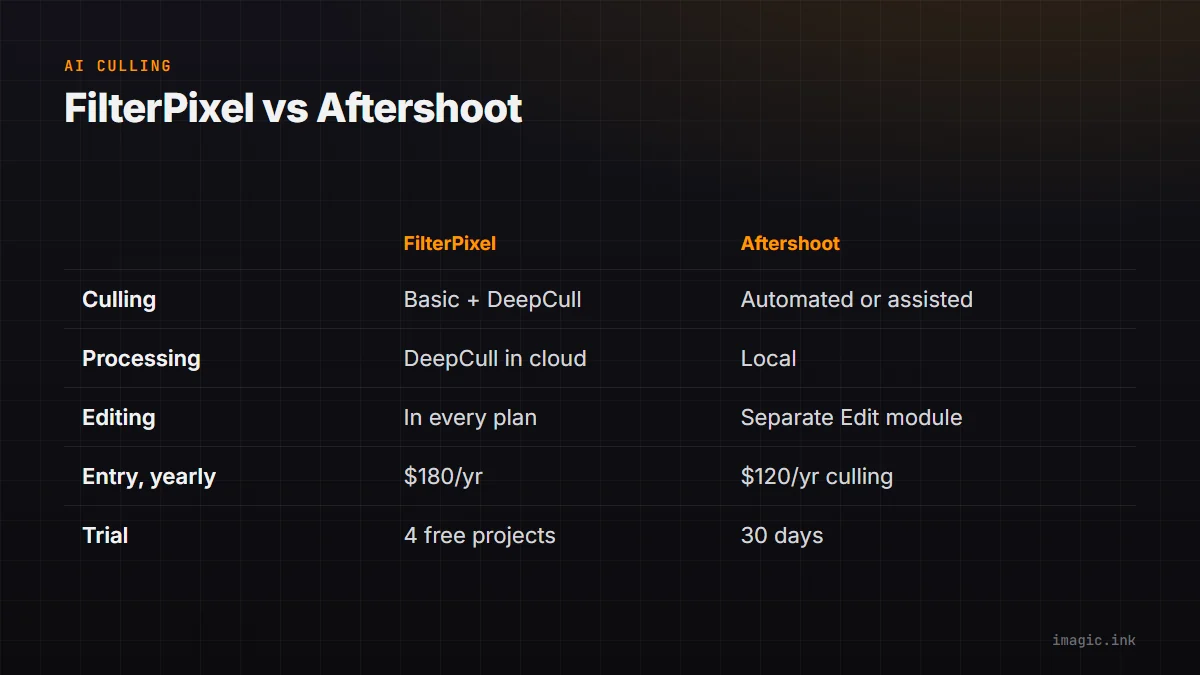
FilterPixel and Aftershoot are two of the AI culling tools photographers most often weigh against each other. Both score a shoot, group similar frames and hand you a shorter list to review; both have grown editing features on top; both are subscriptions. The differences are in the details that decide which one fits: where the analysis runs, how each meters its heavier AI features, and how the prices stack up once you add editing. Everything below was checked on each vendor's own pages on 25 October 2026, in USD before any sales tax or VAT.
How each one culls
FilterPixel has two levels of culling. Basic Cull handles the technical pass: blur, focus, expressions and composition, plus grouping of similar images. DeepCull is genre-aware (wedding, sports, concert, conference and others) and scores each photo with a reason, looking at expressions, moments and peak action. Survey Mode puts near-identical frames side by side, and Magic Number suggests how many images to keep. FilterPixel also says it never removes an image: its Review Mode keeps every frame, and it can learn how you use stars, colours and flags.
Aftershoot offers two culling modes, AI-automated and AI-assisted, along with duplicate grouping, key face detection with scores, and a Survey mode plus a "Spray Can" for bulk selections. Its selections export directly to Lightroom Classic, Lightroom, Capture One, Bridge and Adobe Camera Raw.
In practice both cover the same core job well enough that the deciding factor is rarely "which finds blinks". It is more often how each fits the rest of your workflow and what it costs.
Where the processing happens
This is the clearest technical difference. Aftershoot's own support article says it "works locally on your device" and that you decide how much processing power it can use. It runs on Windows and macOS, with 8 GB of RAM as the stated minimum.
FilterPixel is hybrid. Its site says your original files never leave your computer, but for DeepCull the embedded preview of each image is uploaded and analysed in the cloud. FilterPixel presents that as a benefit (no GPU to buy, and about 1,000 photos culled in 8 minutes, by its own figure). If uploading previews is a problem for your clients or contracts, it is a point to weigh; if a slow laptop is your bottleneck, it may be the point in FilterPixel's favour. It also runs on Windows and Mac.
Editing on top of culling
Both now sell editing as well. FilterPixel includes AI editing in every paid plan: one-click edits with built-in profiles from Standard up, and custom trainable profiles (learned from your edited Lightroom catalog) from Pro up, two on Pro and five on Studio.
Aftershoot sells editing as a separate module, Edit, with marketplace styles, AI cropping, straightening and masking, and a Personal AI Profile trained on your own edits (Aftershoot recommends at least 5,000 edited images for best results). A third module, Retouch, adds portrait retouching. You can buy Select (culling) alone, or bundle the modules.
Pricing, side by side
| Plan | Billed yearly | Billed monthly | Per year, yearly billing |
|---|---|---|---|
| Aftershoot Select (culling) | $10 | $15 | $120 |
| Aftershoot Select + Edit | $40 | $50 | $480 |
| Aftershoot Complete (cull, edit, retouch) | $45 | $55 | $540 |
| FilterPixel Standard | $14.99 | not listed | $180 |
| FilterPixel Pro | $34.99 | not listed | $420 |
| FilterPixel Studio | $64.99 | not listed | $780 |
Aftershoot also has an "annually billed monthly" option (for example $12 a month for Select) that commits you to 12 months, with a $30 fee if you cancel in the first six. FilterPixel's pricing page lists yearly billing and says it saves 25 percent; it did not show a month-to-month total when checked.
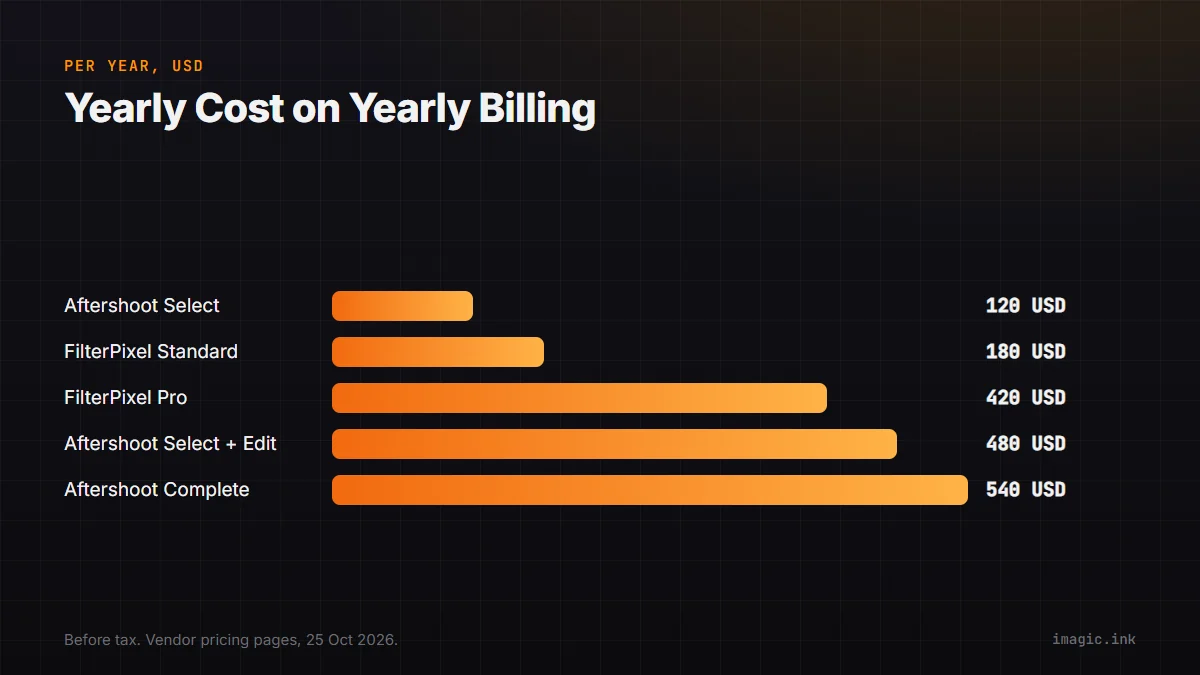
The comparison that matters depends on what you want. For culling only, Aftershoot Select at $120 a year is the cheaper entry, while FilterPixel Standard at $180 also includes basic AI editing. For culling plus editing trained on your own style, compare Aftershoot Select + Edit ($480 a year) with FilterPixel Pro ($420 a year).
The meter to watch: DeepCull shoots
Aftershoot does not cap the number of images you cull. FilterPixel's Basic Cull is unlimited too, but DeepCull is counted in shoots: 20 a year on Standard, 70 on Pro, 140 on Studio, each covering up to 5,500 photos, with extra shoots at $7.99. A wedding photographer doing 30 weddings a year who wants DeepCull on every one would outgrow Standard, so count your shoots before choosing a tier.
Trials
Aftershoot offers a free 30-day trial. FilterPixel's site offers four free projects with unlimited photos and no card required. Either way, run the trial on a real, full shoot you have already culled by hand: comparing the AI's picks with your own is the only test that tells you whether it suits your style.
Which one fits
- Aftershoot fits photographers who want everything to run locally, want culling-only at the lowest entry price, or want portrait retouching from the same vendor.
- FilterPixel fits photographers on modest hardware who are happy to send previews to the cloud for DeepCull, want genre-aware scoring for sports or events, and want AI editing included from the first paid tier.
And if the subscription itself is the problem, imagic is a one-time purchase (EUR 19, 49 or 99) that scores sharpness, closed eyes and composition, groups bursts and duplicates, and then develops and exports the RAW files, all on your own machine. It has no genre-trained DeepCull and no portrait retouching, so it is a different trade-off rather than a like-for-like swap; there is a free 500-export trial with no card. Our imagic vs FilterPixel comparison, Aftershoot's pricing explained over five years and the imagic and Aftershoot comparison page go into each in more depth, and the rest are in Software Comparisons.
Frequently asked questions
Is FilterPixel cheaper than Aftershoot?
It depends on the bundle. For culling only, Aftershoot Select costs $120 a year on yearly billing against $180 for FilterPixel Standard, which also includes basic AI editing. For culling plus a personal editing profile, FilterPixel Pro ($420 a year) costs less than Aftershoot Select + Edit ($480 a year), at prices checked in October 2026.
Does FilterPixel upload my photos?
FilterPixel says your original files never leave your computer, but DeepCull uploads each image's embedded preview and analyses it in the cloud. Aftershoot states that its processing runs locally on your device.
Can I cull an unlimited number of photos with either tool?
Aftershoot does not cap culling. FilterPixel's Basic Cull is unlimited, while its genre-aware DeepCull is counted in shoots per year (20, 70 or 140 by plan, up to 5,500 photos each), with extra shoots sold at $7.99.