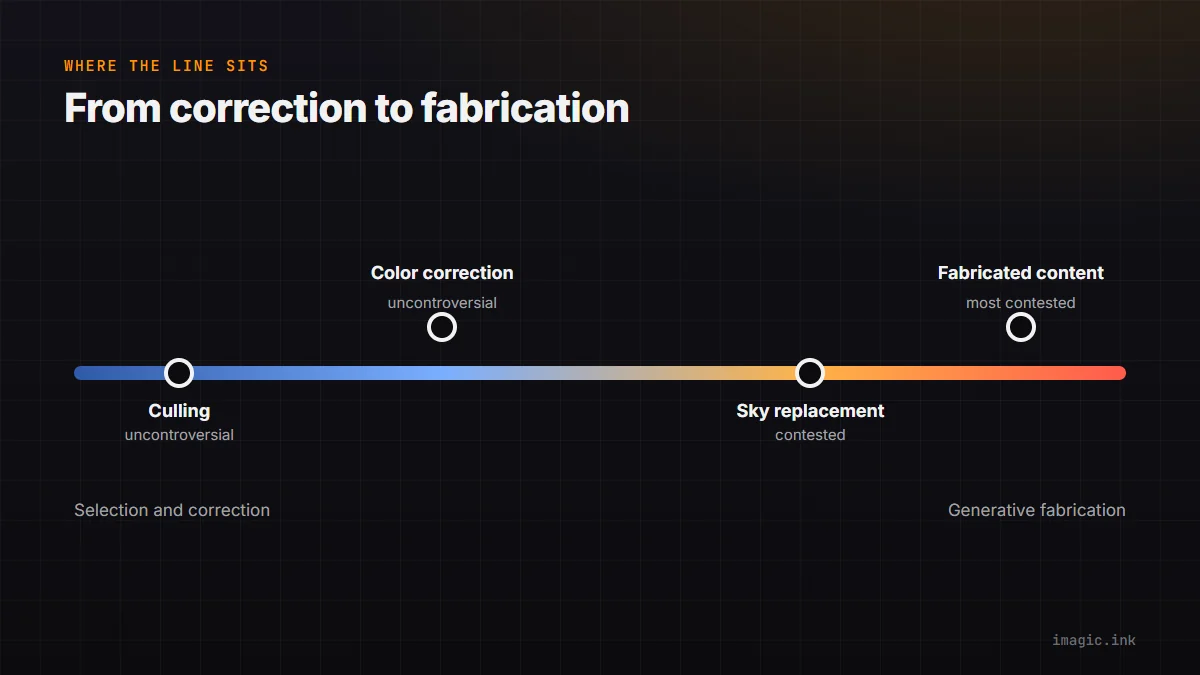
AI in photo editing covers such a wide range of actual behavior, sharpness scoring, duplicate detection, batch color correction, generative content addition, that treating it as one ethical question misses the point. Where photographers actually draw lines depends on what the AI is doing to the photo, not whether the word "AI" appears in the tool's marketing.
Culling and Correction: Largely Uncontroversial
AI that helps decide which photos to keep, scores sharpness and exposure, flags closed eyes, groups near-duplicate bursts, is not really an ethics question for most photographers, since it does not change what is actually in the frame. Similarly, AI-assisted color correction, exposure balancing, noise reduction, applying a consistent style across a batch, is functionally an automated version of adjustments photographers have always made by hand. Almost no working photographer treats these as ethically different from manual dodge, burn, or curves work; they are the same edits, done faster.
Generative Alteration: Where the Real Debate Lives
The genuinely contested territory is generative AI that adds, removes, or fabricates content that was never actually in the frame: swapping a gray sky for a dramatic one, adding people who were not present, generative fill that invents detail rather than recovering it from the original capture. This is where client trust and documentary accuracy come into direct tension with creative flexibility, and reasonable photographers land in different places depending on the genre and the client relationship. imagic deliberately does not include generative fill or content fabrication tools, keeping its AI features scoped to culling, correction, and style application rather than content invention, which sidesteps this particular debate rather than resolving it.
Disclosure Norms Emerging in Contracts
A growing, though still inconsistent, practice is photographers adding a line to contracts or delivery notes specifying what kind of editing was used, particularly for genres where authenticity matters to the client or the eventual audience. This mirrors, at a much smaller scale, the disclosure conversations happening in photojournalism and stock photography around AI-generated or AI-altered content. There is no industry-wide standard yet, and enforcement is entirely a matter of individual studio policy, but the direction of travel is toward more explicit disclosure rather than less, especially as clients become more aware that generative tools exist at all.
Standards Differ Sharply by Genre
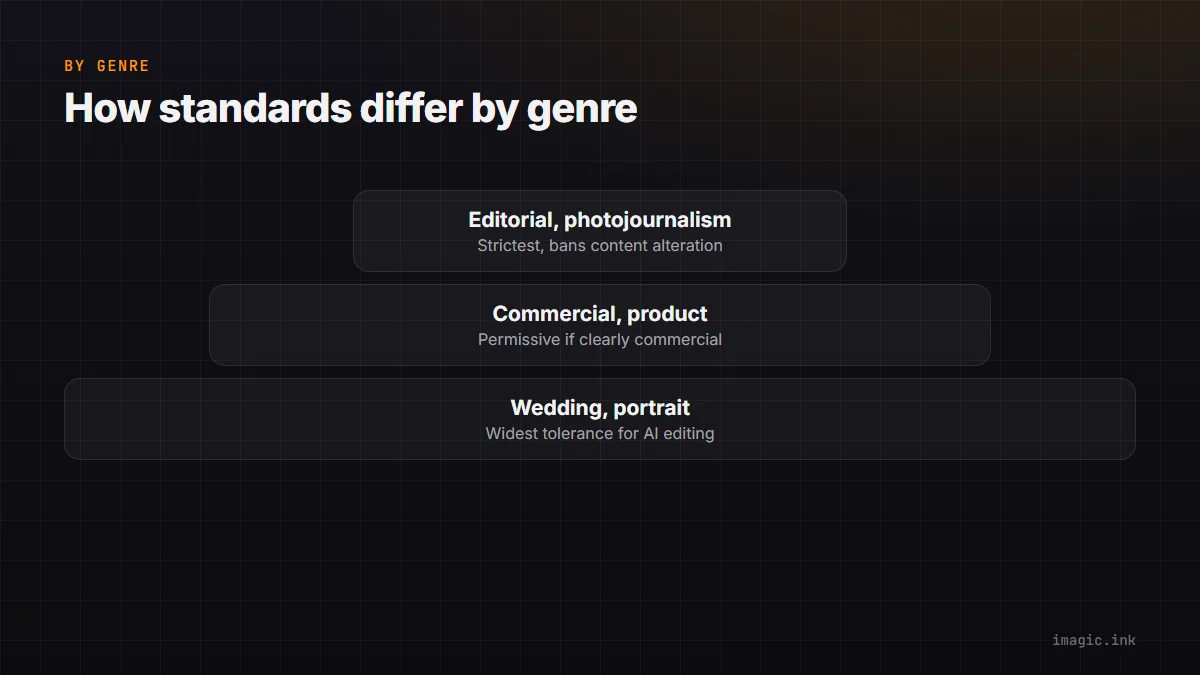
Wedding and portrait photography generally tolerate the widest range of AI-assisted editing, since the goal is a flattering, polished final image and clients rarely expect documentary literalism from their wedding gallery. Editorial and photojournalism hold a much stricter line: content alteration beyond standard color and exposure correction is widely considered a serious ethical breach, with some publications and contests explicitly banning generative changes and disqualifying work that violates it. Commercial and product photography sits somewhere in between, often permissive about background changes or composite work as long as it is understood to be commercial imagery rather than a documentary record. Read how AI is changing photo editing for professionals for how these shifts are playing out across the industry more broadly.
A Practical Line for Working Photographers
A workable rule of thumb many photographers land on: AI that helps you decide or adjust is a workflow tool; AI that fabricates content the camera never captured is a creative decision that deserves a conversation with the client, or at minimum a note in the delivery. Where exactly that line sits for wedding work versus commercial work versus editorial is a genre-specific judgment call, but the underlying distinction, selection and correction versus fabrication, holds up reasonably well across most of them. How professional photographers are actually using AI and the industry insights section cover where the broader profession is landing on these questions.
Frequently asked questions
Is AI culling considered manipulation of the final image?
No. Culling only determines which already-captured frames get delivered; it does not alter the content of any individual photo, so it falls outside most ethical debates about image manipulation.
Do clients generally care whether editing used AI?
Most clients care about the result, not the method, as long as the image still represents what actually happened. Concern tends to rise specifically around generative content addition, not around AI-assisted correction or culling.
Should photographers disclose AI-assisted color correction?
Most photographers do not, treating it as equivalent to manual correction, since no content is being added or removed. Disclosure norms are more actively debated for generative changes than for correction-level AI editing.