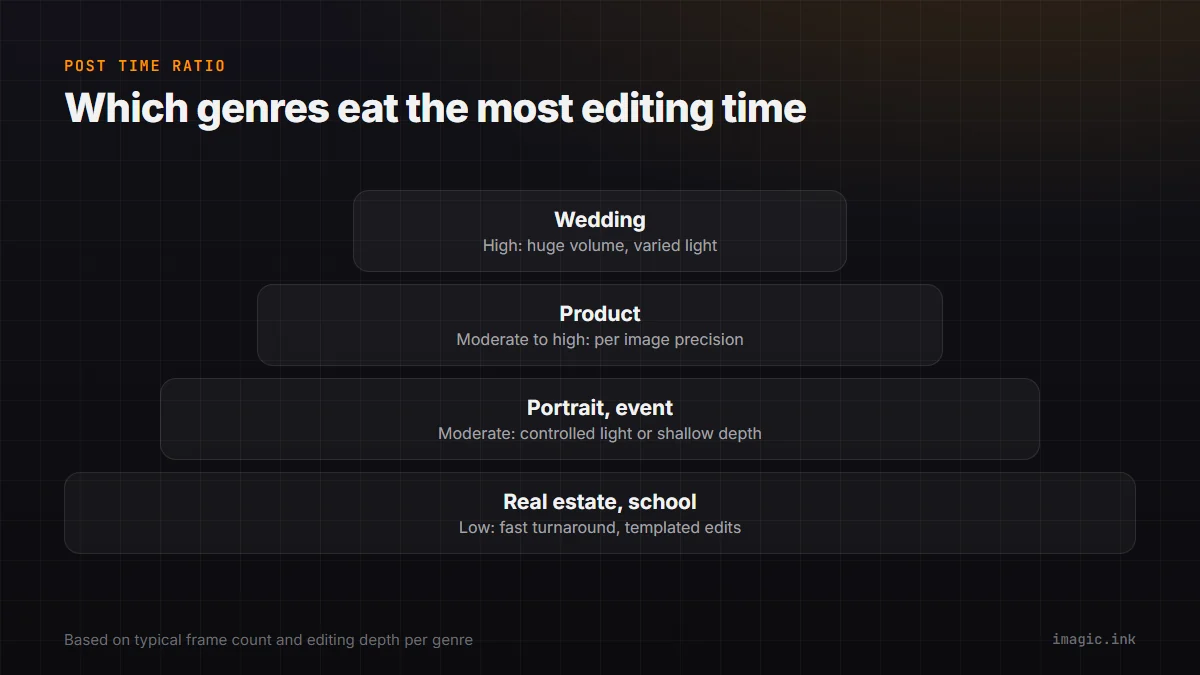
Photographers usually choose a genre based on what they love shooting, which is the right instinct, but it is worth also knowing what that genre costs you afterward. Post-processing hours per shoot hour vary enormously across genres, and that ratio quietly shapes how many clients you can realistically take, no matter how fast you shoot.
Ranking Genres by Post-Time Ratio
This is a rough, reasoned ranking based on typical frame volume, required per-image editing depth, and delivery expectations, not a precise formula, since individual style and client expectations shift the numbers meaningfully.
| Genre | Typical post-time ratio | Why |
|---|---|---|
| School/volume photography | Low | High frame count but templated, consistent edits applied in batch |
| Real estate | Low to moderate | Fast turnaround expectations force efficient, standardized editing |
| Portrait (studio) | Moderate | Controlled light reduces correction time; retouching adds it back |
| Event/corporate | Moderate | High volume, but editing depth per frame is usually shallow |
| Product | Moderate to high | Fewer frames but high per-image precision expectations |
| Wedding | High | Very high frame count, varied light, high per-frame care expected |
Why Weddings Sit at the High End
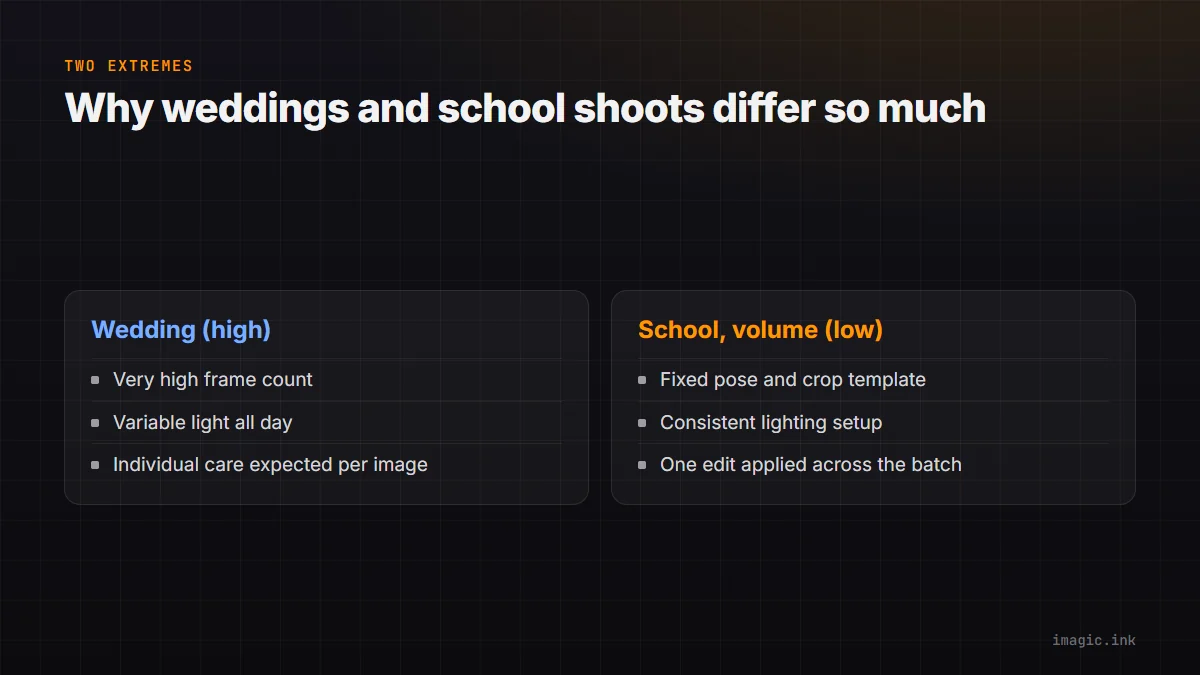
Weddings combine the two factors that drive post-time up simultaneously: very high frame counts (often several thousand images across a single day) and highly variable lighting conditions across ceremony, portraits, and reception, each demanding different correction. Clients also expect meaningful care per delivered image rather than uniform batch treatment, since a wedding gallery is a once-in-a-lifetime deliverable. This combination is why experienced wedding photographers lean hard on culling automation and batch editing tools just to keep turnaround times reasonable; see the dedicated wedding photography workflow guide for the specifics.
Why School and Volume Work Sits at the Low End
School photography is high volume but low per-image editing depth: consistent lighting setup, a fixed pose and crop template, and a batch edit style applied uniformly across the entire set. The efficiency comes from standardization, not from having fewer photos to handle. This is also why volume photographers are often the earliest and heaviest adopters of batch automation: the genre is built around applying one correct edit to thousands of nearly identical frames rather than making thousands of individual judgment calls.
Choosing a Genre With Eyes Open
None of this is a reason to avoid a genre you love because its post-time ratio is high. It is a reason to price and schedule accordingly. A wedding photographer charging based on shoot-day hours alone, without accounting for the editing hours that follow, will consistently undercharge relative to actual time invested. Understanding roughly where your genre sits on this spectrum, and being honest about your own editing speed within it, makes pricing and client-load decisions far more grounded than guessing.
Frequently asked questions
Why do wedding photographers spend so much time editing compared to other genres?
Weddings combine very high frame counts with highly variable lighting across a single day, plus a client expectation of individual care per image, which together push post-processing time well above genres with more uniform conditions or lighter editing expectations.
Is school photography actually easier than it looks?
The shooting and setup are often more demanding than expected (volume, tight scheduling), but the editing itself is comparatively efficient because it relies on batch-applying one consistent template across a large, uniform set of frames.
How should this affect how I price my work?
Price based on total time invested, including post-processing, not just time spent shooting. A genre with a high post-time ratio needs pricing that reflects the editing hours, not just the hours on location.
See also how this plays out for school and volume photography and wedding photography specifically. More in Industry Insights.