
Most one-person photography studios hit a capacity ceiling that feels like a hiring problem but is often actually a workflow problem. Before assuming the only way to take on more clients is to bring on staff, it is worth being honest about how much of your current time is going to work that could be automated rather than work that genuinely needs a human.
The Solo Ceiling, Honestly
A solo photographer's capacity is bounded by two separate things: how many shoots you can physically do in a week, and how many hours of post-shoot work each shoot generates. Most photographers hit the second wall long before the first. You could plausibly book more shoots, but culling, editing, and delivering the ones already booked already fills every evening and weekend, so the ceiling is really a post-production bottleneck wearing a scheduling costume. Recognizing this distinction matters, because hiring an assistant to help shoot does nothing for a bottleneck that lives in the edit suite.
What to Automate First: Culling and Delivery
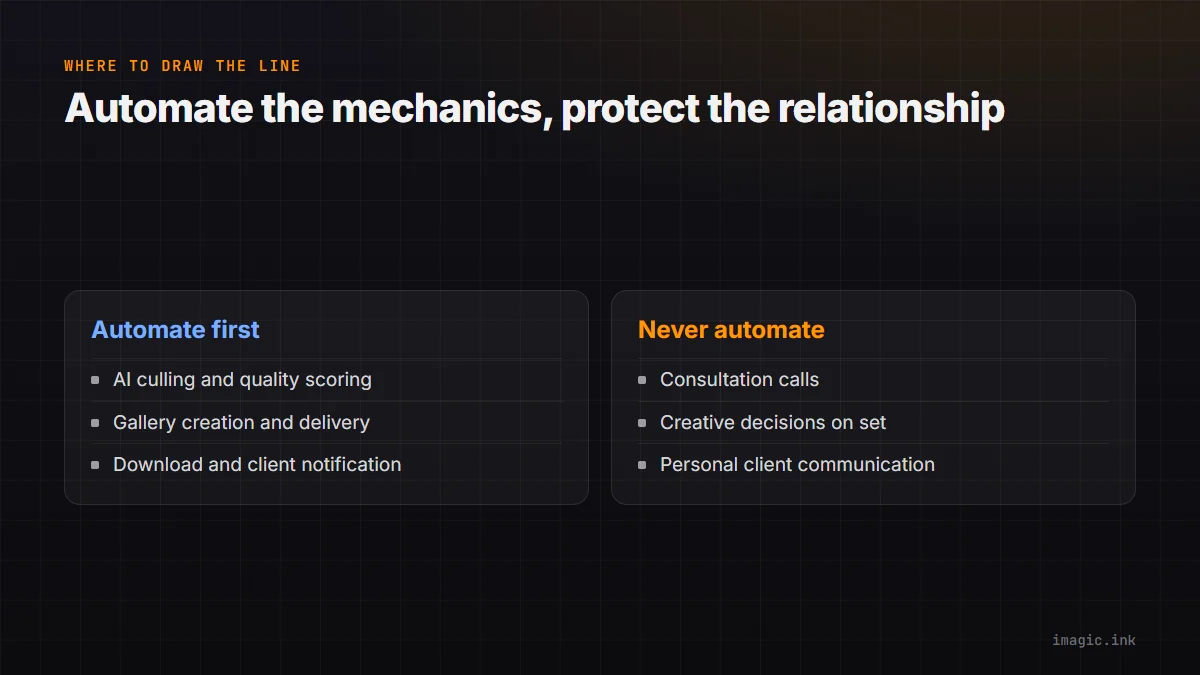
The two highest-leverage automation targets are the ones that consume the most hours for the least genuinely creative judgment: culling and delivery. AI-assisted culling and quality scoring can take a first-pass sort down from hours to minutes, leaving your judgment for the close calls rather than the obvious rejects. Delivery, gallery creation, client notification, download management, is almost entirely mechanical and benefits enormously from a repeatable, largely automated pipeline. Automating both of these frees the hours that are currently the actual limit on how many clients you can serve, without touching the parts of the work that make you good at your job.
What Never to Automate: Client Relationships
The trap in scaling a solo studio is applying the automation instinct too broadly and letting it touch client-facing judgment: the consultation call, the shot list discussion, the moment-to-moment creative decisions during a shoot, the personal touch in how you communicate. These are the actual differentiators of a solo studio versus a larger operation, and automating or templating them too aggressively is how a personal, high-touch brand starts feeling generic. The goal of automating culling and delivery is specifically to protect the time and energy for this part, not to remove the human element from the business entirely.
Realistic Capacity Math
If post-production currently consumes, say, three times the hours of the shoot itself, cutting that ratio meaningfully, even by a third, through better culling and delivery automation translates directly into bookable capacity without adding a single hour to your week or a single dollar to payroll. This is a more realistic first lever than hiring for most solo studios, because hiring adds cost, management overhead, and quality-control work immediately, while automating the mechanical parts of your own existing workflow adds none of that. Hiring becomes the right move later, once the automatable slack is already gone and the remaining bottleneck is genuinely your own physical shooting capacity.
Frequently asked questions
Should I hire an assistant or automate my workflow first?
For most solo studios, automating culling and delivery is the lower-cost, faster first move, since the real bottleneck is usually post-production hours rather than shooting capacity. Hiring makes more sense once that automatable slack is already gone.
What parts of a photography business should never be automated?
Client-facing judgment and relationship-building, consultations, creative direction during a shoot, personal communication, are the differentiators of a solo studio and are worth protecting rather than templating away.
How much time can automating culling realistically save?
It varies by shoot volume and style, but AI-assisted culling commonly turns an hours-long first pass into a much shorter one, since the mechanical sorting (blur, closed eyes, duplicates) is handled before you apply your own judgment to what remains.
See also delivering photos faster to clients. imagic's automation tools and MCP/CLI access are built for exactly this kind of pipeline. More in Industry Insights.