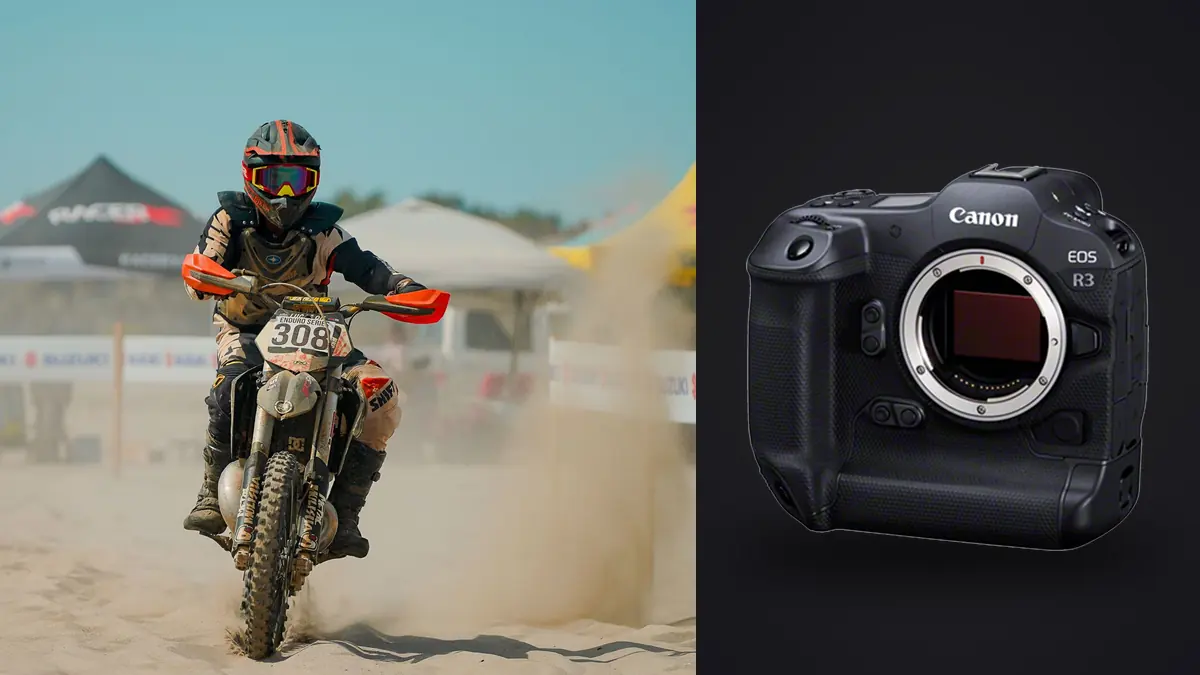
I shot my first outdoor track meet with a Canon EOS R3 in the spring of 2023, expecting it to feel like a slightly faster EOS R5 with a grip bolted on. It doesn't feel like that at all. The R3 is built around a different assumption about what "fast" means for a camera, and a track meet is one of the few environments where you actually feel that assumption pay off every single race, not just in a lab buffer test.
Track and field is a strange sport to shoot compared to almost anything else with a whistle. You're not tracking one continuous ninety-minute flow like football or hockey. You get eight lanes of sprinters converging on a line in under ten seconds, then twenty minutes of dead air while the next heat gets called to the blocks. You get a pole vaulter who telegraphs almost the entire attempt except the half second that matters. You get a discus thrower who turns their back to you through the whole wind-up and only shows you anything on release. Every event on the infield asks something different of the camera, and the R3 answers some of those asks far better than others.
The sensor and shutter are the part that actually changes things
The headline spec on the R3 is 30 frames per second with the electronic shutter, and on paper that number gets thrown around next to a dozen other cameras that also claim big burst rates. What's different is that the R3's stacked sensor reads out fast enough that the electronic shutter doesn't turn a sprinter's legs into jello. I've used electronic-shutter bursts on other bodies at track meets and watched lane dividers bend and running blocks smear because the rolling readout couldn't keep up with a body moving at nine meters a second. On the R3, at full readout speed, a 100m start at 30fps holds its shape. That's not a small thing. It means you can actually leave the electronic shutter engaged for finals without worrying you'll get a portfolio of warped hurdles.
The other piece is the blackout-free viewfinder while shooting at 30fps. On a mechanical body, even a good one, you lose the moment of exposure from your eye, and at a false-start-prone 100m final that gap is exactly when a lean or a stumble happens. With the R3 you keep a live feed the entire time you're firing, which changes how you frame. I stopped pre-guessing where a sprinter's torso would be at the line and started actually watching it happen through the finder, adjusting composition mid-burst instead of hoping I framed it right three frames ago.
Eye Control AF: genuinely useful, genuinely inconsistent
Canon's eye-control autofocus, where the camera tracks where your eye is looking inside the viewfinder and moves the AF point there, sounds like a gimmick until you use it on a crowded start line where six athletes are bunched in the frame and you need the point on lane 4 specifically. When it's calibrated well, it's faster than any joystick flick I can manage, and for events like the long jump runway, where the athlete is off-center and closing distance fast, being able to just look at them and have the AF point follow is a real advantage.
The catch is calibration drifts. Sweat on your brow, a slightly different eyecup pressure because you're leaning into a fence for support, sunglasses swapped for clear glasses between events, and suddenly the eye tracking is landing on the fence behind the athlete instead of the athlete. I recalibrate at every meet, sometimes twice, and I still keep the rear joystick as backup because there are afternoons it just won't lock in reliably, especially once the light gets low and my pupil behaves differently than it did at the calibration station at 10am. Treat it as a genuine tool, not something you can turn on and forget.
Buffer and cards: where the CFexpress slot earns its keep
Track meets generate absurd numbers of frames per useful moment. A 30fps burst through a two-second sprint finish is sixty frames for what might become one usable image. Multiply that by eight lanes worth of finishes, four rounds of hurdles, a dozen high jump attempts, and by the end of a full day meet you can be looking at four or five thousand frames.
With a fast CFexpress Type B card in the primary slot, the R3 shooting full-resolution RAW at 30fps effectively doesn't stall for anything shorter than a relay, which is the longest continuous action you'll shoot at a track meet anyway. Drop down to the UHS-II SD slot as your only card and you'll feel the buffer clear noticeably slower coming out of a long burst, enough that I'd never run SD-only for anything faster than 12fps mechanical. I run CFexpress for RAW and SD as a JPEG backup, which also means if a card fails I've still got something usable off the second slot, and after enough seasons on the infield you learn every backup habit has already saved somebody's meet at least once.
Matching shutter speed and AF case to the actual event
The biggest mistake I see photographers make at their first track meet with a high-end body is leaving one shutter speed and one AF case dialed in for the whole day. Track and field is really eight or nine different sports stapled together, and they don't share settings.
| Event | Shutter speed I use | AF Case / tracking notes |
|---|---|---|
| 100m / 200m sprints | 1/2500s or faster | Case 2 (ignore obstacles), Eye Control or single-point on lead runner's torso |
| 400m turn | 1/2000s, slight pan | Case 3, subject can enter frame fast off the bend |
| Hurdles | 1/3200s minimum | Case 4, erratic vertical movement over the barrier |
| High jump / pole vault | 1/1600 to 1/2000s | Servo with a wide zone, subject moves toward camera then falls away fast |
| Long / triple jump | 1/2000s | Eye Control works well here, runway approach is predictable |
| Discus / shot put / javelin | 1/1600s | Single point, pre-focus on release point, subject faces away during wind-up |
| 4x100/4x400 relay exchange | 1/2500s | Case 5 or manual re-acquire, two runners overlapping in frame |
None of that is exotic advice specific to the R3, honestly, it's just track photography fundamentals. What the R3 changes is how forgiving the wrong AF case is. On older bodies, picking Case 1 for a hurdles race meant you'd lose focus lock the moment the athlete's silhouette changed shape going over the barrier. The R3's subject tracking holds onto a human shape through those transitions well enough that a slightly wrong case choice costs you fewer frames than it used to. It's not an excuse to stop thinking about settings, but it does mean fewer entirely blown sequences from a bad guess.
Lens choices that actually make sense on a track
Stadium geometry dictates lens choice more than any camera spec does. If you've got infield access, a 400mm f/2.8 is still the workhorse for straightaway sprints and the far turn, but for anything happening in the field events near the infield, that lens is often too long, you can't back up. I lean on a 100-500mm for a meet where I'm moving between the runway, the pit, and the throwing circle, accepting the smaller aperture in exchange for not needing to swap bodies or lenses every fifteen minutes.
From the stands, without infield credentials, a 300mm f/4 or a 200-400mm gets you close enough for the far straightaway, but the near lanes and the finish line will still feel distant unless you're shooting a smaller local meet where you can sit trackside. Wide 24-70mm coverage matters more than people think too, for the start line chaos, the medal ceremony, the coach huddle, the stuff that happens outside the actual race and tells the story of the meet rather than just the result.
What happens after the gun goes off: the real bottleneck
Here's the part nobody warns you about before your first R3 track meet: the camera solves the capture problem so well that it creates a much bigger problem on the back end. A day that used to hand you six hundred frames on an older body now hands you three or four thousand. Scrolling through that in Lightroom, one at a time, comparing frame 14 against frame 15 of the same 100m final to figure out which one actually has the lean at the line in focus, is its own kind of exhausting that has nothing to do with photography skill.
This is where I stopped trying to cull manually and started running everything through imagic before it ever touches my main catalog. It's a local app, so nothing leaves my laptop, which matters to me because some of these files are under embargo for a school or federation until results are official. It groups burst sequences automatically, so instead of forty near-identical frames of a long jump landing sitting in a flat folder, they're clustered together and scored for sharpness, and I can pick the one where the athlete's foot actually hit the sand in focus without eyeballing forty thumbnails at 100% zoom. For a meet with six thousand raw frames, that's the difference between a two-hour edit session and staying up until 1am.
The other thing that's helped is training a custom preset on my own past edits of track work using imagic's apply_my_style feature, so the color and contrast treatment I've settled on for stadium lighting under sodium vapor or mixed LED floods gets applied automatically across a batch instead of me manually matching white balance shot by shot. It's not a replacement for actually looking at the good frames, it just removes the repetitive part so I spend my time on the twenty images that are actually worth keeping, not the four thousand that got the camera there.
Weather sealing and the battery grip you don't get to remove
Track meets happen outdoors in whatever the sky decides to do, and the R3's integrated grip means you're not choosing whether to add a battery grip for a rainy meet, it's just always there. That's mostly a good thing, the sealing is on par with the 1D-series bodies I used before switching, and I've shot through a genuinely bad thunderstorm delay at a state championship without babying the camera under a jacket the way I would have with a smaller body. The LP-E19 battery, shared with the old 1D X Mark III, also just does not die on you mid-meet, I've gone a full day of finals sessions on one battery with room to spare, which matters when you don't want to be swapping batteries during a race you can't get back.
The downside is size and weight when you're not shooting finals, when you're doing the four hours of prelims and field event qualifying that make up most of a real meet day. It's a heavy camera to have hanging off a strap while you walk laps around a stadium chasing field events between running events. I don't regret the trade, but anyone coming from a smaller mirrorless body should know the R3 asks something of your shoulder that lighter bodies don't.
Frequently Asked Questions
Is the Canon EOS R3 overkill for a local high school track meet?
For casual coverage, yes, probably. The 30fps buffer and eye control AF earn their keep at a state championship or a meet where you're covering finals for a paper or a college recruiting file, where one missed lean at the line actually costs something. For a Tuesday dual meet, a much cheaper body with a good 400mm-equivalent reach will get you results that are hard to tell apart in the final edit.
Do I need the electronic shutter at 30fps, or is 12fps mechanical enough for track?
For sprints and hurdles, I want 30fps, the window where a finish line lean is actually correct is often under a tenth of a second and 12fps can straddle it. For field events like shot put or high jump, where the decisive instant is more spread out, 12fps mechanical is plenty and saves you from digging through triple the frames afterward.
How do I stop track meet photos from all looking the same after a full day of shooting?
Vary your position more than your settings. Most of the sameness in track photography comes from shooting every race from the same spot on the infield rail. Move between the start, the turn, and low angles near the pit for jumps, and the shutter speed table above will naturally produce different-feeling images even on the same camera body.
What's the actual workflow for getting through thousands of track photos in one evening?
Get the cards off the camera and into a culling pass before you do anything else, don't start editing individual frames first. I run bursts through imagic to cluster near-duplicate sequences and rank them by sharpness before I ever open a full editor, which cuts a four-thousand-frame day down to the two or three hundred images actually worth grading.