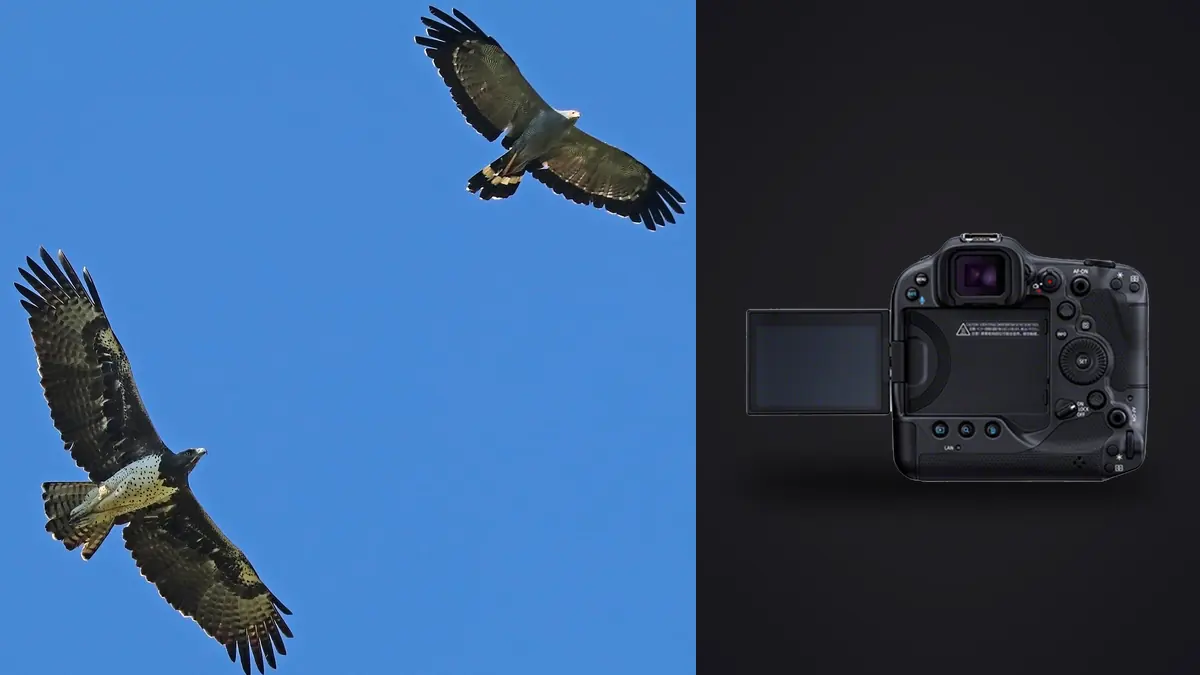
The first morning I took the EOS R3 out for ospreys, I burned through a 325GB CFexpress card before lunch. Not because I was careless with the trigger, but because that's what a stacked-sensor body encourages you to do: hold the shutter down through the entire dive, the plunge, and the pull-up with a fish, instead of guessing at the decisive frame and clipping the burst short. That single habit change is the real story of this camera for bird photographers, more than any spec sheet line about frame rates.
Why the sensor matters more than the fps number
Everyone quotes the 30fps figure for the R3's electronic shutter, but the number that actually changes how you shoot birds in flight is the stacked, back-illuminated 24.1MP sensor underneath it. Stacked sensors read out far faster than a conventional CMOS chip, which means the rolling shutter skew that turns a heron's wingtip into a rubbery smear (or a propeller-style curve on a fast-beating wing) is dramatically reduced compared to older non-stacked electronic shutter systems. I've shot swifts and swallows, birds that flap fast enough to embarrass a lot of mirrorless bodies, and the wing shape holds up. It's not perfect under every lighting condition and shutter speed combination, but it's the first Canon body I'd trust at full electronic shutter for erratic, fast wingbeat species without constantly checking for banana-shaped feathers.
The resolution itself, 24.1 megapixels, is on the modest side next to a 45MP R5 II or a 50MP body from another brand. For bird photographers who like to crop hard, that's a real tradeoff, and I won't pretend otherwise. But 24MP files move through a 30fps buffer, a laptop, and a culling pass a lot faster than 45MP files do, and when you're dealing with several thousand frames from a single flight sequence, file size stops being an abstract spec and starts being the thing that determines whether you finish editing that week.
Autofocus in the field, not the brochure
Dual Pixel CMOS AF II with 1053 selectable zones sounds impressive on paper, but what you actually feel while tracking a bird is how confidently the camera holds onto the eye once it's found it. Canon's animal detection on the R3 recognizes birds specifically, not just a generic "animal" category, and it will lock onto the head and eye of a raptor at a distance where I genuinely couldn't confirm by eye through the finder that it had found anything. Where it struggles is the same place every camera struggles: birds against cluttered backgrounds, a kestrel hovering against a hedge line, a woodpecker against tree bark of a similar tone. In open sky it's close to unshakeable. In a mixed background it needs help, usually a smaller AF area and a half-press to confirm before you commit to the burst.
Eye Control AF gets talked about as a novelty, and for years on the original EOS 3 film body it kind of was. On the R3 it's genuinely useful for one specific bird photography scenario: fast subject reacquisition when a bird crosses from one AF zone to another faster than your thumb can move the joystick. Calibrate it properly (do the calibration indoors, in stable light, and redo it if you swap glasses or sunglasses) and it becomes a way of nudging the active AF point toward where your eye already went. It won't replace good tracking technique, and I still lead most shots with the joystick, but on erratic flyers like terns it's shaved a beat off my reaction time more than once.
AF Case settings that actually hold up on birds
Canon's AI Servo Case system is the same underlying logic Canon has used across EOS bodies for years, and it carries over to the R3 with the usual sliders for tracking sensitivity, acceleration/deceleration response, and AF point switching. Here's what I actually run, by scenario, rather than the generic "just leave it on Case 1" advice you'll find everywhere:
| Scenario | Case | Tracking Sensitivity | Accel/Decel Tracking | Why |
|---|---|---|---|---|
| Gulls, geese in a loose skein | Case 1 | 0 (default) | 0 | Predictable flight path, no reason to chase every hesitation |
| Raptor stooping on prey | Case 4 | +1 | +2 | Extreme speed change from glide to dive needs fast accel response |
| Swallows, terns feeding erratically | Case 5 or 6 | +2 | +1 | Constant direction changes; camera needs to release and re-acquire quickly |
| Bird against branches/reeds | Case 2 | -1 | 0 | Locked sensitivity resists jumping to a twig that crosses the frame |
| Single bird taking off from a perch | Case 3 | +2 | 0 | Needs to grab focus the instant it leaves the branch, not gradually acquire it |
None of this replaces practice. But starting from a scenario-matched case instead of leaving everything on the factory default saved me more keepers over a season than any lens upgrade did.
Buffer depth and why your card choice actually matters
Canon rates the R3's buffer at roughly 1000 RAW frames on a CFexpress card at full 30fps electronic shutter, and in practice that's close to what I see, meaning you can genuinely hold the shutter through a long dive-and-recovery sequence without the buffer choking mid-action. Drop to a UHS-II SD card in the second slot and that number falls off a cliff, not because the sensor readout changes but because the card simply can't absorb the data fast enough. If you're shooting BIF seriously, the CFexpress slot is not optional, it's the whole point of buying this body. I keep the SD slot for a backup JPEG or a secondary RAW copy rather than relying on it for anything time-critical.
The tradeoff nobody mentions until they've lived with it: a full 30fps burst through a long osprey dive can produce four or five hundred frames in fifteen seconds, most of which are near-duplicates separated by a fraction of a wingbeat. That's not a camera problem, it's a workflow problem, and it's the reason I don't try to eyeball a day's shoot in a standard file browser anymore. I run the card through imagic before touching Lightroom. Its local sharpness and focus scoring flags the two or three genuinely sharp frames out of a fifty-frame dive sequence, and the burst clustering groups the near-duplicates together instead of making me click through each one individually. It's all processing on the machine, nothing gets uploaded, which matters when you're coming back from a week in the field with a card full of RAW files and patchy internet at the cabin.
Lens pairing: what actually gets you close enough
The R3's body alone doesn't solve the reach problem, and reach is the actual bottleneck for most bird photographers, not autofocus speed. The RF 100-500mm f/4.5-7.1L is the lens I reach for most, because it's light enough to hand-hold through a full morning of walking a shoreline, and it takes the RF 1.4x and 2x extenders if you need the extra 700mm or 1000mm reach for something distant and skittish. The tradeoff is the variable aperture: at 500mm you're at f/7.1, and stacking the 1.4x extender pushes you to f/10, which starts eating into your shutter speed margin on an overcast day.
The RF 200-800mm f/6.3-9 is the newer option and it's the one I'd point a dedicated birder toward if budget allows, because 800mm native reach without an extender means you're not stacking optical elements and losing autofocus responsiveness in the process. It's heavier and slower to react on a tripod head than the 100-500, so for handheld flight shooting from a kayak or a blind where fast panning matters, I still default to the shorter lens. For anyone shooting from a fixed hide where weight isn't a factor, the 200-800 wins on pure reach per dollar.
If you're coming from a crop-sensor system and worried about losing reach on full frame, the R3's APS-C crop mode gives you a usable middle ground, effectively extending your longest lens's reach at a resolution cost, useful for confirming a distant identification shot even if it's not your keeper frame.
Settings that hold up when the light gets bad
Shutter speed for freezing a wingbeat depends entirely on the species. Something the size of a heron or an eagle, 1/2000s is generally enough to freeze the wing without motion blur eating the feather detail. Small, fast-wingbeat birds like swallows or hummingbirds need 1/4000s or faster to actually stop the wing rather than just reduce the blur, and at that shutter speed on an overcast morning you're leaning on the R3's clean high-ISO performance to hold exposure. Native ISO tops out at 102400, and I'll push into the 6400 to 12800 range without much hesitation on this sensor before noise starts costing me detail I actually need.
Back-button focus is close to mandatory for BIF work regardless of camera, and the R3 makes it easy to set up with a dedicated AF-On button plus the option to assign a second custom button for AF point reset, so you can recenter tracking instantly when a bird you were following ducks behind cover and a new one appears. I run auto ISO with a minimum shutter speed floor rather than a fixed ISO, because light on a moving subject against open sky changes faster than I can react to manually.
Battery life and the practical stuff nobody puts in the marketing copy
The LP-E19 battery is a genuinely large cell, CIPA rates it around 860 shots through the viewfinder, and in cold weather sitting in a hide waiting for activity, I've gotten a full day out of a single charge more often than not. Weather sealing has held up through drizzle and salt spray at a coastal reservoir without issue, though I still keep a rain cover on hand for anything heavier than a light shower, mostly out of habit from cameras that weren't this well sealed. The body itself is heavy, noticeably more than an R5 or R6-class body, and if you're hiking any real distance to a hide that weight adds up over a full day carrying a long lens on top of it.
Where this leaves the editing side
Once you're home with a card full of flight sequences, the volume problem doesn't go away, it just changes shape. A single productive morning at 30fps can leave you with several thousand frames, and manually rating them one by one is how a lot of people's bird photography backlogs turn into a permanent pile of unedited cards. The workflow I've settled into is running everything through imagic first: the duplicate and burst clustering collapses those long dive sequences down to the handful of genuinely distinct moments, and the local focus scoring means I'm not the one squinting at 24MP files on a laptop screen trying to judge which frame has the sharpest eye. Because it's all local processing, no cloud upload involved, it's the same speed whether I'm doing this at a desk with fiber internet or on a laptop in a car park with no signal at all.
For the edits themselves, once I've picked the keeper from a sequence, I lean on the apply_my_style preset feature to carry my usual wildlife color and contrast treatment across a batch of shots from the same session, since flight sequences from the same morning tend to need near-identical adjustments and doing that manually across dozens of frames is where most of an editing evening disappears. If you're new to thinking about culling as a distinct step from editing rather than something you do inside Lightroom by scrolling and squinting, it's worth reading through how AI photo culling actually works to see why separating the two speeds things up more than people expect. There's also a broader rundown of workflow habits that cut editing time that applies just as well to a card full of bird bursts as it does to a wedding shoot.
Frequently Asked Questions
Is the 30fps electronic shutter actually usable for birds in flight, or does rolling shutter ruin fast wingbeats?
The stacked sensor's fast readout keeps rolling shutter distortion well controlled even on fast wingbeat species like swallows and terns, which is a real step up from non-stacked electronic shutter systems where you'd see visible wing warping. It's not flawless in every light and shutter speed combination, but for the vast majority of BIF work I no longer think twice about running full electronic shutter.
Do I need the RF 200-800mm, or is the RF 100-500mm enough for birding?
The 100-500mm is lighter, more responsive for handheld panning, and takes extenders when you need extra reach occasionally. The 200-800mm gives you native reach without stacking an extender, which matters if you're shooting distant, skittish birds most of the time, but it's heavier and slower to swing around for erratic close-range flight. Pick based on whether you're mostly shooting from a fixed position or moving and reacting.
How many RAW files can the R3 buffer before it slows down at full burst?
Canon rates it around 1000 RAW frames on CFexpress at 30fps electronic shutter, and that's roughly what holds up in practice. On a UHS-II SD card the buffer depth drops substantially, so for serious flight sequences the CFexpress slot isn't optional.
Is Eye Control AF worth setting up for bird photography specifically?
It's worth calibrating carefully and using as a fast reacquisition tool when a bird jumps between AF zones quicker than a joystick nudge can follow, particularly on erratic flyers. It's not a replacement for solid tracking technique or a well-chosen AF Case setting, and it needs recalibration if you switch glasses, but as a supplementary tool it's earned a permanent place in my setup rather than staying a novelty.