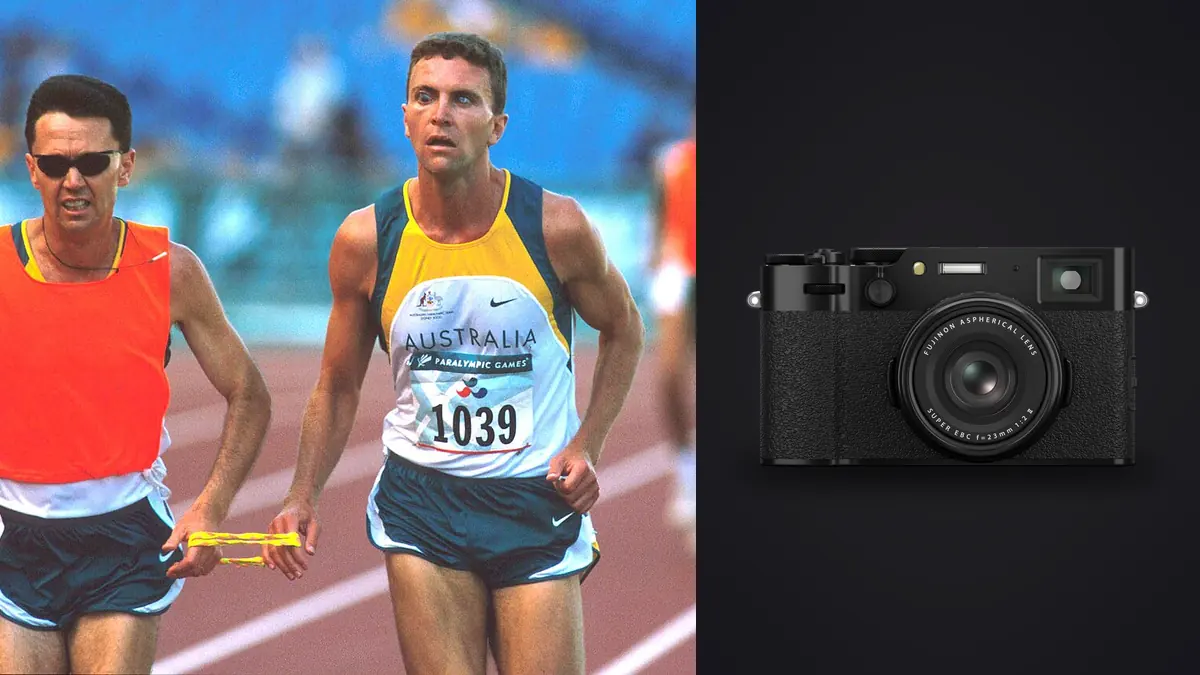
Why a Fixed 35mm-Equivalent Camera Shows Up at Track Meets at All
I borrowed a Fujifilm X100VI for a regional high school invitational last spring, mostly out of curiosity and partly because my usual sports body was in for a sensor clean. My assumption going in was that it would live in the bag once the 100m heats started and only come out again for the podium shots. That is not quite what happened. It stayed on my shoulder for the entire meet, but it changed what I photographed rather than how far I could reach.
The X100VI has a fixed 23mm f/2 lens, which works out to roughly 35mm on a full-frame sensor. There is no zoom ring, no lens mount, and no way to bolt on a proper telephoto short of the digital crop modes built into the menu. Nobody buys this camera specifically to shoot a track meet. What actually happens is that photographers who already own one for street work, weddings, or personal projects end up asking whether it can pull double duty when their kid, sibling, or training partner is competing on a Saturday. That is the honest question this article answers, not "should you buy an X100VI for sports," but "what can this specific camera actually do at a track and field event, and where does it fall apart."
Where a 35mm Equivalent Actually Works on an Oval
Track and field is a strange sport to photograph because the action is spread across an entire stadium at once. A 400m oval puts sprinters on the home straight, jumpers on a runway forty meters away, and throwers behind a safety fence that can be twenty-five meters or more from any spectator line. A fixed 35mm lens is not going to isolate a shot putter mid-release from behind that fence. It is, however, genuinely good at the things that happen close to where officials and credentialed photographers are allowed to stand.
Long jump and triple jump are the standout events for this camera. Most meets let photographers position themselves within a few meters of the pit, and a 35mm field of view captures the full body extension through takeoff, flight, and landing without the compression that a longer lens introduces. High jump works for similar reasons if you can get low and close to the mat. The starting blocks and the first twenty meters of a sprint, before the field strings out, are close enough for a wide environmental frame that shows lane assignments, the gun going off, and the crowd reaction together in one shot. None of that requires reach. It requires proximity and timing, and the X100VI's fast, quiet leaf shutter and instant startup make it easy to have ready.
| Event | Typical shooting distance | 23mm (35mm-equiv) viability | Practical approach |
|---|---|---|---|
| Sprints (100m/200m), start and finish | 3-8m if credentialed trackside | Good for wide, weak for isolation mid-race | Shoot the blocks or the line, use the 70mm digital tele-converter for a tighter finish frame |
| Long jump / triple jump | 2-4m from the pit | Strong | Stand at the sand pit edge, prefocus on the board |
| High jump | 3-5m from the mat | Strong if positioned low | Shoot from the landing mat side, not head-on |
| Shot put / discus / javelin | 15-25m+ behind safety perimeter | Weak, even with digital crop | Bring a longer lens on a second body or skip these events |
| Hurdles | 3-8m at a specific hurdle | Good for one hurdle, not the full race | Pick a hurdle and hold position rather than panning the whole lane |
| Relay exchange zones | Variable, spread along the backstretch | Moderate at one zone | Commit to a single exchange zone rather than chasing the baton |
What 20 Frames a Second Actually Buys You
The X100VI's electronic shutter tops out around 20fps, but that speed comes with a 1.29x sensor crop applied, which bumps the effective focal length slightly and trims resolution. The mechanical leaf shutter is slower, closer to 8-11fps depending on the drive mode, but it shoots the full uncropped frame and, more importantly, doesn't suffer from rolling shutter skew. That distinction actually matters on a track. Electronic shutters read the sensor line by line, and when you pan quickly with a fast-moving subject like a sprinter, that readout delay can skew verticals in the frame, bending a runner's torso or a hurdle's uprights in a way that looks like a processing glitch rather than intentional motion blur. For anything involving lateral motion at speed, I stuck with the mechanical shutter and accepted the lower frame rate.
The mechanical shutter's ceiling of 1/4000s can also be a real limit at midday. Wide open at f/2 in bright sun with the base ISO of 125, you'll blow past correct exposure before you hit that shutter speed ceiling. The X100VI carries a built-in 4-stop neutral density filter, toggled from a function button or the menu, which is exactly the tool for this situation. It let me keep the aperture open for background separation on portraits between races without switching to the electronic shutter and reintroducing the rolling shutter problem.
Buffer depth is the other constraint that shows up fast once you start bursting. Shooting compressed RAW at the top electronic rate, I was consistently getting into the high teens of frames before the camera slowed to catch up on writes, not the thousand-plus figure you'll see quoted for small JPEGs. That's enough for one clean sprint finish or one jump sequence. It is not enough to hold the shutter down through an entire relay leg and expect every frame to land.
| Shutter mode | Approx. max rate | Sensor crop | Rolling shutter risk | Compressed RAW buffer before slowdown |
|---|---|---|---|---|
| Mechanical | ~8-11fps | None | None (mechanical curtain) | Deeper, but capped by shutter speed and flash sync |
| Electronic, full frame | ~8fps | None | Moderate on fast pans | Similar to mechanical |
| Electronic, high-speed | ~20fps | 1.29x | Noticeable on sprinters and thrown implements | High teens of frames on a UHS-I card |
The Single Card Slot Is the Real Bottleneck
Here's the detail that catches people off guard: the X100VI has one SD slot, and it's UHS-I, not UHS-II. That caps your realistic write speed well below what a UHS-II card would give a camera like the X-T5 or X-H2, which share the same sensor and processor. In practice, this means that after a burst fills the buffer, you're waiting on the card rather than the camera to catch up, and that wait happens exactly when the next race is starting. My workaround was to drop from lossless compressed RAW to the standard compressed RAW setting, which trades a small amount of file size efficiency for meaningfully faster buffer clearing.
The knock-on effect is that you end up leaning harder on volume than precision. Instead of nailing one frame per moment, you fire a shorter burst and hope the timing lands somewhere in it, then sort it out later. That's a fine trade to make trackside, but it means a full meet on this camera can leave you with several hundred frames of the same sprinter crossing the line or the same jumper leaving the board, most of them near-duplicates with only one or two actually sharp on the eyes or the point of contact.
This is where I actually use imagic rather than sitting at a laptop clicking through a folder frame by frame. It runs its sharpness and focus scoring locally, so I can drop the day's card straight into it in the parking lot with no wifi and no upload, and it clusters those burst sequences together instead of showing me four hundred flat thumbnails I have to compare by eye. For a meet where half your shots are minor variations of the same three-second sequence, that clustering step is the difference between a twenty-minute cull and a two-hour one. If you haven't used AI-assisted culling before, how AI photo culling works covers the mechanics in more depth.
Color Out of the Box, and a Faster Edit Pass
Fuji's film simulations are a genuine advantage for meet photography because they get you closer to a finished look before you've opened an editor. Provia handles the mixed shade-and-sun lighting of an afternoon meet reasonably well, and Classic Chrome mutes the saturated team jerseys and lane colors just enough that skin tones don't get lost in the noise. I shot RAW+JPEG so the simulation was baked into the preview but I still had the RAW file to fall back on for anything underexposed in the stadium's shadowed sections.
Where this gets useful for actually delivering a gallery is on the editing side. If you've already built a consistent look across a season of meets, imagic's apply_my_style feature lets you train a preset off your own previously edited photos rather than starting from a generic filter, and it applies that to a new batch of RAW files automatically. For a coach or parent who wants a same-day gallery, that cuts out the part of the workflow where you'd otherwise be manually matching white balance and contrast across three hundred frames shot under a shifting late-afternoon sky. It's not doing anything mysterious, it's replicating decisions you've already made on your own files, just without you re-making them one by one.
Faking Reach: the Digital Teleconverter
The X100VI's menu includes a digital tele-converter that crops the 40.2-megapixel sensor to simulate 50mm and 70mm equivalent framing. It's not optical zoom, it's a crop with a boosted-resolution EVF preview so you can compose as if you had a longer lens. At 50mm equivalent you're still working with a healthy file, somewhere around 20 megapixels after the crop. At 70mm equivalent you're down closer to 10-12 megapixels, which is fine for a web gallery or an 8x10 print but starting to get thin for anything larger.
Trackside, this is genuinely useful for tightening a finish-line frame or getting a head-and-shoulders shot of a hurdler without physically moving position, which you often can't do once a race has started. It does not turn this into a shot put lens. Twenty-five meters at 70mm equivalent is still a wide shot of someone standing in a circle, not a tight frame on a release. If you need that reach, you need a longer lens on a second body, full stop. The digital tele-converter buys you maybe one extra useful framing option per event, not a substitute for glass you don't have.
What I'd Actually Pack for a Meet
A few settings changes make a real difference. Back-button focus with a small single-point or small zone AF area tracks well enough on jumpers and sprinters approaching from a predictable angle, though it's noticeably less sticky than a dedicated sports body's tracking once a subject crosses laterally at speed. I kept the mechanical shutter as my default and only switched to the electronic high-speed mode for static or near-static moments, the peak of a high jump clearance or the instant before a starter's gun, where rolling shutter isn't a factor because nothing is moving sideways fast.
Battery life is rated around 450 shots CIPA on the NP-W126S, and burst shooting eats into that faster than the number suggests. I went through two batteries across a four-hour meet, and that included a fair amount of chimping between events, which the tilting rear screen makes easy but which also drains the battery further. Bring at least one spare, two if you're also shooting video clips for social. On the card side, since you're capped at UHS-I speeds regardless of what card you buy, there's no point paying for a UHS-II card here. A fast, reliable UHS-I card with good sustained write speed is the actual bottleneck-relevant spec.
The honest summary after that meet: the X100VI works best as a second camera trackside, the one you carry for the warmups, the team huddle before the 4x400, the coach's reaction on the infield, and the close-range field events, while a longer lens on another body handles the throws and the mid-race isolation shots. Used that way it earns its spot in the bag. Used as your only camera for a meet with heavy field-event coverage, you'll spend the day wishing for reach it was never built to provide. For general advice on tightening up a shooting-to-delivery workflow regardless of camera, these workflow tips apply just as well to a meet shot on an X100VI as to one shot on a flagship sports body.
Frequently Asked Questions
Is the Fujifilm X100VI a good primary camera for shooting a full track meet?
It depends heavily on which events dominate the meet. For a meet that's mostly sprints, jumps, and hurdles shot from close, credentialed positions, it can carry the day on its own. For a meet with heavy field-event coverage, particularly throws shot from behind a distant safety perimeter, the fixed 23mm lens simply can't reach, and you'll want a longer lens on a second body as backup.
What's the effective reach with the digital teleconverter engaged?
The built-in crop modes simulate 50mm and 70mm full-frame equivalents by cropping the 40.2-megapixel sensor, dropping resolution to roughly 20 and 10-12 megapixels respectively. That's enough to tighten a finish-line or hurdle frame without moving position, but nowhere near enough reach for shot put, discus, or javelin shot from a standard spectator distance.
Does the built-in ND filter actually help with fast shutter speeds in daylight?
Yes, and it's one of the more overlooked features for outdoor sports work. The mechanical shutter caps at 1/4000s, which at f/2 and base ISO 125 will overexpose in direct midday sun. The camera's built-in 4-stop neutral density filter lets you keep the aperture open for background separation without switching to the electronic shutter, which avoids the rolling shutter skew that shows up on fast lateral motion like a sprinter's stride.
How should I handle the RAW files afterward without losing the evening to editing?
A meet shot in bursts on this camera produces a lot of near-duplicate frames, since the buffer and single UHS-I card slot push you toward shorter, repeated bursts rather than single decisive frames. Running the card through imagic's local sharpness scoring and duplicate clustering sorts those bursts down to the sharpest frame per sequence without any cloud upload, and if you've trained apply_my_style on a previous gallery's edits, it can carry that same look across the new batch automatically, which is usually the bigger time saver than the culling step itself.