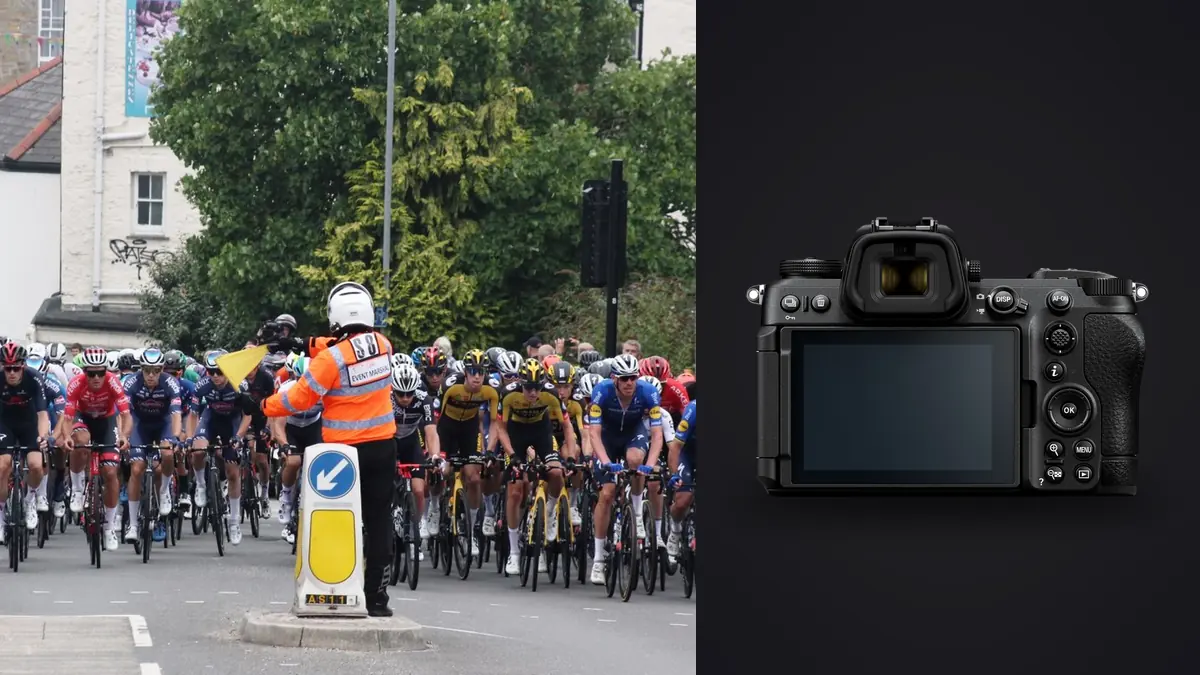
The first meet I brought the Z6 III to was a regional qualifier on a wet Tuesday evening, the kind of meet where the infield lights flicker slightly and half the sprint finals get pushed back because a javelin measurement takes twenty minutes to sort out. I'd shot the same track two years earlier with a Z6 II and remembered exactly why I'd been frustrated: the finish-line burst would blackout in the viewfinder at the worst possible moment, and panning shots through the home straight came out with that faint jello wobble in the background fencing. None of that happened this time. That's really the whole story of what changed between the two cameras, and it's worth explaining properly rather than just listing spec numbers.
The sensor readout is the actual story, not the megapixel count
Nikon calls the Z6 III's sensor "partially stacked," which is marketing language for a genuinely useful engineering choice: part of the pixel array gets the fast-readout stacked treatment normally reserved for flagship bodies like the Z9, while the rest stays on a conventional BSI design to keep the sensor affordable. For track and field, this matters more than almost any other spec on the sheet. Rolling shutter distortion, the diagonal skew you get on fast-moving subjects when the sensor scans top to bottom too slowly, is the single biggest complaint sports shooters had with the Z6 II's electronic shutter. Runners' legs would smear at an angle, and pole vault poles would look like they were bending in ways that had nothing to do with fiberglass.
On the Z6 III, that readout speed is fast enough that I stopped avoiding the electronic shutter altogether. I shoot 100 percent silent (electronic) at every meet now, indoor and outdoor, and I've stopped checking every frame for skew the way I used to. It's not zero rolling shutter, nothing without a fully stacked sensor is, but it's low enough that you'd need a very fast pan across a very fast subject, think a discus mid-release rather than a sprinter, to see it clearly at typical viewing sizes.
Setting up autofocus so it actually tracks a runner and not the fence behind them
The 273-point AF system with EXPEED 7 processing brings the same subject-detection categories down from the Z8 and Z9, and for track work the "People" detection mode with 3D-tracking layered on top is what I use for probably 90 percent of frames. It locks onto torso and eye when the athlete is close enough, and falls back to body shape recognition at distance, which matters a lot when you're shooting a 400m runner who's still 60 meters away at the start of the back straight.
Where it gets trickier is relay handoffs and any event with two athletes close together in frame, like a hurdler being lapped or a handoff zone with the incoming and outgoing runner both in the AF box. I turn off subject-switching sensitivity aggressiveness (Nikon buries this in the AF custom menu as "subject-detection sensitivity") and drop it toward the slower end, otherwise the camera happily jumps from the athlete you're tracking to whoever crosses closer to the lens, usually a coach jogging along the rail. For field events like long jump and pole vault I switch to a smaller Wide-Area AF box rather than full 3D-tracking, because the background (sand pit, crash mat, sponsor banners) has enough visual noise that letting the camera pick a subject on its own gets it wrong more often than I'd like.
A note on Pre-Release Capture
This is the one feature I didn't expect to lean on. When it's enabled, the camera keeps buffering frames from up to a second before you fully press the shutter, so if your reaction time is a hair slow on a gun start or a bar clearance, you still get the frame. I keep it set to about half a second of pre-capture for sprint starts. It's JPEG-only in that mode, which is a real trade-off, but for a start-gun sequence where you mainly need one usable frame to identify the false-start reaction, it's more useful than it sounds on paper.
Frame rate, buffer depth, and matching the mode to the event
Twenty frames per second in 12-bit raw with full AF/AE tracking and a blackout-free viewfinder is the headline number, and it's genuinely usable, not a marketing-mode you'd never touch. The buffer with a fast CFexpress Type B card is deep enough that I've stopped counting frames mid-burst, which was a real habit with older bodies. Where I don't use 20fps is anything with a long lead-up, like the wait before a pole vault attempt, because even a deep buffer fills eventually and you end up with 400 frames of an athlete standing still followed by three usable frames of the actual clearance. I built a rough table of what I actually dial in per event, based on a full season shooting with this body:
| Event | Typical shooting distance | Starting shutter speed | Drive mode | AF area mode |
|---|---|---|---|---|
| 100m / 200m, straight-on from the finish | 40-80m | 1/2000s or faster | 20fps (H+ extended) | 3D-tracking, People |
| 400m, panning through the home straight | 15-30m | 1/500 to 1/750s for background blur | 10-15fps (C-H) | Wide-area (S), People |
| Long jump / triple jump, side-on | 10-20m | 1/2500s | 20fps | 3D-tracking |
| Pole vault, low angle | 8-15m | 1/3200s | 20fps + pre-release capture | 3D-tracking, People |
| Discus / hammer, rotational release | 15-25m | 1/2000s minimum | 20fps | Wide-area (L) |
| 4x100 / 4x400 handoff zone | 5-15m, two athletes in frame | 1/2000s | 20fps | Wide-area (S), subject-switch damped |
The panning row is the one people question most. Slowing the shutter down for a 400m runner on purpose, instead of freezing everything at 1/2000s, is a personal preference rather than a rule, but the sensor's improved readout is exactly what makes it viable now. On the Z6 II I'd get more skew doing this than I was comfortable with; on the Z6 III the background blur reads as motion, not as a sensor artifact.
Lenses that actually make sense at a track meet
The Z 70-200mm f/2.8 VR S is the workhorse for infield events (long jump, triple jump, shot put, and any field event you can walk up close to with credentials). It's fast enough for evening meets under floodlights and the zoom range covers most reasonable camera positions without needing to relocate mid-event. For the actual track, especially 100m and 200m finishes shot from a fixed photographer's position, I'm usually reaching for the Z 100-400mm f/4.5-5.6 VR S, sometimes with the 1.4x teleconverter attached if my assigned position is further back than I'd like. The f/4.5-5.6 aperture sounds like a compromise next to a fixed f/2.8, but at the shutter speeds this camera lets you use in daylight, the extra reach matters more than the extra stop.
If budget stretches to it, the Z 400mm f/4.5 VR S is a genuinely different experience for straightaway sprint work: lighter than you'd expect for a 400mm prime, and the autofocus is noticeably snappier locking onto a runner at distance than the zoom is at the long end. I don't own one outright, I rent it for meets where I know I'll be stuck at a fixed distant position (state finals, mostly, where photographer zones are locked down by the meet organizer).
Stadium lighting, flicker, and why indoor meets are their own problem
Indoor track meets under fluorescent or older LED fixtures are where the Z6 III's flicker reduction earns its keep. Without it, shooting at 1/2000s or faster under mismatched banks of lighting produces visible banding in some frames and not others within the same burst, which is maddening to sort through afterward. Turning on flicker reduction in the shooting menu costs you a small amount of continuous frame rate in exchange for consistent exposure across the whole burst, and for indoor meets I consider that trade non-negotiable. Outdoors under natural light or modern stadium floodlights it's rarely necessary, and I leave it off by default so I'm not losing frame rate I don't need to lose.
What happens after the meet: the part nobody puts on the spec sheet
A six-hour track meet at 20fps produces a genuinely absurd number of frames. A single 100m final, shot from three seconds before the gun to the finish, can be 200-plus raw files on its own, and a full meet with heats, finals, and field events easily clears four or five thousand frames by the time the last event wraps. Sorting that by hand, at a stadium with patchy wifi and a laptop battery that's also fading, is the least enjoyable part of the job. This is where I actually rely on imagic rather than just tolerating it: it runs entirely on the laptop with no upload step, which matters when you're working from a press box with no reliable signal, and its sharpness scoring will flag the three sharp frames out of a 40-frame burst of a hurdler's stride without me scrubbing through all of them manually.
The burst and duplicate clustering is the other piece that saves real time here. A 20fps sequence of a long jumper's takeoff is, structurally, forty near-identical frames, and having them grouped automatically rather than appearing as forty separate thumbnails in a folder is the difference between a twenty-minute cull and a ninety-minute one. Once I've picked the keepers, I run imagic's apply_my_style preset, trained on how I've edited my own meet photos in the past, across the whole selection so the finish-line shots and the field-event shots from the same day don't look like they came from two different photographers. If you haven't compared culling approaches before, our piece on how AI photo culling actually works goes into more detail on how sharpness scoring differs from a simple face-detection pass, and there's a broader workflow rundown in 10 tips for a faster photo workflow that applies beyond just track meets.
Battery life and the practical grind of a full meet day
Nikon rates the EN-EL15c around 380 shots by CIPA standards, which as usual undersells real-world performance for burst shooting since CIPA testing doesn't account for long continuous sequences. In practice, shooting mostly electronic shutter at 20fps for the bursts I actually need, I get through a full outdoor meet, roughly five to six hours, on one battery with a second in reserve that I rarely touch. Indoor meets in cold arenas eat into that more, and I've had a battery drop noticeably faster on a January meet in an unheated fieldhouse than on a warm September afternoon outdoors. I now just carry two batteries as a default rather than gambling on the CIPA number, since a dead battery during a 4x400 relay final is not a mistake you get to explain your way out of with a meet director.
The dual card slots (CFexpress Type B and UHS-II SD) are worth setting up correctly before your first meet, not during it. I write raw to the CFexpress card only and use the SD slot for a JPEG backup, rather than mirroring both cards with full raw files, because the SD card's slower write speed will bottleneck your buffer clearing if you're writing full 20fps raw bursts to both cards simultaneously. That one setting change made a noticeable difference in how quickly the buffer cleared between back-to-back sprint heats.
Frequently Asked Questions
Is the Z6 III fast enough for track and field compared to a dedicated flagship body?
For nearly everything short of covering an Olympic final where you're competing against wire-service photographers with a Z9 and a 400mm f/2.8, yes. The 20fps raw burst with a genuinely deep buffer and blackout-free viewfinder covers sprints, relays, and field events without the compromises that made older Z6-series bodies frustrating for this kind of work. Where a flagship still pulls ahead is subject-detection consistency in trickier field-event backgrounds and outright AF speed at very long distances, but for club, high school, and most collegiate-level meets the gap is smaller than the price difference suggests.
Do I need the 1.4x teleconverter, or is the 100-400mm long enough on its own?
It depends entirely on your photographer position. If you have infield access or a position near the finish line, 400mm on its own is plenty, and adding the teleconverter just costs you light and slightly slower AF acquisition. If your assigned position is a fixed spot in the stands or behind a rope line well back from the track, which is common at bigger meets, the extra reach becomes genuinely necessary rather than optional.
Should I shoot mechanical or electronic shutter for sprint finishes?
Electronic, without much hesitation, given how much the readout speed has improved on this sensor compared to the Z6 II. The only case I'd switch back to mechanical is heavy artificial lighting where flicker reduction settings interact oddly with electronic shutter timing, and even then I'd try flicker reduction with electronic shutter first before falling back.
How many raw files should I expect to cull from a typical meet, and how do you manage that volume?
Somewhere between three and six thousand frames for a full meet with multiple events is normal if you're shooting bursts through most finishes and field-event attempts. Manually reviewing that many frames one by one isn't realistic on a same-day turnaround, which is the main reason I moved my culling step onto imagic rather than doing an initial pass in a raw browser: the sharpness scoring and burst clustering happen locally on the laptop, without an upload queue, and get the four or five thousand frames down to a working shortlist fast enough that I can still hand off edited galleries the same evening.