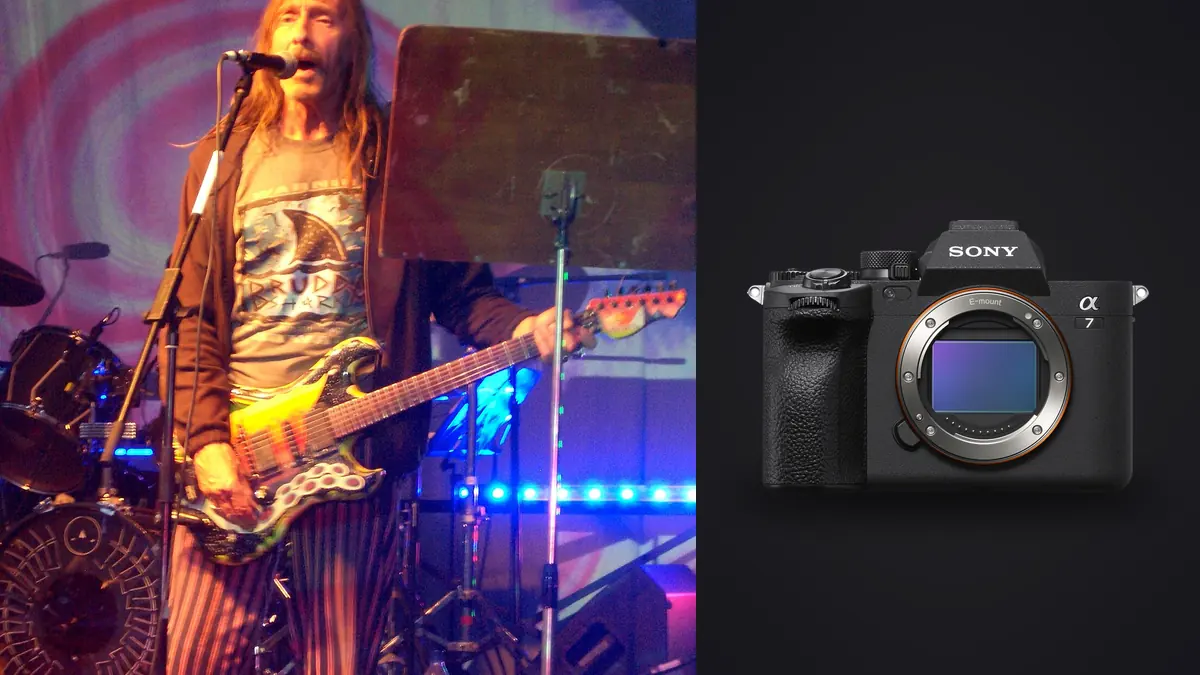
Three songs, no flash, and a barrier full of elbows. That's the deal at most photo pits, and it's the environment that actually tells you whether a camera is good for live music work, not a spec sheet. The Sony A7 IV works well in clubs, theaters, and arena shows, and it makes a strong default body for live music for reasons that have almost nothing to do with the 33-megapixel number Sony likes to put in the marketing copy.
The sensor and the buffer matter more than the megapixels
The A7 IV's 33MP BSI CMOS sensor isn't the headline-grabbing part of this camera for concert work, the way it is engineered to behave at high ISO is. Sony pushed the base native ISO range to 100-51200 with expansion to 204800, and in practice I'm comfortable shooting stage lighting at ISO 6400 without a second thought, and I'll push to 12800 for a moody single-spotlight ballad without feeling like I've wrecked the file. Past that it gets noisy fast, and I'd rather pull shadows in post than shoot at 25600 and hope.
What actually changes how a night goes is the buffer. Sony rates the A7 IV at roughly 828 compressed RAW frames before it fills on a CFexpress Type A card, versus something closer to 59 frames on a fast UHS-II SD card at the same 10fps burst rate. That's not a rounding error, that's the difference between shooting through an entire guitar solo and having the camera lock up on you mid-chorus while it clears the buffer. If you're still shooting SD only, budget for a CFexpress card before your next assignment, not after you miss the shot that mattered.
Autofocus that keeps up with a singer who won't stand still
The A7 IV's 759-point phase-detection array covering about 94% of the frame, paired with Real-time Eye AF and Real-time Tracking, does the actual hard work of concert photography, which is keeping focus on a face that's moving through a strobing, backlit, constantly shifting wash of colored gels. I run Eye AF with tracking locked to the person, not a specific eye, because performers turn their heads fast enough that switching eyes mid-frame will cost you the shot if you've pinned it to left-eye-only.
It's not flawless. During hard strobe hits or when a performer walks directly in front of a par can, the AF will occasionally hunt for a frame or two, and there's no dedicated "musician" or "instrument" recognition mode the way there's a bird or animal mode on newer bodies. You're relying on human eye detection the whole set, and it does drop lock when a singer turns fully profile into a black backdrop. I've learned to half-press and recompose in those moments rather than trust the tracking box to find something that isn't there.
Picking lenses for a three-song sprint
Pit access is short and the lens on your camera when doors close the pit is the lens you're stuck with. I rotate through four options depending on venue size, and each one earns its place for a specific reason rather than being a generic "great all-around lens" pick.
| Lens | Focal Range | Max Aperture | Approx. Weight | Best For | Trade-off |
|---|---|---|---|---|---|
| Sony FE 24-70mm GM II | 24-70mm | f/2.8 | ~695g | One-lens pit coverage, quick recompose between songs | Not quite fast enough at 70mm in the darkest clubs |
| Sony FE 70-200mm GM II | 70-200mm | f/2.8 | ~1045g | Arena and theater stages, compressing a distant singer against the crowd | Heavy to swing during a fast three-song set, needs elbow room |
| Sony FE 85mm F1.4 GM | 85mm | f/1.4 | ~820g | Tight clubs, rim-lit portraits with real background separation | Fixed focal length, you're recomposing with your feet |
| Sony FE 35mm F1.4 GM | 35mm | f/1.4 | ~524g | Small venues, wide stage-and-crowd shots, guitarist silhouettes | Too wide for anything past ten feet from the stage |
If I can only bring one body and one lens into a small club, it's the 35mm f/1.4 GM. If it's an arena show where the pit is thirty feet back from the stage, the 70-200mm GM II is non-negotiable and the 24-70mm stays in the bag entirely.
The settings I actually dial in before doors open
I shoot manual exposure with Auto ISO, aperture wide open or one stop down depending on the lens, and a minimum shutter speed I set myself rather than letting the camera guess. For a singer standing mostly still, 1/250s is enough to freeze motion. For a drummer or anyone doing more than swaying, I push the floor to 1/500s or 1/640s, because a slightly noisier file beats a soft one every time you look at full-resolution crops.
Drive mode stays on continuous high at 10fps with the mechanical shutter for most of the night. The A7 IV does offer a fully silent electronic shutter, and I'll switch to it for acoustic sets or quieter venues where a shutter clacking through a ballad is genuinely rude, but I'm careful with it under LED stage lighting. Electronic shutter readout on this sensor isn't instant, and under PWM-flickering LED fixtures (which is most modern stage lighting) you can get banding or inconsistent exposure across a burst that the mechanical shutter and its anti-flicker shooting mode largely avoid. If the venue is loud, mechanical shutter and 10fps stays the default.
Metering that doesn't get fooled by a spotlight
Spot metering off the performer's face, not multi-segment, because a single hard spotlight against an otherwise black stage will crush average-metered exposure into a silhouette every time. I meter once during soundcheck if I can get in early, and then trust manual exposure with Auto ISO to ride the changes as lighting cues shift through the set.
Mixed stage lighting will wreck your color if you let it
Concert lighting rigs mix tungsten wash, colored LED gels, and the occasional strobe or haze-cut beam, sometimes all within the same song. Auto white balance on the A7 IV does a reasonable job of not overcorrecting a deliberately red-lit chorus into something gray and lifeless, which matters, because you don't want the camera fighting the lighting designer's actual intent. I still shoot RAW exclusively for this reason. JPEG white balance decisions made in-camera under a shifting magenta-to-blue wash are a headache to walk back later, and RAW gives me the full latitude to match color across a set that might swing through four different lighting looks in twelve minutes.
Getting through the take before the file is due
A single three-song pit set at 10fps easily produces 800 to 1200 frames once you count every burst on every chorus hit and jump. Multiply that by a festival day with six acts and you've got a genuinely unpleasant culling job waiting for you back at the hotel or the car. This is where I stopped trying to eyeball every frame at 100% zoom and started running the take through imagic before I touch Lightroom at all. It scores sharpness and focus locally on the machine, clusters the near-identical frames from each burst so I'm comparing five real candidates instead of forty duplicates, and none of it uploads anywhere, which matters more than people expect when you're holding unreleased tour photos under an artist's embargo. If you want the mechanics of how that scoring and clustering actually works rather than taking my word for it, we've written up how AI photo culling works in more detail.
The other piece that's saved me real time is the apply_my_style preset feature, which trains on edits I've already made rather than shipping a generic "moody concert" LUT. After I've graded thirty or forty photos from a tour to a look I'm happy with, applying that same trained style to the rest of the night's takes gets me to a consistent first pass fast, and I'm doing fine adjustments per photo instead of building every edit from a flat RAW file. It's not magic, and I still go through every image before delivery, but it cuts a two-hour post-show edit down to something closer to forty minutes.
Why local-only processing actually matters here
Most working concert photographers have signed something, whether it's a formal photo pass agreement or an informal understanding with a band's team, that says unreleased images don't touch a random third-party server before the client has seen them. That's a real constraint, not paranoia, and it's one of the reasons I moved my culling workflow off anything cloud-based in the first place. Processing everything on the laptop itself, without images leaving the machine, isn't a nice-to-have for this kind of work, it's close to a contractual requirement on some tours.
Video and behind-the-scenes clips
The A7 IV also shoots respectable 4K at up to 60fps with a Super35 crop, which I use sparingly for short behind-the-scenes clips to hand off for socials rather than as a primary video tool. Rolling shutter is noticeable if you whip-pan fast under stage lighting, so I keep camera movement slow and let the performers provide the motion. It's a genuinely useful bonus given I'm already carrying the body for stills, but nobody hiring me for concert coverage is expecting cinema-grade footage out of it, and I don't oversell it as such.
Frequently Asked Questions
Is 10fps mechanical shutter actually fast enough for a photo pit?
For most live music work, yes. Ten frames per second is plenty to catch the peak of a jump, a hair flip, or a guitar strum, especially paired with the pre-capture habit of holding the shutter down a beat before the moment rather than reacting to it. Sports photographers shooting fast-moving action at 20-30fps have a different problem to solve, but a stage is a fixed, predictable space, and 10fps with good buffer depth covers it comfortably.
Should I use the silent electronic shutter to avoid disturbing quieter sets?
Use it for acoustic or seated shows where the mechanical shutter's clack is genuinely intrusive, but be aware of banding risk under flickering LED rigs, which cover most modern stage lighting. Test a burst during soundcheck if you can. For louder rock and pop shows where the shutter noise is drowned out anyway, I default back to mechanical for its more predictable exposure under mixed lighting.
Do I really need the 70-200mm GM II, or can the 24-70mm cover everything?
It depends entirely on pit distance. In a small club where the barrier is three feet from the stage, the 24-70mm covers nearly everything you'll need and the 70-200mm is dead weight you won't use. In an arena or large theater where the pit sits twenty to forty feet back, you need the reach, and a 24-70mm alone will leave you cropping heavily in post and losing resolution you paid for.
How high can I push ISO on the A7 IV before the noise becomes a real problem?
I treat ISO 6400 as fully usable for delivery without much cleanup, ISO 12800 as usable with modest noise reduction, and anything past 25600 as an emergency setting I'll use rather than miss a shot entirely, knowing I'll need to lean on noise reduction and probably won't print it large. Where that ceiling sits depends on how much you're willing to trade detail for a clean file, but for editorial and social delivery sizes, 12800 has never been a dealbreaker for me.