
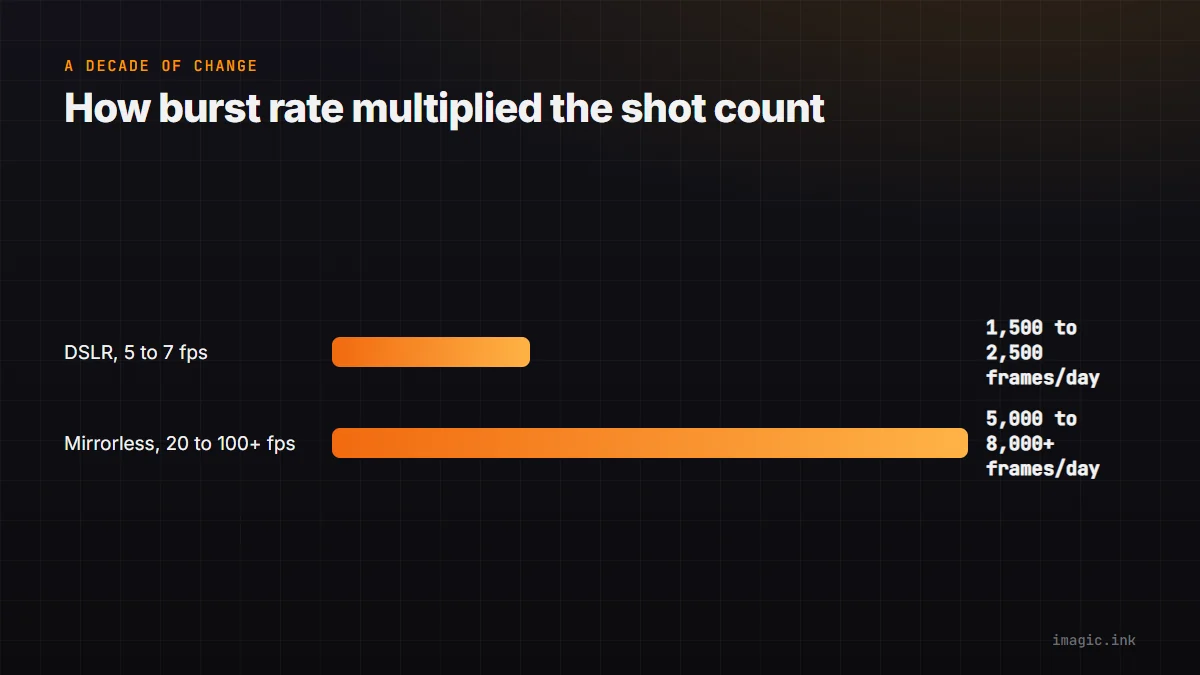
A wedding photographer shooting a DSLR a decade ago at 5 to 7 frames per second might come home with 1,500 to 2,500 images from a full day. The same photographer shooting a modern mirrorless body capable of 20, 30, even over 100 frames per second in electronic shutter mode can easily come home with 5,000 to 8,000 or more. The workflows, habits, and even the software norms built around the old shot counts have not fully caught up to what the new hardware makes routine.
The 10x Shift in a Decade
Burst rate increases on mirrorless bodies have been dramatic and fast: bodies commonly capable of 20fps electronic shutter became mainstream, and flagship and enthusiast bodies pushing past 30 or even 100fps in specific modes are no longer exotic. Combined with faster, larger memory cards that no longer force photographers to ration bursts the way older, slower cards did, the practical result is photographers routinely shooting far more frames per moment than they used to, whether or not they consciously intend to. A three-second burst at 30fps produces 90 near-identical frames of essentially one moment, compared to maybe 15 to 20 frames at older DSLR burst rates for the same three seconds.
Storage Norms Have Not Fully Adjusted
Card capacity and computer storage have grown, but not proportionally to burst rate growth in every case, and many photographers still budget storage based on older per-shoot expectations. A studio's backup routine, RAID setup, or cloud backup tier sized for 2,000-image shoots a few years ago can get uncomfortably tight when the same genre of shoot now regularly produces 6,000 to 8,000 images. Backing up and organizing a photo library is worth revisiting periodically as shot counts creep up, since a backup plan sized correctly two years ago is not automatically still sized correctly today.
Culling Became the New Bottleneck
Manual culling time scales roughly with image count, so a genre that quietly moved from 2,000 to 7,000 images per shoot did not just get a bit slower to cull, it got proportionally much slower, and that shift happened gradually enough that many photographers absorbed it as "just how long culling takes now" rather than noticing the underlying cause. Managing burst photography and burst shot culling for sports both address this directly, since sports and wildlife genres hit the highest burst-driven shot counts of any category and felt this shift earliest and hardest.
Why AI Culling Fits This Moment Specifically
The near-duplicate grouping problem, dozens of frames capturing essentially the same moment with only tiny differences in expression or peak action, is exactly the kind of task that scales well for automated scoring but scales badly for manual review, since a human has to actually look at each frame to tell them apart while a model can compare and rank them systematically. imagic's duplicate and burst grouping is built specifically around this pattern, clustering near-identical frames and surfacing the sharpest or best-timed one from each cluster rather than requiring a full manual scrub through every frame in a 90-shot burst.
Delivery Norms Lag Behind Too
Even after culling, a delivered gallery of 600 to 800 final images, itself larger than a decade-old norm, still represents a smaller fraction of the shots taken than it used to, simply because the starting pool is so much bigger. Client expectations around gallery size have grown more slowly than actual shot counts have, which means culling discipline (getting from thousands of raw bursts down to a tight, genuinely curated final set) matters more now than it did when shot counts were naturally smaller and self-limiting.
Frequently asked questions
Has burst shooting actually made photography better, or just bigger?
Both, in different ways. High burst rates genuinely catch peak moments (a exact expression, precise action timing) that were easy to miss at lower frame rates, but they also multiply the culling workload substantially, which is a real cost even when the capture quality benefit is real too.
Should photographers just shoot lower burst rates to manage the workload?
For some genres, yes, dialing back burst rate for less action-dependent shots is a reasonable workflow choice. For sports, wildlife, and fast-moving events, the burst rate is often doing real work capturing moments a slower rate would miss entirely.
Is storage the main cost of the burst shooting shift?
Storage is a real cost, but culling time is usually the bigger one, since it scales with photographer hours rather than just hardware spend, and hours are the harder resource to simply buy more of.