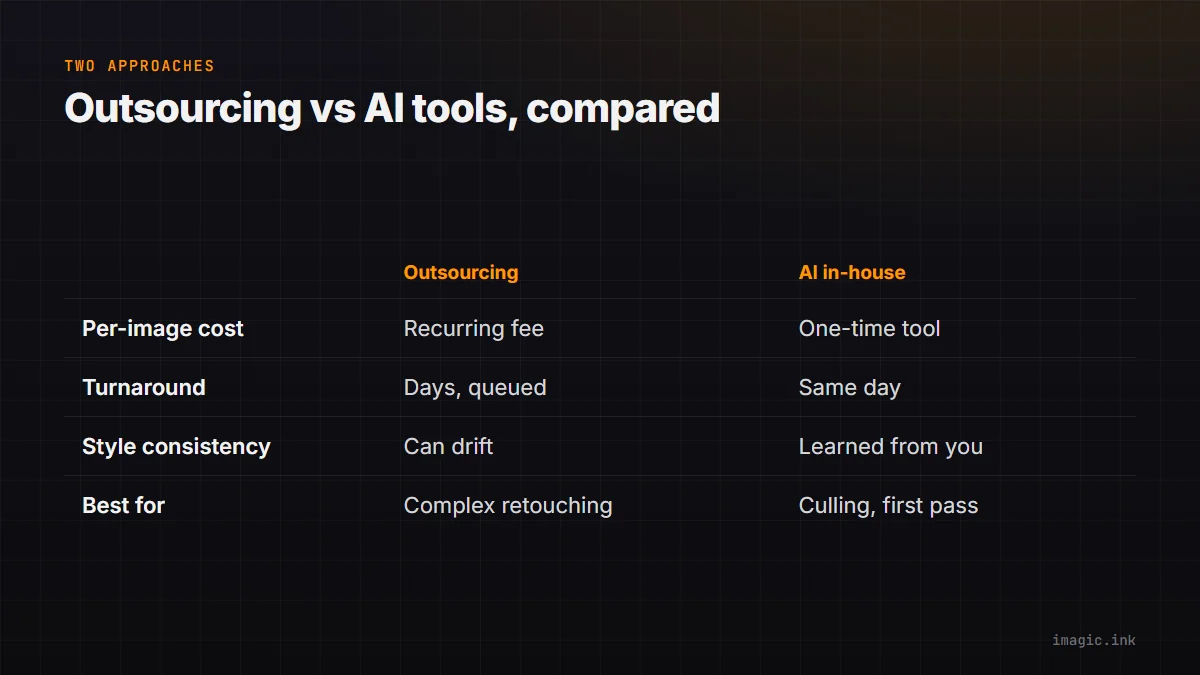
Outsourcing editing to a service or freelancer and using AI tools to speed up in-house editing are often framed as competing solutions to the same problem: too many photos, not enough time. In practice they solve overlapping but distinct parts of the workflow, and the right answer for a given studio depends on what specifically is eating the hours.
Per-Image Outsourcing Pricing, Realistically
Outsourced editing services typically price per image, commonly somewhere in the range of a few tens of cents to a couple of euros per photo depending on complexity, turnaround speed, and whether the service is a high-volume offshore operation or a boutique editor matching a specific style. For a 600-image wedding delivery, that puts outsourced editing costs anywhere from roughly 100 to 500+ euros per event, recurring every single booking, which adds up fast across a full season of weddings. It is worth pricing this into your actual shoot cost calculation rather than treating it as separate overhead; the full breakdown of photography business software costs covers how these recurring per-shoot costs stack up against one-time tooling.
Turnaround: The Other Real Cost
Beyond the per-image fee, outsourcing introduces a queue: even fast services typically quote a turnaround measured in days, not hours, and premium rush pricing usually applies if a client needs a faster delivery than the standard queue allows. AI-assisted in-house editing removes that queue entirely, since culling and batch adjustment run on your own machine on your own schedule, no waiting on someone else's workload. For studios competing partly on delivery speed, same-day sneak peeks or rapid full-gallery turnaround, that queue difference can matter as much as the per-image cost.
Style Drift: Outsourcing's Quiet Risk
A less discussed cost of outsourced editing is style drift: even a skilled outsourced editor working from written notes or reference images will not replicate a photographer's exact eye with perfect consistency, especially across different editors within the same service or across a service's staff turnover. Clients who have seen a photographer's portfolio expect that specific look in their delivered gallery, and small consistent deviations compound into a noticeably different feel across a season's worth of work. AI tools that learn a photographer's own editing choices, rather than approximating them from a brief, sidestep this risk structurally: the "style" being applied is quite literally derived from the photographer's own past edits rather than a third party's interpretation of them.
Where AI Genuinely Replaces Outsourcing
Culling and the first pass of consistent, batch-level color correction are the parts of the editing pipeline AI tools handle well and reliably today, and this is exactly the part of outsourced editing that tends to be the most template-driven and least dependent on individual artistic judgment anyway. imagic's style calibration, available in imagic Max, builds a model of a photographer's own editing preferences from guided examples, then applies that learned look across new shoots, covering much of what a "first pass" outsourced edit was doing, without the queue or the per-image cost.
Where Human Editors Still Win
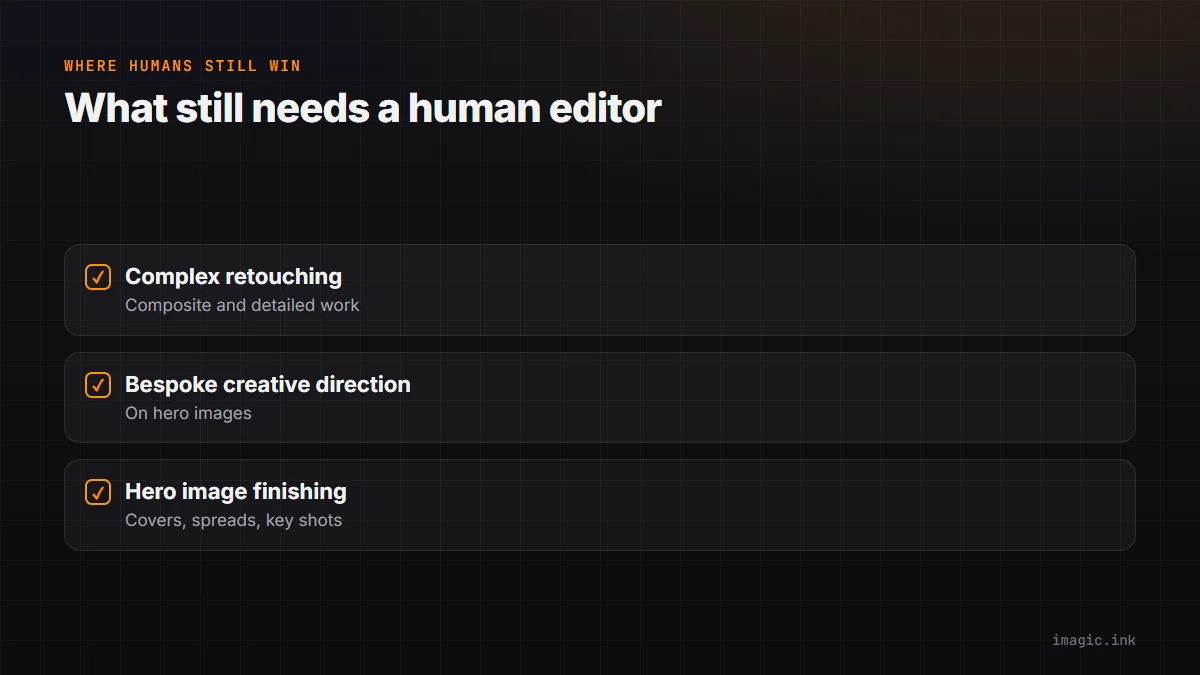
Complex retouching, composite work, and highly bespoke creative direction on hero images remain areas where a skilled human editor outperforms current AI tools, and most studios that use AI for the bulk of a shoot still hand-finish a handful of key images, the cover shot, the album spreads, anything getting extra client attention. The realistic pattern for most studios is not all-AI or all-outsourced, it is AI handling volume and outsourcing or in-house hand-finishing reserved for the images that actually need it. The industry insights section covers more of this cost-versus-control tradeoff across the business side of photography.
Frequently asked questions
Is outsourcing cheaper than AI tools for a small photographer?
Usually not over time. A one-time AI editing tool's cost is fixed regardless of shoot volume, while outsourcing costs scale per image and recur every booking, so the crossover point where AI tools pay for themselves is often just a few shoots in.
Can AI tools fully replace an outsourced editor?
For culling and consistent batch correction, largely yes. For complex retouching or bespoke creative composites, not currently, and most studios still keep a human option for that narrow slice of work.
Does outsourcing guarantee more consistent quality than AI?
Not necessarily. Quality consistency depends more on the specific service or editor's process than on whether a human or an AI model is doing the work, and outsourced quality can vary with staff turnover in ways a locally-run tool does not.