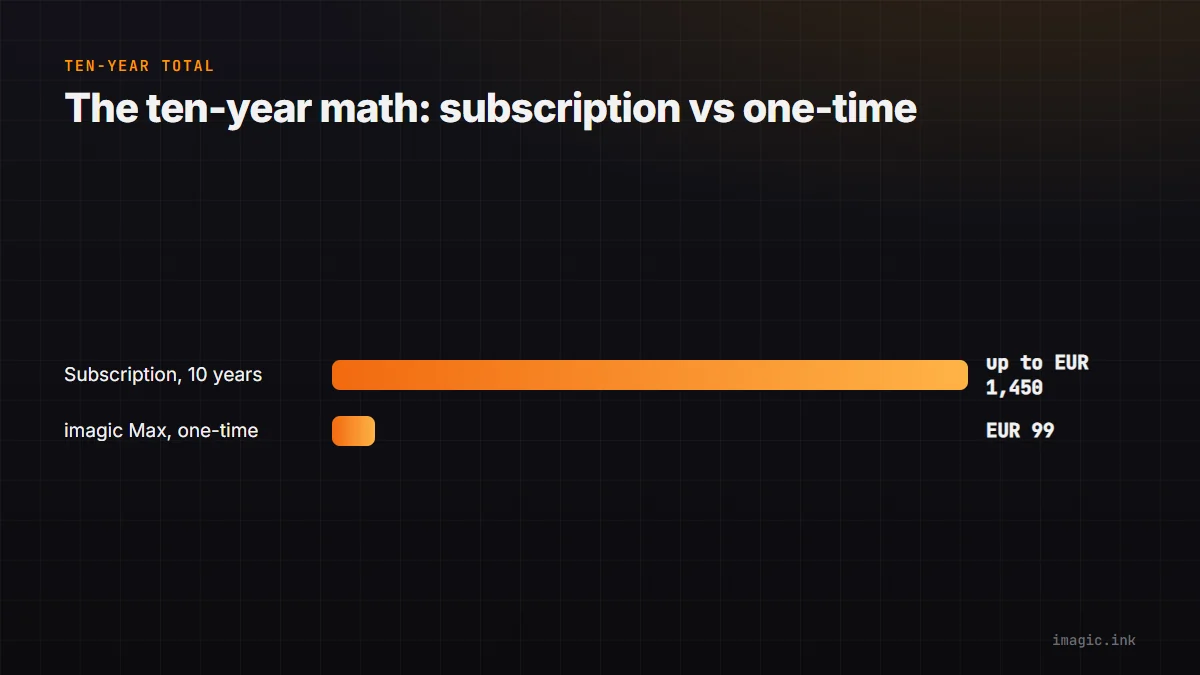
A subscription photo editor at roughly 10 euros a month looks cheap next to a one-time purchase priced in the double or triple digits. Run the same comparison out ten years instead of one month, and the math flips hard, in a way that rarely gets shown next to the "just 10 euros a month" pricing page.
The Total Cost Curve, Drawn Out
A subscription at roughly 10 to 12 euros a month totals somewhere around 120 to 145 euros a year, and multiplying that out ten years lands well over 1,000 euros for continuous access, typically 1,200 to 1,450 euros depending on the exact plan and any price increases along the way. A one-time license, imagic Max at 99 euros as one example, costs that amount once. Even accounting for a possible major-version upgrade purchase somewhere in that decade, the one-time model's ten-year total usually lands at a fraction of the subscription total. The curve is not close; it is not even the same order of magnitude past year two or three.
The Update-Entitlement Question
The fair counterargument for subscriptions is that they include continuous updates, new features arrive automatically without a repurchase, whereas one-time software eventually stops receiving free major updates and might require a paid upgrade to a new version down the line. That is a real tradeoff worth naming honestly rather than glossing over. The practical question is not whether updates have value, they do, but whether that value is worth roughly ten times the total cost over a decade, especially for tools where the core functionality (culling, RAW processing, batch editing) does not fundamentally change year to year the way a rapidly evolving category might. The hidden cost of Adobe Creative Cloud breaks down how this plays out for photographers specifically, beyond just the sticker price.
Subscription Fatigue Is a Real, Measured Trend
Surveys of consumer spending have repeatedly found that people typically underestimate their total monthly subscription spend by a wide margin when asked to guess versus when their actual accounts are tallied, often by a factor of two or more. Photography software rarely exists in isolation either; it usually sits alongside cloud storage, gallery delivery platforms, invoicing tools, and stock libraries, each billing separately and each individually looking affordable while the combined total quietly becomes a significant fixed monthly cost. What to use instead of a Lightroom subscription covers concrete alternatives for photographers specifically trying to break that cycle.
When a Subscription Genuinely Earns It
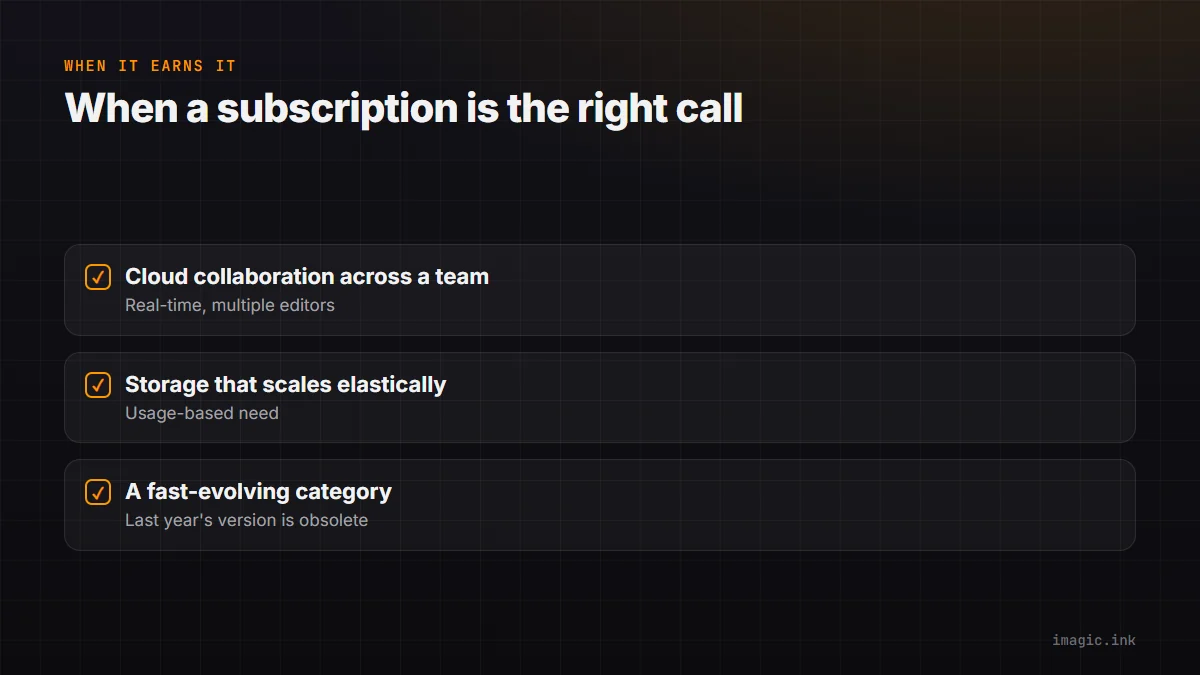
Subscriptions are not always the wrong call. Cloud collaboration across a distributed team, storage that needs to scale elastically with usage, or software in a category evolving so fast that last year's version is genuinely obsolete, video AI tools in recent years are one example, all make a case where paying continuously for continuous improvement is a reasonable trade. The distinction that matters is whether the ongoing payment buys something that keeps changing meaningfully, or whether it is funding access to functionality that was already essentially complete years ago.
Running the Numbers for Your Own Stack
The useful exercise is not abstract, it is listing every recurring software cost tied to your photography business, multiplying each by 12, then by however many years you realistically expect to keep working, and comparing that total against one-time alternatives for the same job. More industry-economics breakdowns like this one live in the industry insights section, including the total software stack question for photographers just starting out.
Frequently asked questions
Is one-time software always cheaper than subscription software?
Over a long enough time horizon, usually yes, for tools where core functionality is stable rather than rapidly evolving. Short usage windows, a single project or a few months of work, can favor subscriptions instead.
What happens if one-time software stops being updated?
It typically keeps working exactly as it did on the day support stopped, since there is no subscription to lapse and lock you out. The tradeoff is you stop receiving new features unless you purchase an upgrade later.
Do subscriptions make more sense for beginners?
They can, since a lower upfront cost lowers the barrier to trying a tool. Most one-time photo editors, imagic included, offer free trials specifically to remove that barrier without requiring an ongoing commitment.