Raising ISO in camera and lifting exposure later in post can, on many modern sensors, produce a nearly identical result in terms of final noise. That single fact, ISO invariance, quietly changes how you should think about exposing tricky, high-contrast scenes, and it is worth understanding in plain terms rather than as a spec-sheet buzzword.
Sensor Behavior in Plain Words
A digital sensor's ISO setting mostly controls amplification applied at (or shortly after) capture; it is not fundamentally different from you brightening the same underlying signal later in software, at least on sensors designed with this in mind. On a fully ISO-invariant sensor, shooting at a lower ISO and lifting exposure in RAW processing produces roughly the same noise as shooting at a higher ISO directly, because the underlying read noise characteristics do not meaningfully change across that ISO range. This is why some experienced shooters deliberately underexpose slightly at a lower ISO in tricky light rather than pushing ISO up in camera, then recover exposure afterward.
Shadow-Lift Latitude by Sensor Generation
Not every sensor behaves this way equally, and it is not a universal law, it is a design characteristic that varies by sensor generation and manufacturer. Many modern sensors from the last several years show strong ISO invariance across a useful middle range of ISOs, meaning shadows lift cleanly with limited extra noise penalty. Older sensors, and some sensor designs even today, are less invariant, where raising ISO in camera genuinely does produce a cleaner result than an equivalent post-exposure lift. If you are unsure where your camera sits, a quick real-world test (shoot the same scene at a base ISO underexposed by a couple of stops, then at the corresponding higher ISO, and compare shadow noise after lifting the first) tells you more than any spec sheet.
When to Protect Highlights and Push in Post
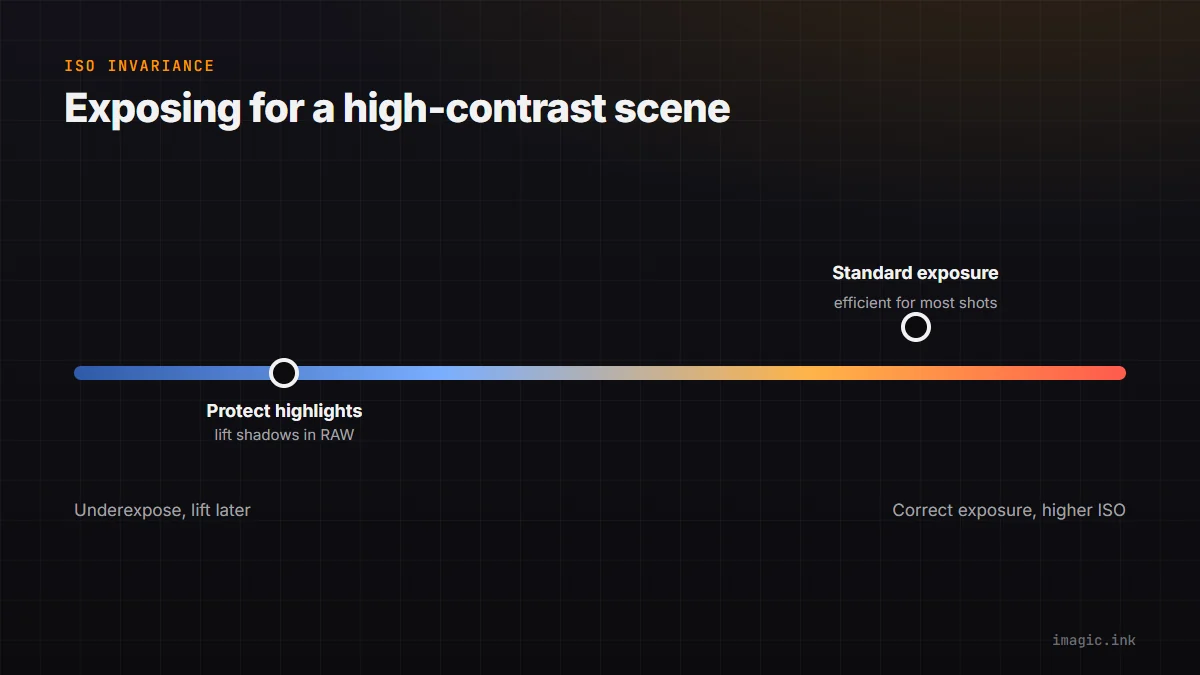
The practical case for using ISO invariance deliberately is high-contrast scenes where you are worried about blowing highlights: a backlit subject, a bright window in an otherwise dim room, harsh midday sun on part of a scene. Exposing for the highlights at a lower ISO, accepting darker shadows than you would normally want, and lifting those shadows in RAW processing afterward preserves highlight detail that in-camera high-ISO shooting would have clipped and lost permanently. This only works because RAW retains far more shadow information than it appears to on the camera's rear screen.
Where This Fits Into a Real Workflow
This is not a reason to underexpose everything by default; correct exposure in camera is still the more efficient path for most shots, and pushing shadows always costs some noise, invariant sensor or not. It is a targeted tool for scenes where the dynamic range genuinely exceeds what a single correct exposure can capture cleanly. Knowing your specific camera's invariance behavior means you can make that call deliberately in the field instead of guessing, and RAW files hold enough latitude for the recovery to matter, which is part of why shooting RAW rather than JPEG-only remains the default advice for anyone doing this kind of exposure work.
Frequently asked questions
Does ISO invariance mean ISO settings do not matter anymore?
No. It means that on invariant sensors, within a certain range, shooting lower and lifting in post produces similar noise to shooting higher directly, which gives you a useful exposure strategy option. It does not eliminate noise or make exposure choices irrelevant outside that range.
How do I know if my camera's sensor is ISO invariant?
Run a simple comparison: shoot the same scene underexposed at a lower ISO and correctly exposed at a higher ISO, then lift the underexposed shadows in RAW processing and compare noise. Many cameras from recent sensor generations show strong invariance across a useful middle range.
Is it better to underexpose or overexpose if I am unsure?
Protecting highlights by slightly underexposing is generally the safer choice on an invariant sensor, since RAW files hold considerably more recoverable detail in shadows than in blown highlights, which are typically unrecoverable.
See also exposure scoring for photo quality. This matters most for available-light work like wedding photography, and cameras like the Sony A7S III are known for strong low-light and invariance behavior. More in Guides.