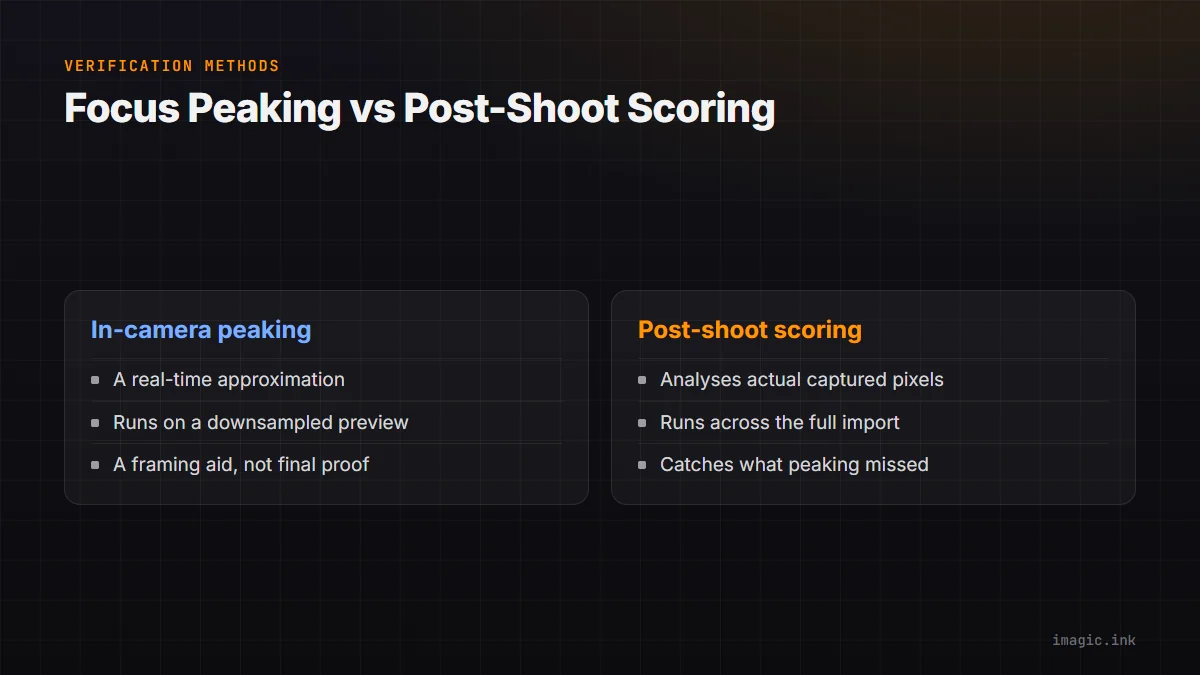
Focus peaking shows a border of highlighted pixels and feels like proof. It is not proof, it is an approximation, and at the resolutions modern cameras now ship at, the gap between "peaking says it's sharp" and "it's actually sharp at 100%" has gotten wider, not narrower.
What In-Camera Sharpness Aids Actually Do
Focus peaking highlights areas of high local contrast on the live view or EVF feed, which usually correlates with in-focus edges, but it is a real-time approximation running on a downsampled preview feed, not an analysis of the actual captured pixels. It can miss subtle front or back focus, and it can flag texture or contrast that is not the intended focus point at all, especially with a moving subject or a wide aperture where the plane of focus is thin. It is a useful shooting aid for framing decisions in the moment. It was never designed to be a final verification tool.
Why EVF Confirmation Fails at 45 Megapixels
The core problem is resolution mismatch. An EVF or rear screen displays a preview at a small fraction of the sensor's actual resolution, so "looks sharp" on a 45 or 60 megapixel sensor's tiny live preview tells you very little about whether the image holds up at 100% crop. A frame that appears perfectly crisp in the viewfinder can reveal soft eyes or a missed focus plane once you view the actual pixels on a large monitor. This gap grows as sensor resolution climbs, which is exactly the direction the market has moved; a camera like the Sony A7R V makes this mismatch more consequential than it was on lower-resolution bodies a decade ago.
Post-Shoot Sharpness Scoring as the Safety Net
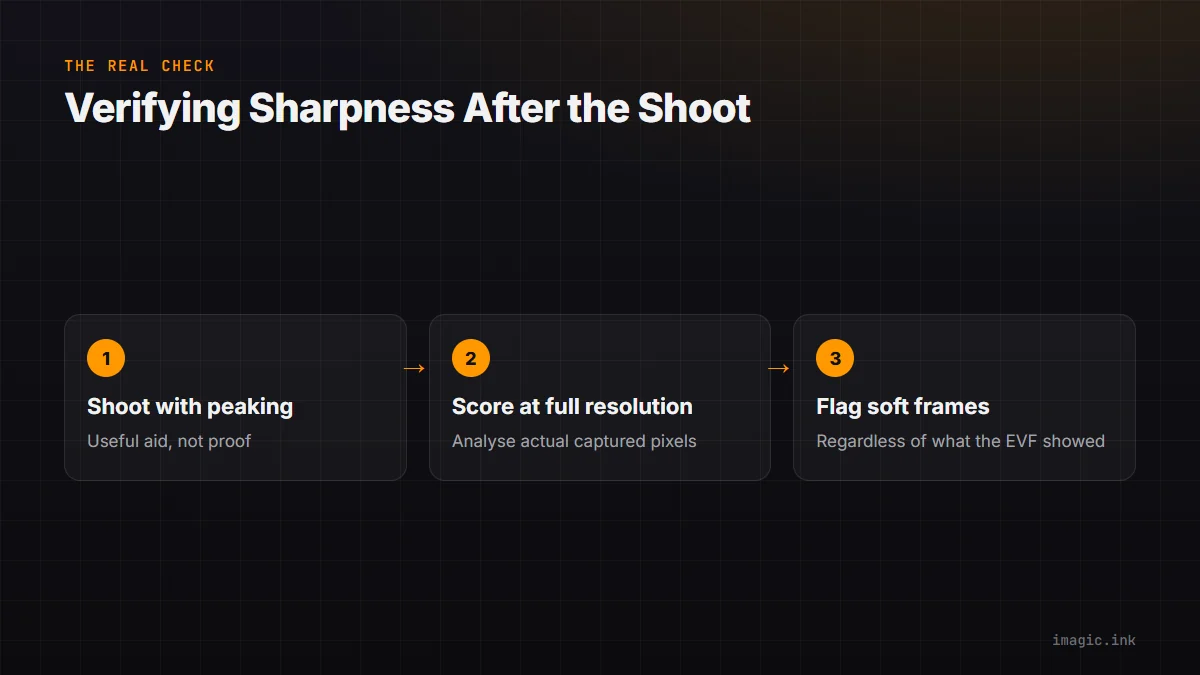
The reliable fix is verifying sharpness after the shoot, at full resolution, systematically, rather than trusting in-the-moment confirmation. Doing this manually for every frame of a large shoot is not realistic, which is where automated sharpness scoring earns its place: imagic's quality scoring analyzes actual pixel-level sharpness across a full import, flagging soft frames regardless of what the EVF suggested during capture. This catches the specific failure mode focus peaking cannot: a frame that looked confirmed-sharp in camera but is measurably soft once you can actually see it at scale.
Building Verification Into Your Workflow
The practical shift is treating in-camera focus confirmation as a first-pass shooting aid, not a final check, and building a real sharpness pass into your post-shoot routine before you commit to a selection. This matters most for anything shot at wide apertures, with fast-moving subjects, or at very high resolution, where the margin for a missed focus point is thinnest and the cost of not catching it (a client's favorite frame turning out soft at full size) is highest.
Frequently asked questions
Is focus peaking unreliable, or just limited?
It is limited rather than unreliable for its intended purpose: it is a real-time framing aid based on a downsampled preview, not a pixel-level sharpness check. Treating it as final confirmation is the mistake, not the tool itself.
Why does this matter more at higher megapixel counts?
Higher resolution sensors capture finer detail that a small EVF or rear-screen preview cannot represent accurately, widening the gap between what looks sharp in the moment and what is actually sharp once you view the full file.
Can software catch soft focus after the fact reliably?
Automated sharpness scoring analyzes the actual captured pixels rather than a live preview, so it can catch soft frames a photographer might have trusted based on in-camera confirmation during the shoot.
Related: how AI sharpness detection works and AI photo scoring accuracy explained. More in AI & Technology.