
The AI vs Manual Debate: Where Does It Actually Stand?
The photography industry has been debating AI editing tools seriously since around 2020. By 2026, the debate has moved from "will AI replace photographers?" to the more useful question: "where does AI add genuine value, and where does human judgment remain essential?" The honest answer is nuanced and depends heavily on what part of the workflow you're discussing.
The Culling Stage: AI Wins Clearly
For technical pre-screening — identifying out-of-focus shots, severely over- or under-exposed frames, frames with excessive noise — AI consistently outperforms human judgment on speed while matching it on accuracy. Humans performing manual culling get fatigued, make inconsistent decisions, and physically take 3-5 seconds per frame even at high speed. imagic's AI scoring processes thousands of frames consistently, without fatigue, in a fraction of the time.
The one area where human judgment remains superior in culling: expression, decisive moment, and editorial narrative. AI can't reliably determine whether a subject's expression is authentic, whether the timing captured something unique, or whether a composition tells a compelling story. But it doesn't need to — AI handles technical elimination; humans handle editorial selection.
The Develop Stage: Hybrid Wins
For RAW processing, the best results come from a hybrid approach. AI-based exposure correction and auto-white balance provide a solid starting point — often requiring only minor tweaks per image. But creative decisions (the mood of the color grade, the amount of contrast for the genre, the specific skin tone treatment) remain better when made by a human who understands the photographer's artistic intent.
Fully AI-automated processing produces competent results but often lacks the specific personality that distinguishes a photographer's signature style. The edit "looks good" without looking distinctive.
The Retouching Stage: Depends on the Work
AI retouching has improved dramatically. AI blemish removal, AI sky replacement, AI subject masking — these are genuinely useful and time-saving. For high-volume commercial work (e-commerce product photography, school portraits, event work), AI retouching makes the economics of individual image editing viable at scale.
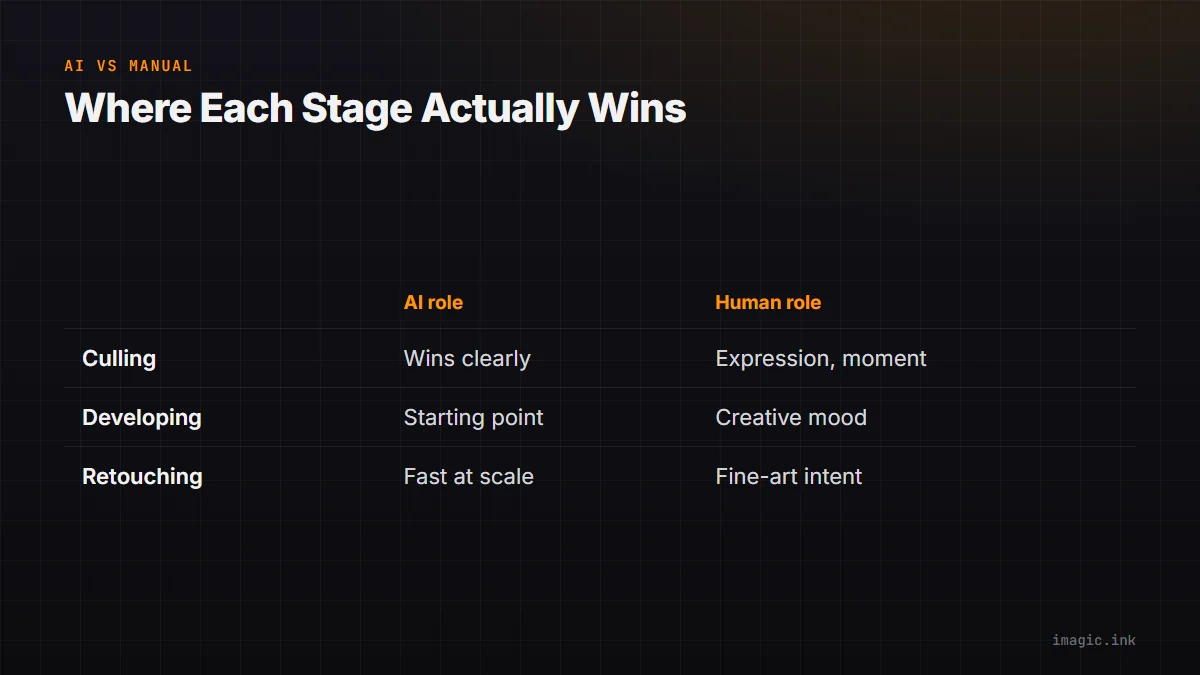
For fine-art, high-end fashion, or personal work where the photographer's eye is the product, AI retouching often produces homogenized results. The AI smooths what shouldn't be smoothed, replaces elements that were chosen deliberately, and generally trends toward a commercially appealing average that isn't always the photographer's intention.
Measured Time Savings
Real-world data from photographers using AI culling tools like imagic, tracked in our time savings calculator, shows consistent results:
- Culling time reduced by 50-70% across different shoot types
- Total editing time (cull + process + retouch) reduced by 30-40% on average
- The largest savings are on high-volume genres (weddings, events, sports)
- The smallest savings are on fine-art work where per-image attention is the product
Quality: Does AI Compromise It?
For technical quality, AI tools generally maintain or improve it by removing fatigued human decision-making from the selection stage. For creative quality, the answer depends on how much creative latitude the AI is given. imagic's approach — AI handles technical scoring, human handles creative selection — preserves creative quality while gaining technical efficiency.
The Right Mental Model
AI in photo editing in 2026 is best understood as a powerful assistant, not a replacement. It handles the mechanical, repetitive, fatigue-sensitive parts of the workflow. The photographer's eye, taste, and creative judgment remain essential — and are actually better applied when not exhausted by hours of mechanical frame-by-frame review. imagic's design embodies this philosophy: AI handles the technical triage, you make the creative decisions.
Frequently asked questions
Does AI editing ever fully replace manual editing?
Not in 2026. AI reliably wins at technical, repetitive tasks like culling and exposure correction, but creative decisions such as color grade mood and skin tone treatment still benefit from a human who understands the intended style.
Which stage of editing benefits most from AI?
Culling shows the clearest win: AI consistently matches human accuracy on technical pre-screening while working far faster and without fatigue, which is why culling time reductions of 50-70% show up across most shoot types.
Does using AI tools reduce the quality of the final images?
Not when AI is limited to technical scoring and humans keep the creative selection, which is how imagic's approach works. Fully automated processing can look competent but lose a photographer's distinctive style. More AI and technology articles cover where automation fits into a photography workflow.