
Client expectations around photo delivery have shifted noticeably over the past several years, driven less by photographers themselves and more by everything else in clients' lives that now happens near-instantly. A gallery delivered on a timeline that would have been considered fast a decade ago can now read as slow, simply because the surrounding baseline for "fast" moved.
Turnaround Norms by Genre
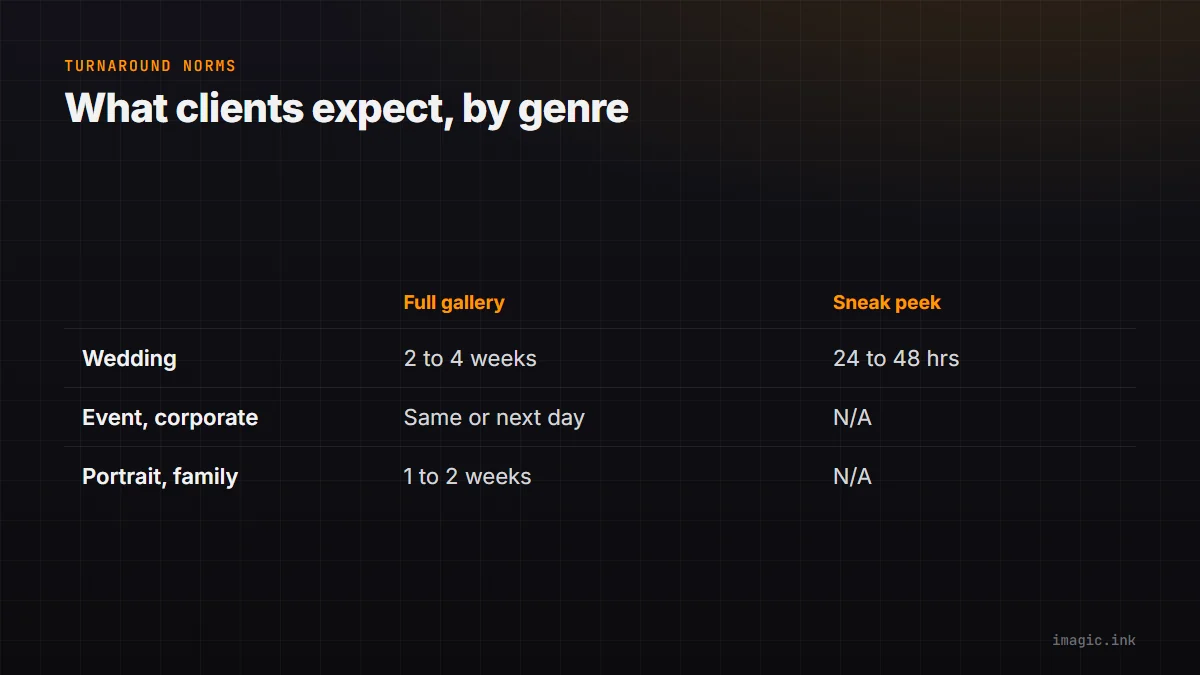
Expectations are not uniform across photography types. Wedding clients, historically used to waiting 6 to 8 weeks or longer for a full gallery, increasingly expect a meaningfully shorter window, with many studios now targeting 2 to 4 weeks as a competitive standard rather than an exceptional one. Event and corporate photography clients often expect same-day or next-day delivery, particularly for anything meant to be shared or used quickly, a conference recap, a same-night social post. Portrait and family sessions sit in between, with 1 to 2 weeks being a common, comfortable expectation for most clients booking that kind of shoot today. How to deliver wedding photos faster and making same-day event delivery actually possible both dig into the practical mechanics behind hitting these windows.
Gallery Presentation Now Matters as Much as Speed
Delivery is no longer just a folder of files; clients increasingly expect a proper online gallery experience, easy to browse on a phone, simple to share with family, with straightforward download and, often, print-ordering built in. A technically fast delivery that arrives as an unsorted folder of a thousand files reads worse to most clients than a slightly slower delivery presented as a curated, well-organized gallery. Presentation and speed are both part of the same expectation now, not separate concerns.
Sneak-Peek Culture
The expectation of a small preview set within 24 to 48 hours of a shoot, a handful of hero images shared quickly, ahead of the full gallery, has become close to standard for weddings and many event bookings, driven partly by clients wanting something to share on social media almost immediately. This does not shorten the full-gallery deadline so much as it splits delivery into two expectations: a fast, small preview, and a complete, well-edited full set that can still take longer. Studios that build a sneak-peek step into their standard workflow report it reduces client anxiety about the wait for the full gallery considerably, even when the full-gallery timeline itself has not changed.
How Delivery Speed Became a Booking Factor
Turnaround time increasingly shows up explicitly in how photographers market themselves, in portfolio sites, in reviews, in word-of-mouth recommendations, alongside style and price as a factor couples and clients weigh before booking. This is a meaningful shift from a decade ago, when turnaround was rarely mentioned until after booking, treated as an operational detail rather than a selling point. Photographers able to genuinely hit fast, reliable turnaround without sacrificing edit quality have a real competitive angle worth stating plainly rather than downplaying.
What Actually Makes Fast Delivery Possible
The photographers hitting these tighter windows consistently are rarely working longer hours; they have compressed the culling and editing bottleneck specifically, since that is almost always where the real time goes rather than in shooting or in final export. AI-assisted culling and batch editing are a direct lever on that bottleneck, and imagic's local processing means a shoot can be culled and edited the same evening it was shot, without uploading anything or waiting on a cloud service. See what a finished gallery experience looks like for a concrete sense of the presentation side of this expectation.
Frequently asked questions
What is a competitive wedding gallery turnaround in 2026?
Many studios now target 2 to 4 weeks as a competitive standard, though this varies by market and season. Studios still delivering in 6 to 8 weeks or longer are increasingly the exception rather than the norm.
Do clients actually expect a sneak peek now?
For weddings and many events, it has become a common expectation rather than a bonus, though it is not universal across every genre or every market. It sets client expectations even when the full gallery still takes longer.
Does faster delivery risk lower quality editing?
Not inherently, if the speed comes from a more efficient workflow rather than from skipping review steps. Studios that speed up culling and batch correction typically maintain the same final quality bar, just with less time spent getting there.