
A photographer who quotes a 4-hour wedding package at a set price has not actually worked 4 hours on that wedding. Culling, editing, client communication, and delivery routinely add another 8 to 15 hours or more behind the scenes, invisible in the quote but very much real in the calendar. Pricing off shutter time alone is one of the most common ways working photographers quietly underprice themselves.
The Invisible Post-Production Tax
Ask most photographers how long a shoot "takes" and they will describe the time on location. Ask how long a shoot actually occupies from booking to final delivery, and the honest answer usually includes culling a few thousand frames, editing the keepers, client back-and-forth, gallery setup, and any revisions, a tax that frequently equals or exceeds the shoot time itself. This gap is not a personal failing or a sign of inefficiency; it is simply the part of the job that does not happen in front of a client and therefore does not get counted the same way when a price is being set.
Computing Your True Hourly Rate
The exercise worth doing at least once a year: take a recent, representative shoot's total price, then track (or honestly estimate from memory) every hour actually spent on it end to end, shoot time plus culling plus editing plus admin and client communication. Divide price by total hours, not shoot hours, and compare that number to what you would consider a reasonable hourly rate for skilled creative and technical work. Many photographers doing this exercise for the first time are surprised, and not pleasantly, at how far the real number sits below what the headline package price implied. How much time AI culling actually saves is a useful companion number for this calculation, since post-production time is usually the largest single line item in the total.
Workflow Speed Feeds Margin, Not Just Free Time
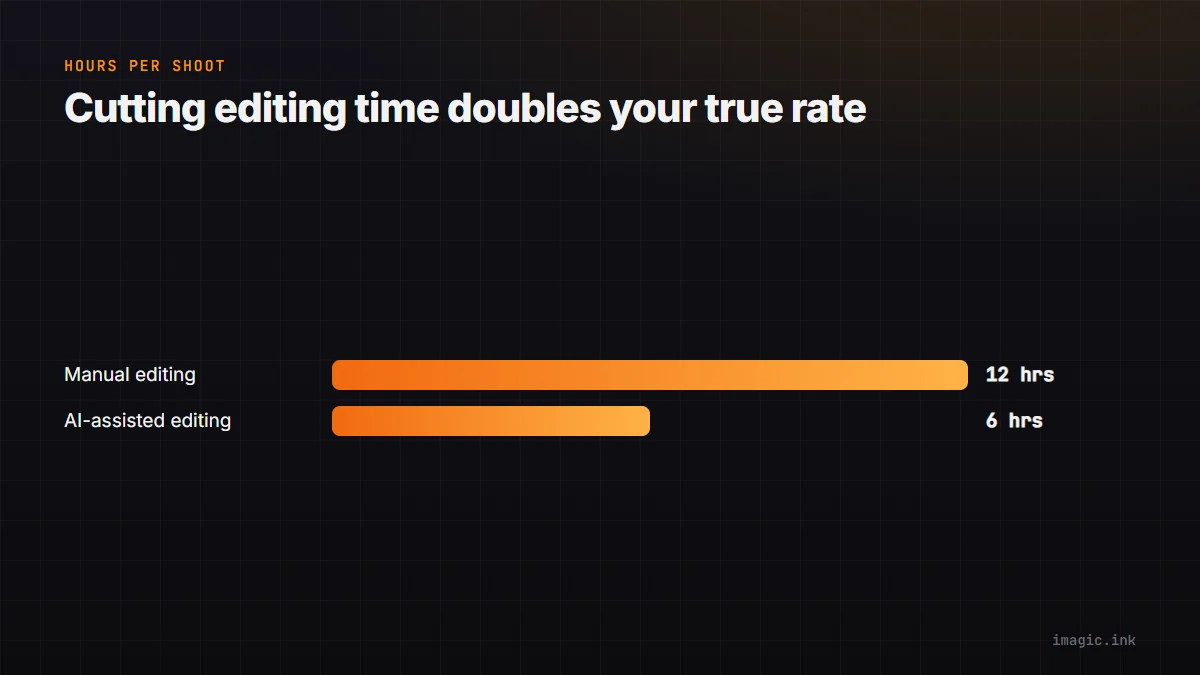
The instinct when post-production speeds up is often to think of it purely as more free time or the ability to take more bookings. Both are real benefits, but there is a third, less discussed one: the same package price now maps to a higher true hourly rate, meaning existing bookings become more profitable without a single price increase. Cutting editing time on a shoot from 12 hours to 6, a plausible outcome of moving from fully manual culling and editing to an AI-assisted pipeline, effectively doubles the true hourly rate on every booking priced the same way as before. This is margin recovered from the workflow itself, not from raising prices or working more hours, and it compounds across every future booking without any client-facing change at all.
Building Post-Production Time Into Quotes Honestly
Photographers who track total hours accurately tend to price more sustainably, because the number they are working from reflects the real job rather than just the visible part of it. This does not necessarily mean charging clients more; it often means recognizing where a package is underpriced relative to the actual work involved, and deciding deliberately whether to adjust the price, adjust the scope, or invest in faster tooling to close the gap from the cost side instead. The industry insights section covers more of this kind of business-economics thinking for working photographers.
A Simple Starting Formula
Total hours = shoot time + average culling time for that shot count + average editing time for the keeper count + a reasonable estimate for admin and communication. True hourly rate = package price divided by that total. Run this once a quarter on a representative booking, and use the trend, not just a single number, to judge whether pricing or workflow needs attention.
Frequently asked questions
How much time does post-production typically add to a shoot?
It varies widely by genre and shot count, but for many event and wedding shoots, post-production time meets or exceeds the actual time spent shooting, often by a significant margin once culling a large burst count is included.
Should true hourly rate calculations change how packages are priced?
Not automatically, but they should inform the decision. A true hourly rate well below a sustainable target is a signal to either adjust pricing, adjust scope, or invest in workflow speed, not something to ignore.
Does faster editing always mean lower quality?
Not inherently. Speed gains from good tooling (AI culling, batch editing) typically come from eliminating repetitive manual work, not from skipping judgment calls, so quality does not have to suffer for the process to get faster.