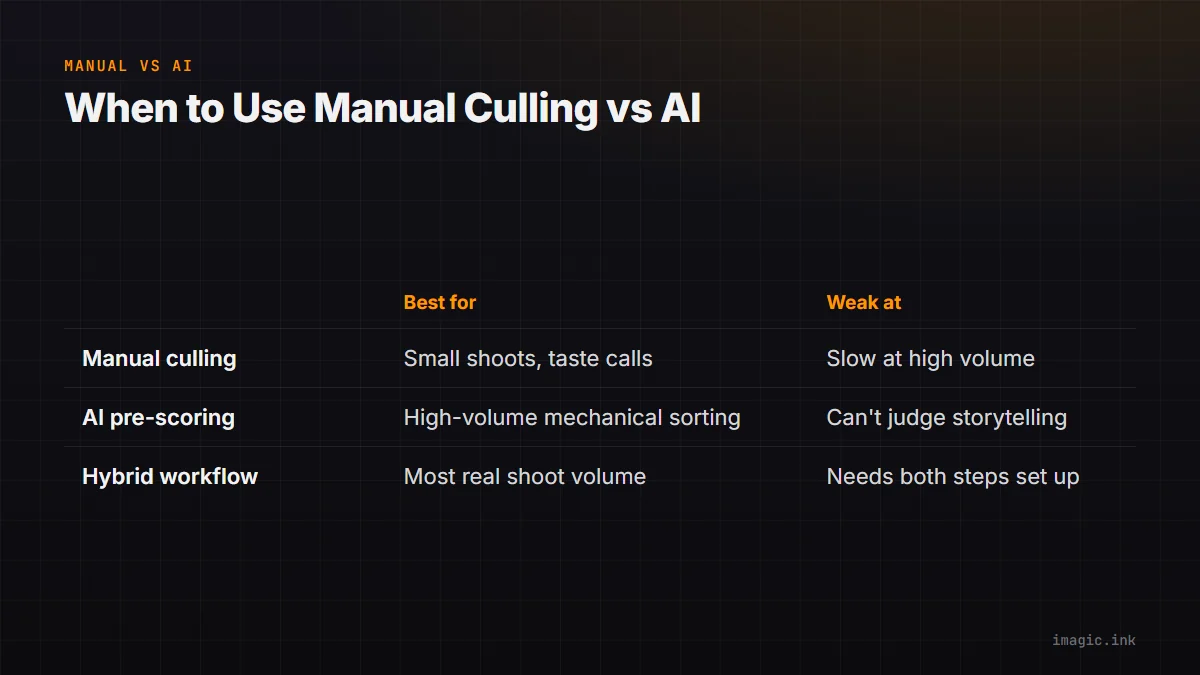
Manual culling, scrubbing through a shoot frame by frame with keyboard shortcuts to flag picks and rejects, is a real skill, and for a lot of shoots it is still the right tool. This is not an argument to abandon it. It is an honest look at how to cull photos faster: where manual culling genuinely wins, where it starts costing more than it delivers, and a hybrid approach that uses both.
The Honest Case for Manual Culling
For small shoots, a 30-minute portrait session, a handful of product shots, manual culling is fast precisely because there is not much volume to process, and it keeps every decision in the photographer's judgment with no pre-filtering to second-guess. It is also genuinely better suited to editorial and documentary work, where the "best" frame is often a taste call about storytelling or a fleeting expression that quality scoring cannot evaluate, sharpness and exposure are not the deciding factors in that kind of edit. A photographer with strong, fast manual culling habits on a 200-frame shoot may not save meaningful time by introducing AI pre-scoring into that specific workflow.
Where the Volume Threshold Actually Sits
The honest answer is that there is no single frame count where manual culling stops working, but a pattern shows up consistently in high-burst genres: once a shoot regularly produces multiple thousands of frames, weddings, sports, wildlife, events, the bottleneck shifts from "which frame is best" (a judgment call) to "which of these 20 near-identical burst frames should I even be comparing" (a mechanical sorting problem). Mechanical sorting is exactly what AI pre-scoring and duplicate grouping are good at, and manual review time spent on that step, rather than on the actual judgment calls, is where the volume threshold makes AI pre-scoring worth introducing.
A Hybrid Workflow
The strongest workflow for most working photographers running any real volume is not "manual vs AI," it is AI for the mechanical sorting, manual for the judgment calls:
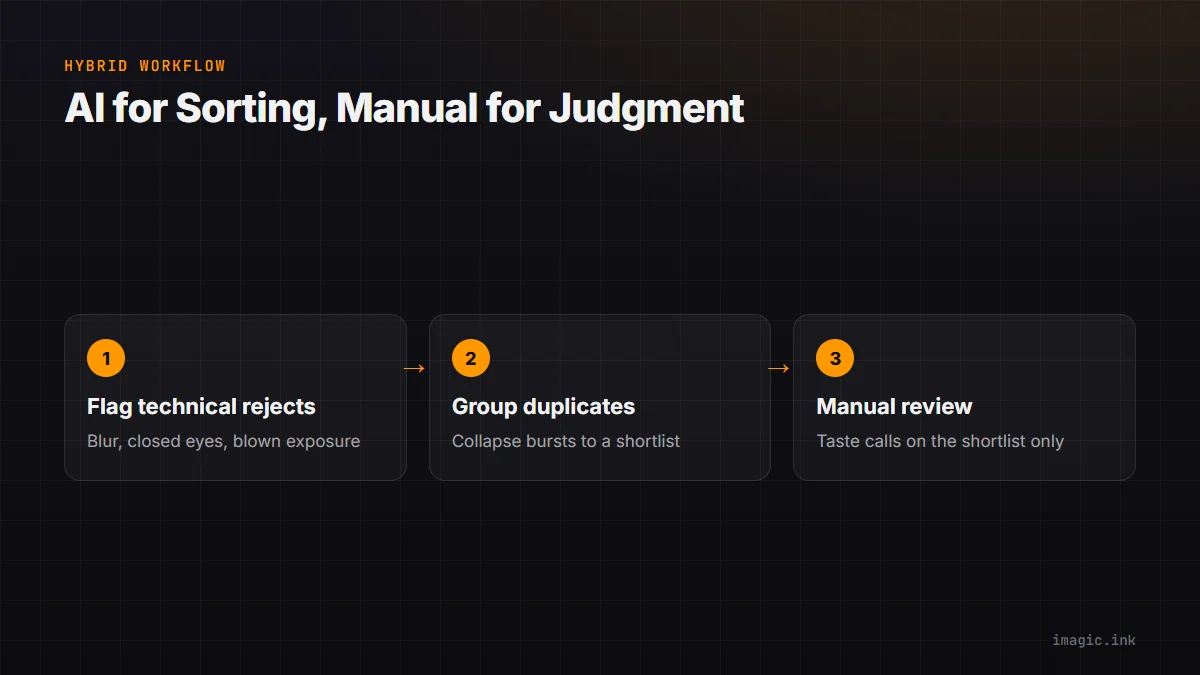
- Let AI quality scoring flag clear technical rejects (motion blur, closed eyes, blown exposure) so they never enter manual review at all
- Let duplicate and burst grouping collapse near-identical frames to a shortlist per moment
- Do manual culling, keyboard shortcuts and all, on that shortlist rather than the full take, focused on the taste calls a score cannot make: expression, composition, storytelling weight
This keeps the manual skill exactly where it adds the most value and removes it from the part of the job that is closer to data entry than editorial judgment. See How to Choose Photo Culling Software for evaluating tools built for this hybrid approach.
Signs You Have Outgrown Pure Manual Culling
A few honest signals worth checking against your own workflow: culling regularly eats more time than editing, you are comparing near-duplicate burst frames by eye more than you are making genuine taste calls, or a backlog of unculled shoots is building up because the manual process cannot keep pace with how much you are shooting. None of these mean manual culling skill was wasted, they mean the mechanical part of the job has outgrown doing it entirely by hand.
Where imagic Fits
imagic's AI culling handles the mechanical sorting, quality scoring, and burst grouping, locally and included at every tier, while leaving the final picks to manual review. It does not replace editorial judgment, it removes the sorting work that was never really using it. See Photo Culling Mistakes to Avoid.
Frequently asked questions
Is manual culling ever the better choice over AI?
Yes, particularly for small shoots and editorial or documentary work where taste and storytelling matter more than technical scoring. AI pre-scoring earns its keep most clearly at high volume with heavy burst shooting.
At what shoot size should I start using AI pre-scoring?
There is no fixed number, but once a shoot regularly runs into the thousands of frames with significant burst shooting, mechanical sorting time typically starts outweighing judgment-call time, which is the signal worth watching for.
Does using AI culling mean giving up manual control over picks?
No, in a hybrid workflow. AI handles pre-filtering and grouping; the actual keep or reject decision on the shortlist remains a manual, human judgment call.
Try imagic free for 7 days, no card required, AI culling included to test against your own manual workflow. Start the free trial.