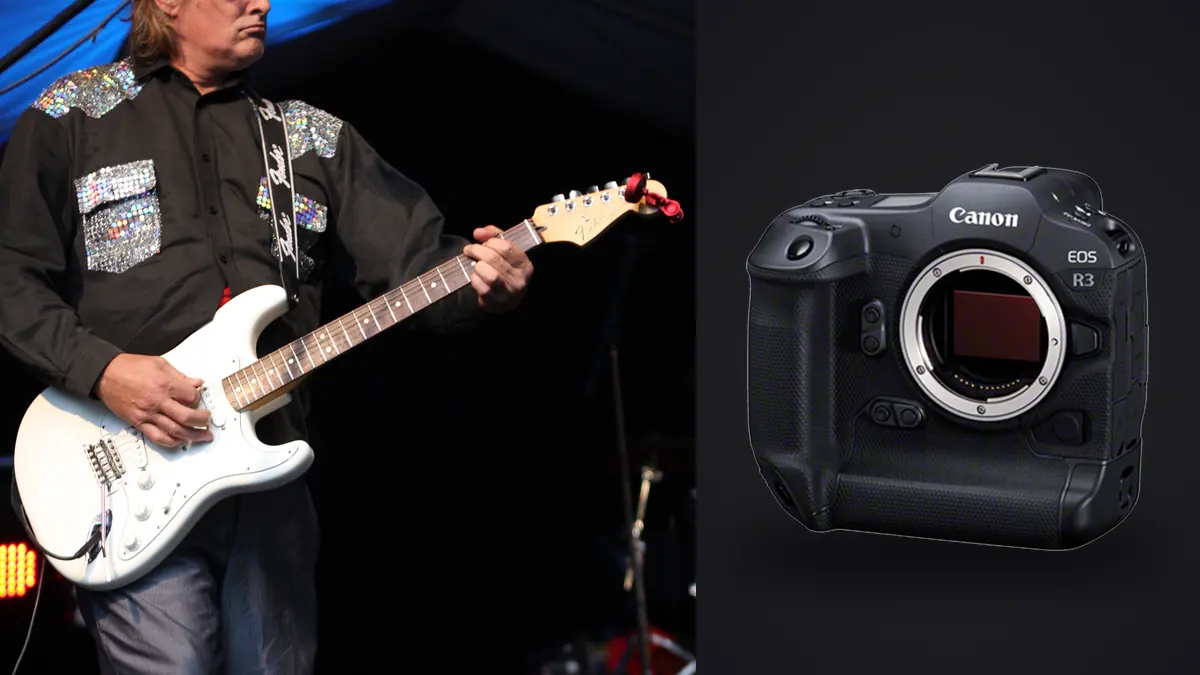
The First Show That Changed My Mind About the R3
I'd used the EOS R3 for sports work for about six months before I ever brought it into a music venue, and I went in expecting it to feel like overkill. A 24.1 megapixel stacked sensor built for autofocus speed didn't sound like a concert camera on paper. Then I shot a three-song pit set for a touring rock act under a lighting rig that swung between deep red washes and blinding white strobes, and the autofocus never once hunted. That's the whole pitch for using this body at shows: it was built to solve a tracking problem, and a singer pacing the front of a stage under constantly shifting color temperature is exactly that problem, just with worse light than any football field.
This isn't a spec sheet regurgitation. It's what actually changes about your shooting when you bring the R3 into a club, a theater, or an arena pit, and what still trips you up even with a body this capable.
What Actually Matters in the Photo Pit
Most gear reviews of the R3 lead with the 30fps electronic shutter number, and it's real, but raw frame rate isn't the thing that wins you usable shots at a show. Three things matter more: whether the viewfinder blacks out between frames, whether autofocus can find a face under a single hard spotlight, and whether the buffer survives a two-minute guitar solo without stalling.
The R3's finder stays live through the burst. You're not guessing where the singer's head went during a strobe hit the way you would on a mechanical-shutter body, you're watching it happen in real time at up to 30fps. That single feature changed how I frame in the pit more than the resolution or the ISO ceiling did. I stopped pre-firing on a guess and started actually tracking movement through the viewfinder, which meant fewer clipped frames where the mic stand cuts through someone's face.
Eye Control AF: Useful, But Don't Trust It Blind
Canon's Eye Control AF gets a lot of attention because it's genuinely new, and in a pit it sounds like a dream: look at the drummer, the camera focuses on the drummer. In practice it's good, not magic. It needs a calibration pass per shooter (do this at home in good light, not backstage five minutes before doors), and it degrades if you're wearing glasses, if the eyecup shifts against your face during a fast pan, or if you're shooting through a monitor wedge or a barricade at an angle. On a good night, with a clean calibration and no glasses, I'll use it for wide crowd-reaction shots where I want to snap focus onto whichever face I glance at without moving a joystick. For tight pit work where a wrong lock means a blown frame of a three-song set you don't get back, I still fall back to a small AF zone or single point with Case 2 or Case 4 tracking. Eye Control is a genuine accelerant for certain shots. It is not yet something I'd stake an entire assignment on.
ISO, Noise, and How Far You Can Actually Push It
The R3's native range runs 100 to 102400, with expansion further in both directions, and the marketing number is impressive. The honest number is different. Up through roughly ISO 6400 the files are clean enough that I don't think twice. Between 6400 and 12800, grain becomes visible but stays fine-grained and doesn't eat detail in skin tones, which matters a lot for close-up performer shots. Past 12800 I start being more deliberate about which frames I keep, because chroma noise creeps into shadow areas lit by colored gels, and magenta or green stage washes make that noise more obvious than a neutral white key light would.
For a small club with a single overhead wash and no pit rail, I'll happily sit at 10000 to 16000 to hold a fast enough shutter speed on a moving vocalist. For an arena with proper production lighting, I rarely need past 6400. The stacked sensor's real advantage at high ISO isn't cleaner files than a comparable body, it's that the fast readout lets you use a genuinely fast shutter with the electronic shutter engaged without introducing rolling shutter skew on quick pans, so you're not forced to compensate for motion artifacts by dropping shutter speed and pushing ISO even further.
Buffer Depth and the Card Slot You Should Actually Be Using
Canon rates the raw buffer at roughly 150 frames on a UHS-II SD card before the burst rate softens. That sounds low next to the 30fps top speed until you do the math: at 30fps, 150 raw frames is five seconds of continuous shooting, and you almost never hold the shutter down for five straight seconds during a real set. What actually happens is short bursts of six to ten frames as a performer hits a pose, then a pause, then another burst. The buffer rarely becomes the bottleneck in that shooting pattern on SD.
Where it matters is CFexpress Type B in the primary slot. If you're shooting a festival set where you genuinely are holding bursts through an entire chorus, or backing up simultaneously to both cards for a high-stakes assignment you can't afford to lose, the CFexpress slot clears dramatically faster and keeps the buffer from ever feeling like a ceiling. My practical setup for a three-song, no-flash photo pit is CFexpress as primary with raw, SD as an in-camera backup copy. For a full headline set where I might be shooting for ninety minutes straight, I'll drop to C-RAW to roughly halve file size without a visible quality hit at normal viewing sizes, which also means less time later waiting on files to copy off cards at 2am in a green room.
Working Settings by Venue Type
| Venue type | Typical lighting | Lens I reach for | ISO range | Shutter floor | AF setup |
|---|---|---|---|---|---|
| Small club, no pit (under 300 cap) | Single stage wash, heavy color gel, low ceiling | 50mm f/1.2 or 35mm f/1.4 | 6400 to 16000 | 1/250s (1/160s for a static vocalist) | Case 2, small AF zone, Eye Control off |
| Theater / mid venue (800 to 2500 cap) | Rigged moving heads, better key light on lead vocal | 70-200mm f/2.8 | 3200 to 12800 | 1/320s to 1/500s | Case 4, expand AF area |
| Arena (10,000 cap and up) | Full production rig, LED walls, strobes, pyro | 100-500mm f/4.5-7.1 for distance, 70-200mm from the pit | 1600 to 6400 | 1/500s to 1/1000s | Case 3, watch for strobe blackout frames |
| Outdoor festival, day into dusk | Harsh sun early, house lighting takes over after sunset | 24-70mm f/2.8 | 100 (day) up to 3200 (dusk) | 1/1000s day, 1/250s dusk | Case 1 flexible zone, dust and weather sealing matter |
Lens Choices That Actually Get Used
The R3's body is heavy and grippy with an integrated vertical grip similar to Canon's 1-series bodies, which changes what glass makes sense to pair with it. A 70-200mm f/2.8 is the workhorse for anything with a photo pit, wide enough for full-body shots at the barricade and long enough to get tight on a face from twenty feet back. For clubs where you're standing in the crowd with no barrier at all, I lean on primes: a 50mm f/1.2 or 35mm f/1.4 for the extra stop of light and a shallower plane of focus that separates a performer from a busy background of amp stacks and cable runs.
For arena and stadium work where you're shooting from a riser fifty or more meters back, the 100-500mm earns its weight, though at f/7.1 on the long end you'll lean on that high ISO ceiling to keep shutter speed up. What I don't reach for at shows is anything slower than f/4 unless it's daylight, because stage lighting rarely gives you enough to spare.
Getting Through the Files After the Last Song
A three-song pit set with the shutter set to high-speed electronic burst can easily produce 800 to 1,200 frames in nine minutes, most of them variations on the same three or four seconds of movement. That volume is where the camera's strengths stop mattering and your culling process starts mattering more. I run everything through imagic once I'm off the venue wifi, because the duplicate and burst clustering groups those rapid-fire sequences into single clusters instead of showing me forty near-identical frames of a guitarist's strum, so I'm picking the sharpest frame per moment instead of scrolling past the same pose repeatedly.
The local sharpness scoring matters even more for concert work than for a controlled shoot, because a decent share of frames from any pit set have motion blur on the hands or a slightly missed focus lock on a fast pan, and it's faster to trust a sharpness score to flag the soft ones than to zoom into every single frame at 100% on a laptop screen at 1am in a tour bus. Since everything runs locally, there's no upload step to wait on, which matters when you're backstage on venue wifi that might not exist at all, or filing to a publication on a two-hour deadline after the encore. If you're new to how automated culling actually separates the keepers from the near-misses, this breakdown of how AI photo culling works covers the mechanics in more depth.
The other habit that's saved me repeatedly on tour is building a style preset from a night I was happy with. Concert lighting shifts the color balance wildly show to show (a magenta-heavy rig one night, a cool blue wash the next), and once I've manually graded a set I'm proud of, imagic's apply_my_style feature learns from those specific edits and applies that same grading logic to the next batch, so the fifth show of a tour doesn't take as long to get through as the first one did. It's not a substitute for actually looking at every keeper, but it removes the repetitive base-grading work that used to eat the first twenty minutes of every editing session. If your bottleneck right now is turnaround time between load-out and delivery, these workflow tips pair well with that approach.
Where the R3 Still Has Limits
It's not a small camera, and after four hours slung over one shoulder at a festival you'll feel it more than you would with an R6 II or a mirrorless body from a lighter class. Battery life is strong for a mirrorless body, generally enough for a full club night without a swap, but I still carry a spare for festival days that start with soundcheck and run past midnight. And while the autofocus is excellent, it's still occasionally fooled by a photographer directly in your sightline in a crowded pit, or by a haze machine thick enough to scatter the AF illumination. No camera solves crowded, three-song, no-flash pit access being a genuinely hard shooting environment. The R3 just gives you fewer excuses inside it.
Frequently Asked Questions
Is 24.1 megapixels enough resolution for arena screens and print use from concert work?
For editorial use, social delivery, and most print sizes up to a full magazine spread, yes. Where you'll notice the ceiling is aggressive cropping, like pulling a tight headshot out of a frame shot from the back of an arena riser. If your work regularly needs that kind of crop-in-post flexibility, a higher resolution body pairs better, but for pit work where you're already framing tight with a long lens, 24.1 megapixels holds up fine.
Does Eye Control AF actually work under moving stage lighting, or is it a gimmick?
It works, with caveats. It's most reliable in steadier lighting conditions like a theater with a consistent key light on the vocalist, and least reliable during strobe-heavy arena segments or if your eyecup shifts during a fast pan. Treat it as a fast way to snap focus onto whichever face you're looking at during calmer moments, not as your primary AF method for the whole set.
How does the R3 compare to a Sony A9 III for someone considering a system switch for gig work?
The A9 III's global shutter eliminates rolling shutter distortion entirely and pushes flash sync further, which matters if you shoot with strobes at events. For pure available-light concert work without flash, the R3's blackout-free finder and autofocus tracking put it in the same practical league, and the decision usually comes down to which lens lineup you're already invested in rather than either body having a clear edge for this specific use case.
Will the electronic shutter cause banding under LED video walls or moving-head lighting rigs?
It can, though less than most electronic shutters because of the sensor's fast readout. LED walls that flicker at certain refresh rates can still produce banding in individual frames, especially at very high shutter speeds. If you notice banding creeping into a set, dropping shutter speed slightly or switching to the mechanical shutter for static shots usually clears it up.